A rare inscribed gold plaque recovered at the Roman fort of Apsaros on Georgia's Black Sea coast offers the first direct epigraphic evidence for the cult of Jupiter Dolichenus at the site, shedding light on religious practices among the garrison
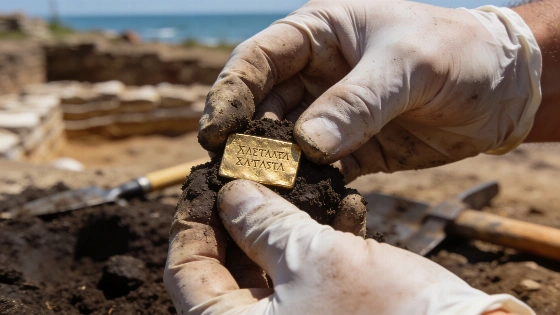
Archaeological excavations at the Roman fort of Apsaros, located near the modern settlement of Gonio on Georgia's Black Sea coast, have produced the first direct epigraphic evidence for the worship of Jupiter Dolichenus at the site. The find centers on a small gold votive plaque, inscribed in Greek, recovered during the 2024 field season and published in a recent issue of Zeitschrift für Papyrologie und Epigraphik. The plaque's inscription records a dedication by an individual named Thrasymedes to the "Dolichen God," a syncretic deity whose cult originated in Roman Syria and became especially prominent among military communities in the second and third centuries CE.
The gold plaque, shaped as a stylized leaf and manufactured using the repoussé technique, was recovered from a stratified context within the fort's occupation layers. Its Greek inscription is notable not only for its rarity at Apsaros-where inscribed artifacts are uncommon-but also for providing a direct link between the site and the cult of Jupiter Dolichenus. Prior to this discovery, evidence for the cult's presence in the region was limited to indirect indicators and comparative material from other Roman frontier sites.
Material Evidence and Context
The plaque measures only a few centimeters in length and was found alongside other small finds, including a bronze figurine depicting an eagle standing on a bull-an iconographic motif closely associated with Jupiter Dolichenus. The stratigraphic context suggests deposition during the period of active Roman military occupation, broadly corresponding to the second century CE. The inscription's reference to Thrasymedes, whose Greek name is relatively uncommon, hints at the cultural diversity present within the garrison, which likely included individuals from across the eastern provinces of the Roman Empire.
Researchers from the Polish Centre of Mediterranean Archaeology at the University of Warsaw and the Adjara Cultural Heritage Protection Agency have emphasized that the plaque represents the first direct epigraphic attestation of Jupiter Dolichenus worship at Apsaros. While ancient authors such as Arrian and Pliny the Elder mention the fort, inscribed dedications have been rare, limiting previous reconstructions of religious life at the site. The presence of a gold offering indicates that the cult held significant importance for at least some members of the garrison, who were willing to commission valuable dedications.
Interpretation and Limitations
The discovery of the gold plaque raises the possibility that a dedicated sanctuary or cult space for Jupiter Dolichenus existed within the fort, although no architectural remains directly associated with such a structure have yet been identified. The presence of additional objects linked to the deity in the same area strengthens the case for a localized cultic focus, but the evidence remains circumstantial pending further excavation and analysis. The inscription also provides a rare glimpse into the life of an individual at the site, but little is known about Thrasymedes beyond his name and act of dedication.
Numerically, the find consists of a single gold plaque with a Greek inscription, recovered in 2024 from a controlled archaeological context within the Roman fort. The associated bronze figurine and other small finds provide supporting evidence for the cult's presence, but the overall sample of inscribed material from Apsaros remains extremely limited. The dating of the plaque relies on stratigraphic association and typological parallels, with no direct radiocarbon or absolute dating applied to the object itself.
Frontier Religion and Cultural Diversity
The evidence from Apsaros contributes to a broader understanding of religious practice and cultural interaction along Rome's eastern frontier. The fort occupied a strategic position linking the Black Sea coast to the Caucasus and the interior of Asia, serving as a point of contact between Roman, local, and eastern populations. The adoption and adaptation of the Jupiter Dolichenus cult by members of the garrison reflects the complex religious landscape of the Roman military, where soldiers from diverse backgrounds participated in shared and localized forms of worship.
While the gold plaque provides the first direct epigraphic link between Apsaros and the cult of Jupiter Dolichenus, the evidence does not establish the scale or organization of the cult at the site. Further excavation and analysis will be required to determine whether a formal sanctuary existed and how the cult fit within the broader religious life of the garrison. The find nonetheless demonstrates the value of small, well-contextualized artifacts in reconstructing aspects of ancient belief and identity that are otherwise difficult to access through material remains alone.
Understanding the significance of inscribed artifacts in archaeology requires attention to both their material and contextual properties. Epigraphic evidence-texts inscribed on durable materials such as stone, metal, or pottery-can provide direct testimony about individuals, religious practices, and social relationships in the past. However, the interpretive value of such inscriptions depends on secure archaeological context, accurate reading and translation, and careful consideration of preservation and sampling bias. In cases where only a single inscription is recovered, as at Apsaros, caution is needed in extrapolating broader patterns of belief or practice from limited evidence.