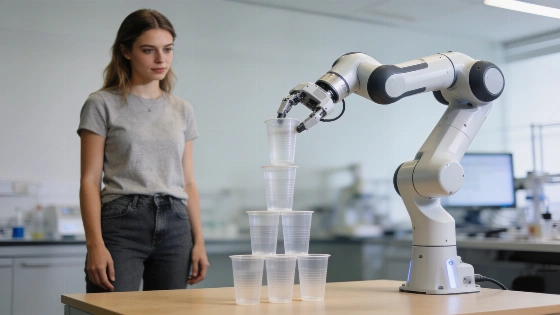
Generalist AI has introduced GEN-1.5, a foundation model for robots that attempts new physical tasks after observing a single brief demonstration, with no fine-tuning or retraining required
Generalist AI has released GEN-1.5, a foundation model designed to enable robots to attempt new physical tasks after observing just one short demonstration. Unlike conventional robot learning, which typically requires extensive task-specific data and repeated optimization, GEN-1.5 is engineered to use a single demonstration-lasting between 3 and 12 seconds-as a "physical prompt." The model processes video, sensor streams, language input, and proprioceptive data, maintaining up to 30 seconds of contextual information and generating action trajectories at 100 Hz. This approach is intended to reduce the need for labor-intensive programming and dataset collection for each new task.
In controlled tests, GEN-1.5 was evaluated on 10 distinct physical tasks, including twisting lids, retrieving coins, stacking cups, sweeping debris, and unzipping pouches. When provided with only one demonstration per task, the model achieved an average success rate of 59% across these activities. When the system was given five minutes of additional task-specific data and allowed 10 gradient update steps, its average success rate increased to 83%. These results were reported by the developer and have not yet been independently verified. The model's ability to generalize was further tested by combining demonstrations to perform continuous sequences and by adapting to changes in hand morphology or object type. In some cases, GEN-1.5 improvised tool use, such as employing a banana as a brush or using a dustpan to manipulate blocks.
GEN-1.5's architecture does not include explicit in-context learning modules, meta-learning loops, or specialized architectural changes for demonstration-based adaptation. According to Generalist AI, the model was not specifically trained for in-context learning, distinguishing it from other approaches that rely on meta-learning or prompt engineering. The company positions this as evidence that foundation models can acquire flexible physical skills without extensive retraining or architectural modification. However, the absence of independent replication and the limited scope of tasks tested mean that broader claims about generalization and reliability remain unproven.
While GEN-1.5's demonstration-based learning is notable, it is not the only recent attempt to reduce the data and engineering burden in robot task transfer. For example, Feagine Robotics has developed a foundation model aimed at transferring task knowledge across different robot arms, as described in a recent report on cross-body robot task transfer. Both efforts reflect a growing interest in enabling robots to adapt to new tasks and hardware with minimal retraining, but the field remains at an early stage, with most results limited to laboratory settings and developer-led evaluations.
Generalist AI envisions a future in which end users can demonstrate tasks directly to robots, allowing the machines to infer the necessary physical actions without detailed programming. However, the current evidence for GEN-1.5 is based on a small set of tasks, limited demonstration durations, and developer-reported outcomes. Key questions remain about the model's robustness to environmental variation, safety in unstructured settings, and the extent of human oversight required during deployment. Until independent evaluations are available, the reliability and safety of demonstration-based robot learning in real-world environments remain open issues.
Foundation models in robotics are large-scale machine learning systems trained on diverse data to support a wide range of downstream tasks. Unlike traditional task-specific models, foundation models are intended to generalize across tasks and environments, often by leveraging multimodal data such as video, sensor streams, and language. In-context learning refers to a model's ability to adapt its behavior based on new examples provided at inference time, without updating its underlying parameters. While this approach has shown promise in language and vision models, its application to physical robots introduces additional challenges, including sensor noise, mechanical variability, and safety-critical failure modes. The distinction between true in-context learning and implicit adaptation through large-scale pretraining remains an active area of research in robotics and AI.