A new image from the Gemini North telescope on Maunakea reveals two spiral galaxies, NGC 7253, in the process of merging. The observation, led by local students, highlights the dynamic interactions that drive galaxy evolution
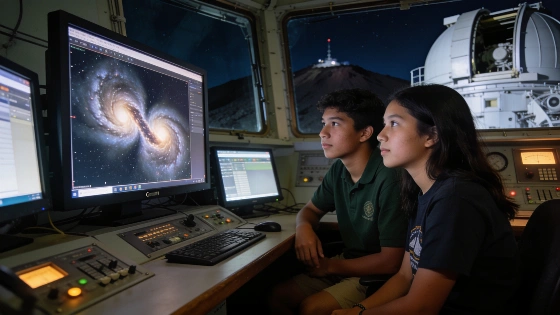
Two spiral galaxies locked in a gravitational struggle have been imaged in striking detail by the Gemini North telescope atop Maunakea, Hawaii. The system, known as NGC 7253, is caught mid-merger, offering a rare look at the complex process by which galaxies combine and transform. The observation stands out not only for its scientific value but also for its origin: the image was selected and named by students participating in the Project Hōkūlani internship, who chose the Hawaiian title Nā 'Uhane Māhoe Huki Pū i ke Ola-'The Twin Spirits Pulling Together Creating Life.'
Imaging a Galactic Collision
The Gemini North telescope, operated by the International Gemini Observatory, used its advanced optical capabilities to resolve the tangled structure of NGC 7253. Located roughly 200 million light-years away in the constellation Pegasus, the pair of galaxies are visibly distorted as tidal forces stretch and warp their spiral arms. The image reveals bright knots of star formation and elongated streams of stars and gas, signatures of the intense gravitational interaction underway.
Student observers from Waiākea High School and the Volcano School of Arts and Sciences accessed the telescope through Project Hōkūlani, a program designed to connect local students with frontline astronomical research. Their naming of the image reflects both the physical process-two galaxies drawn together by gravity-and the cultural context of discovery on Maunakea, a site with deep significance for both science and Native Hawaiian tradition.
Physical Processes and Scientific Context
Galaxy mergers are a fundamental driver of cosmic evolution, reshaping galaxies and triggering bursts of star formation as interstellar gas clouds collide and compress. In NGC 7253, the ongoing merger is expected to eventually produce a single, more massive galaxy, its structure altered by the violent encounter. Despite the apparent chaos, direct collisions between stars are extremely rare due to the vast distances separating them; instead, the main effects are gravitational, redistributing stars and gas on a grand scale.
Observations like this provide a snapshot of a process that unfolds over hundreds of millions of years. The sharpness of the Gemini North image allows astronomers to trace the flow of material and identify regions where new stars are forming. Such detail is essential for testing models of galaxy evolution and understanding how mergers influence the growth and morphology of galaxies across cosmic time.
Instrument Capabilities and Observational Limits
The Gemini North telescope features an 8.1-meter primary mirror and is equipped with adaptive optics to counteract atmospheric distortion, enabling high-resolution imaging in visible and near-infrared wavelengths. For this observation, the instrument captured the interacting galaxies with sufficient clarity to distinguish individual star-forming regions and tidal features. However, even with modern technology, the full three-dimensional structure and internal dynamics of the merger remain only partially accessible from Earth-based observations.
While the image offers a dramatic view of the merger, it represents a single moment in a much longer process. Follow-up studies using spectroscopy and multi-wavelength data will be needed to map the motion of gas and stars in detail and to estimate the rate of star formation triggered by the collision. Similar galaxy interactions have been observed elsewhere, and the fate of NGC 7253 echoes predictions for the eventual merger of the Milky Way and Andromeda galaxies, though on a different timescale and with unique local conditions. For comparison, other recent observations of dynamic cosmic events, such as those reported earlier for comet outbursts, demonstrate the range of transient and transformative processes accessible to modern telescopes.
Interpretation and Remaining Questions
The student-led observation of NGC 7253 highlights both the power and the limits of current astronomical imaging. While the visible features confirm the galaxies are in an advanced stage of merging, key details-such as the precise timeline of the interaction, the total mass involved, and the long-term outcome-require further analysis. The process of naming and interpreting the image also underscores the intersection of scientific inquiry and cultural context, especially at observatories located on sites of indigenous significance.
As with many astronomical discoveries, the image of Nā 'Uhane Māhoe Huki Pū i ke Ola is both a scientific resource and a prompt for further investigation. It provides concrete evidence of galaxy evolution in action, but it does not resolve all questions about the mechanisms driving star formation or the ultimate fate of the merging system. The involvement of students in the observation process demonstrates the value of broadening participation in frontline research, while the technical achievement of the Gemini North telescope sets a benchmark for future studies of galactic dynamics.
To interpret images of merging galaxies like NGC 7253, it is essential to understand the role of tidal forces and the redistribution of interstellar material. When two galaxies interact, their mutual gravity stretches and distorts their disks, creating tidal tails and bridges composed of stars and gas. These features are visible in high-resolution images as elongated streams and bright knots, often marking sites of intense star formation. The process is gradual, with the galaxies orbiting and passing through each other multiple times before finally coalescing. Observational data, especially when combined with spectroscopic measurements, allow astronomers to reconstruct the sequence of events and estimate the physical conditions within the merging system, but significant uncertainties remain due to projection effects and the limits of current instrumentation.