Comet 220P/McNaught unexpectedly brightened by a factor of 20,000 during two recent outbursts near its closest approach to the Sun, offering a rare opportunity for telescopic observation before it fades from view
Comet 220P/McNaught has defied expectations this summer, erupting in brightness by a factor of 20,000 during two sudden outbursts as it rounded the Sun. For a brief window, this typically faint periodic comet became accessible to small telescopes and dedicated astrophotographers, transforming a routine perihelion passage into a rare observational event.
Unexpected Outbursts and Observational Evidence
Most comets brighten gradually as they approach the Sun, but 220P/McNaught's recent behavior was anything but typical. Around its June 14 perihelion, the comet experienced two rapid outbursts, each dramatically increasing its apparent magnitude. Observers using the Comet Observation Database reported a peak brightness of magnitude +9.2-well above its usual threshold-making it visible as a diffuse patch through small telescopes under dark skies. The cause of such outbursts is generally attributed to sudden releases of volatile ices and dust, triggered by solar heating as the nucleus rotates into sunlight.
Astrophotographers responded quickly. Dan Bartlett assembled a detailed mosaic tracking McNaught's movement through the constellation Cetus between August 6 and 26, capturing the evolution of its coma and tail in the aftermath of the August 5 outburst. Meanwhile, Osama Fathi recorded a striking image of the comet above Egypt, coinciding with a Perseid meteor-an alignment that underscores the unpredictable rewards of patient skywatching.
Locating McNaught in the Night Sky
For those hoping to glimpse 220P/McNaught before it dims, timing and location are critical. In early September, the comet can be found in the eastern sky near midnight, positioned close to the Hyades cluster in Taurus. Its proximity to the binary star system Omicron Tauri-two stars out from the point of the Hyades' characteristic "V"-provides a useful reference for telescope users. The new moon phase on September 10-11 will offer the darkest skies, maximizing the chance of detection and enabling long-exposure photography for those equipped to capture faint targets.
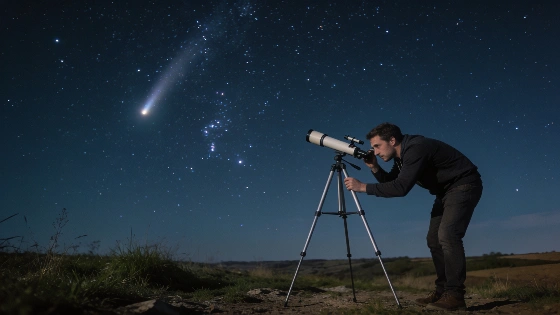
With a current magnitude of +9.2, McNaught is challenging but not impossible for amateur astronomers. Under ideal conditions, small telescopes should reveal the comet as a faint, diffuse glow. Binoculars may suffice only in exceptionally dark locations, and further outbursts could briefly improve visibility. However, as the comet recedes from the Sun, its brightness is expected to decline rapidly, closing this rare observational window.
Physical Mechanisms and Scientific Context
Comet 220P/McNaught follows a 5.5-year orbit around the Sun, with each perihelion offering a new opportunity to study its activity. The recent outbursts highlight the volatile and unpredictable nature of cometary physics. Solar heating can trigger explosive sublimation of ices, releasing jets of gas and dust that reflect sunlight and temporarily boost brightness. Such events are not fully predictable, and their frequency and intensity depend on the comet's composition, rotation, and structural integrity.
While most comets fade into obscurity after perihelion, McNaught's recent activity has drawn renewed attention from both amateur and professional observers. The unpredictability of these outbursts complicates long-term monitoring but also provides valuable data on the physical processes governing cometary evolution. As with other transient astronomical phenomena, rapid response and coordinated observation are essential for capturing fleeting details.
Astrophotography and Broader Observational Efforts
The surge in McNaught's brightness has energized the astrophotography community, with observers sharing images and data to track the comet's evolution. Guides to photographing comets and recommendations for suitable cameras and lenses have circulated widely, reflecting the technical challenges of imaging faint, moving targets against a crowded stellar background. The timing of McNaught's outburst, coinciding with the Perseid meteor shower, produced rare composite images that combine cometary and meteoric activity in a single frame.
Such collaborative efforts echo the importance of rapid data sharing in modern astronomy. As demonstrated in reported earlier on Science Report, timely access to observational data-whether from satellites, telescopes, or ground-based observers-can be decisive in capturing transient astronomical events. For McNaught, the window is closing, but the data collected during this outburst will inform future studies of cometary behavior and solar system dynamics.
Cometary outbursts like those seen in 220P/McNaught are a reminder that even well-studied periodic comets can deliver surprises. The evidence from this summer's observations is clear: solar heating can trigger dramatic, short-lived increases in brightness, but these events remain difficult to predict and even harder to monitor in real time. The scientific value lies not only in the spectacle but in the opportunity to refine models of cometary physics and to test the limits of amateur and professional observation. As the comet fades, the lesson is unmistakable-vigilance and rapid response remain essential tools for anyone seeking to understand the dynamic processes at work in our solar system.
Comet brightness is measured using the astronomical magnitude scale, where lower numbers indicate brighter objects. Each step of one magnitude corresponds to a brightness change by a factor of about 2.5. For comets, apparent magnitude depends on both intrinsic activity and distance from Earth and the Sun. Outbursts can temporarily lower a comet's magnitude, making it more visible, but these episodes are often brief and unpredictable. Observers rely on coordinated databases and rapid reporting to track such changes, as the window for observation can close quickly once the comet resumes its normal fading trend.