Mimic Robotics and Black Forest Labs have introduced FLUX-mimic, a video-action model that enables industrial robots to learn complex manipulation tasks from video demonstrations using far less training data than previous approaches
Swiss company Mimic Robotics, in collaboration with Black Forest Labs, has announced FLUX-mimic, a video-action model designed to accelerate the training of industrial robots for complex manipulation tasks. The system is intended for use in factory environments, including pilot deployments at Audi's production facilities, and is positioned as a step forward in reducing the data and time required for robots to learn new skills from video demonstrations.
Video Pretraining Reduces Robot Training Requirements
FLUX-mimic is built on a generative video foundation model, distinguishing it from conventional vision-language-action (VLA) systems that typically rely on static image-and-text datasets. Instead, FLUX-mimic leverages large-scale video pretraining to capture object dynamics, motion, and physical interactions before being adapted for robotic control. The model architecture pairs a video model with an action decoder, which translates visual predictions into executable robot movements. This approach is intended to reduce the need for extensive task-specific demonstration data, a common bottleneck in deploying robots for high-dexterity industrial tasks.
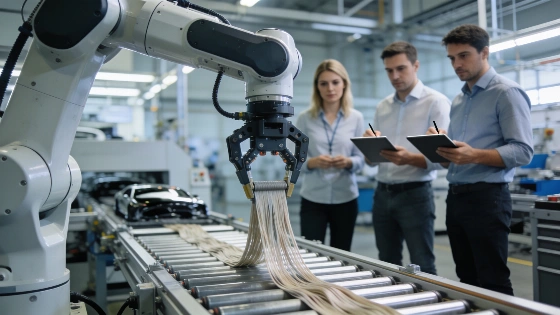
According to Mimic Robotics, FLUX-mimic can be fine-tuned for certain manipulation tasks using as little as 30 minutes of robot demonstration data, compared to the 30 or more hours often required by conventional learning pipelines. The company claims this reduction in training data can shorten deployment cycles from several months to a matter of weeks, though independent verification of these figures is not yet available. The system is currently being evaluated in Audi's production environment, where robots are tasked with automating manipulation of flexible materials and other operations that have historically required extensive programming and frequent re-engineering.
Audi Pilot Tests Flexible Factory Automation
Unlike many robot learning systems that depend on large volumes of curated demonstration data, FLUX-mimic's reliance on video pretraining is intended to improve generalization and adaptability. The company reports that the model's architecture allows robots to learn physical skills more efficiently, but the extent to which this transfers to diverse real-world tasks remains to be established. The collaboration with Audi is focused on assessing whether the technology can reduce engineering effort and expand automation in manufacturing and logistics, particularly for tasks that have resisted conventional automation due to variability and complexity.
While FLUX-mimic's approach is novel in its use of generative video models for robot action prediction, it is part of a broader trend toward leveraging large-scale video data to improve robot learning. Similar efforts, such as the VLASH method developed at MIT, have explored ways to reduce training time and improve robot adaptability by predicting future positions and actions from visual input. For example, recent research on planning techniques for robot movement has demonstrated the potential for video-based models to accelerate learning and deployment in industrial settings.
Safety and Generalization Remain Open Questions
At present, FLUX-mimic remains in the pilot deployment and evaluation phase. The company has not released detailed technical documentation or independent benchmark results, and it is not yet clear how the system performs across a wide range of factory tasks or under varying environmental conditions. Safety, reliability, and the need for human oversight during deployment are likely to remain central concerns as the technology is tested in more demanding real-world scenarios. The extent to which FLUX-mimic can reduce the engineering burden and enable more flexible automation will depend on its ability to generalize beyond curated demonstration data and to operate safely alongside human workers.
Video-action models such as FLUX-mimic are trained by exposing neural networks to large volumes of video data, allowing the system to learn patterns of object movement, interaction, and manipulation. During fine-tuning, the model is adapted to specific robotic tasks using a smaller set of demonstration data collected from the target environment. The action decoder component translates the model's visual predictions into robot control commands. While this approach can reduce the need for extensive manual programming, it also introduces new challenges in ensuring that the model's predictions are reliable, safe, and robust to changes in the physical environment. Ongoing evaluation in real-world settings is essential to determine whether these systems can meet the safety and reliability standards required for industrial deployment.