

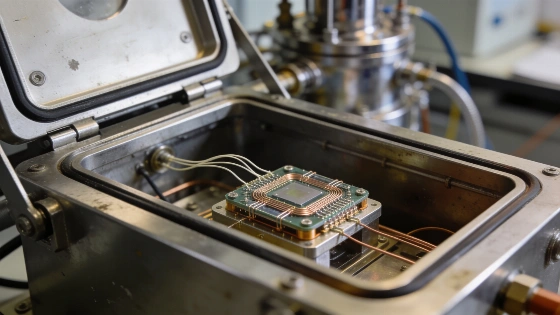
An XY pulse can disturb neighboring superconducting qubits, yet a Chalmers test chip showed that engineered parasitic capacitances can cancel the unwanted lead signal at a frequency away from zero exchange coupling
An XY pulse aimed at one transmon can spuriously excite a neighboring qubit or shift its phase through the AC Stark effect. This microwave-lead crosstalk is a control challenge for superconducting processors: a pulse intended for one qubit can produce unwanted rotations or phase shifts in another. On a Chalmers University of Technology test chip, the weakest cross-Rabi response appeared roughly 300 MHz away from the coupler frequency where Jeff = 0.
Where the Null Falls
The experiment used two fixed-frequency floating transmons: Q1 at 4.752 GHz and Q2 at 4.658 GHz. A flux-tunable grounded transmon coupler linked them, with its Jeff = 0 operating frequency at 3.665 GHz. The cross-Rabi minimum did not coincide with that point.
The Chalmers team, including researcher Anuj Aggarwal, modeled the crosstalk as a function of coupler frequency and measured the crosstalk-induced Rabi rates. The observed rate minima agreed with the theoretical predictions. That separation challenges a common design assumption: setting the effective exchange coupling to zero does not itself set microwave-lead crosstalk to zero. The measured minimum instead reflects interference among signals reaching the neighboring, or victim, qubit.
Interference by Design
The researchers used a time-independent Hamiltonian derived through a first-order high-frequency expansion to model the dressed lead amplitude at the victim qubit, Θm. The model treats the amplitude as a coherent sum. One contribution comes from direct lead-to-target coupling. Another travels through stray capacitance between the lead line and coupler, Cdc. A further contribution comes from stray lead-to-victim capacitance, Cd,victim.
Changing the parasitic capacitances changes the relative amplitudes and phases of those paths. With suitable values, the direct and coupler-mediated signals reach the victim with opposing phases and cancel; the model's condition for the null is Θvictim = 0. In this account, destructive interference among capacitive paths-not the zero-exchange setting-produces the crosstalk suppression. The researchers also considered off-resonant crosstalk, where neighboring qubits are detuned from the driven transition.
The researchers' arXiv preprint, "Suppressing microwave crosstalk in superconducting quantum processors by designing parasitic lead capacitances," describes parasitic capacitances as potential design variables rather than effects that must always be minimized. Its circuit model includes lead-line capacitive coupling to both the coupler and the victim qubit.
Layout and Limits
The comparison between transmon layouts suggests a practical advantage for floating designs. As parasitic capacitance changes, crosstalk-null frequencies for opposing lead lines remain relatively close and move with slopes of the same sign, giving designers lithographic room to align the two nulls. In grounded transmons, the shifts run in opposite directions, which the study says would demand impractically tight fabrication margins. The result concerns the layouts studied and does not mean every floating-transmon design will automatically suppress crosstalk.
The layout can also be chosen so the microwave crosstalk null coincides at the same flux bias with a coupler point where static ZZ interactions vanish. A separate chip-scale effort examined microwave hardware through spin waves, reporting 4 dB of power isolation in a spin-wave isolation study; that device used a different mechanism from the capacitive cancellation described here.
The reported work is a test-chip demonstration of a layout-based approach to microwave crosstalk control in a two-qubit setup. It connects circuit geometry to measured Rabi-rate minima, while leaving performance across larger processors as a separate engineering challenge.







