A team in Italy has demonstrated real-time quantum key distribution across an 18-kilometer free-space link using room-temperature detectors, integrating adaptive optics to overcome atmospheric turbulence and coupling the signal into standard fiber
Researchers from the University of Padova, ThinkQuantum s.r.l., and the National Research Council of Italy (CNR-IFN) have reported a real-time field demonstration of quantum key distribution (QKD) over an 18-kilometer horizontal free-space channel, integrating adaptive optics and room-temperature single-photon detectors. The experiment, published in npj Quantum Information, connects a remote optical transmitter on Monte Grande to an urban Optical Ground Station (OGS) at the University of Padova, then routes the quantum signal through 0.5 kilometers of deployed fiber to a laboratory receiver. This architecture is designed to test the feasibility of intermodal quantum communication systems that bridge free-space and fiber networks without relying on trusted intermediate nodes.
Adaptive Optics and Channel Loss
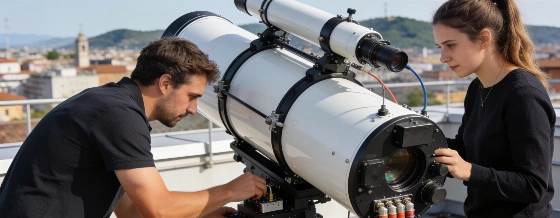
Long-distance terrestrial free-space quantum links are limited by atmospheric turbulence, which distorts the optical wavefront and reduces coupling efficiency into single-mode fibers. To address this, the team implemented a high-order adaptive optics (AO) system at the receiving telescope, using a 64-actuator deformable mirror and a Shack-Hartmann wavefront sensor in closed-loop feedback. This setup corrected spatial aberrations up to 35 Zernike modes, achieving single-mode fiber coupling efficiencies up to 19% (corresponding to -7.2 dB). The measured channel attenuation ranged from 29 to 30 dB, with the AO system enabling direct multiplexing of the quantum signal into standard telecom fiber. Experimental wavefront data were used to validate theoretical models for predicting the Fried parameter (r0) and coupling efficiency under varying atmospheric conditions.
Quantum Key Distribution Performance
The QKD system used the ThinkQuantum QUKY platform, operating at a telecom wavelength of 1565.5 nm and implementing the 3-state 1-decoy efficient BB84 protocol. Room-temperature InGaAs single-photon avalanche diodes (SPADs) with 15% detection efficiency were deployed, yielding a secure key rate (SKR) of approximately 200 bits per second and a quantum bit error rate (QBER) near 2%. For benchmarking, the same setup was paired with cryogenic superconducting nanowire single-photon detectors (SNSPDs) at 80% efficiency, increasing the SKR to around 1 kilobit per second and reducing QBER below 1%. The experiment also multiplexed a 1545 nm beacon and 850 nm alignment signals for channel stabilization and pointing.
Integration With European Quantum Infrastructure
The protocol-agnostic, intermodal architecture demonstrated in this field trial is designed to align with the European Quantum Communication Infrastructure (EuroQCI) roadmap and upcoming European Space Agency (ESA) satellite-to-ground optical link missions, such as Eagle-1 and SAGA. By showing that room-temperature detectors can support real-time QKD over challenging free-space channels, the work addresses a key engineering barrier for practical deployment. The ability to couple free-space quantum signals directly into deployed fiber without untrusted measurement points is a step toward scalable, secure quantum networks that bridge terrestrial and satellite links. Related advances in quantum error correction and device integration, such as those discussed in recent work on quantum LDPC codes, highlight the broader context of ongoing efforts to improve quantum communication and computation hardware.
Quantum key distribution (QKD) enables two parties to generate a shared secret key with security guaranteed by the laws of quantum mechanics. In the BB84 protocol, quantum states are transmitted over a channel and measured in randomly chosen bases, with the resulting correlations used to extract a secure key. The secret-key rate (SKR) quantifies the number of secure bits generated per second, while the quantum bit error rate (QBER) measures the fraction of bits that disagree due to noise, loss, or eavesdropping. Achieving high SKR and low QBER over long, lossy channels requires careful engineering of sources, detectors, and optical links, as well as mitigation of environmental noise and device imperfections. Room-temperature operation of detectors is a significant step for practical deployment, but further improvements in efficiency, noise suppression, and integration will be needed for widespread adoption of quantum-secure communication.