Falqon Systems, formerly Q*Bird, is rolling out operational quantum secure networks in several European countries using measurement-device-independent quantum key distribution and hybrid key management.
Falqon Systems, previously known as Q*Bird, has started deploying multi-node quantum secure networks in Europe. This marks a shift for the company, moving from making components to delivering full quantum communication platforms. Active deployments now cover the Netherlands, Belgium, Luxembourg, Ireland, Austria, and Spain. The company officially rebranded as Falqon Systems on September 15, 2026, as confirmed by Telecompaper. Despite the new name, Falqon says its ownership, management, customer relationships, and technology roadmap remain unchanged, so existing clients and partners will see no disruption.
Measurement-device-independent QKD
Falqon Systems builds its networks around measurement-device-independent quantum key distribution (MDI-QKD). This protocol addresses security gaps in traditional quantum key distribution by routing quantum signals through a central hub that does not need to be trusted. Unlike point-to-point QKD, MDI-QKD removes detector-side channel attack risks and supports star-shaped network layouts, so multiple nodes can share cryptographic keys without exposing raw key material at the hub. MDI-QKD was first demonstrated in labs by teams at MIT and the Max Planck Society, and its security benefits have been discussed in peer-reviewed studies, including in Nature Photonics.
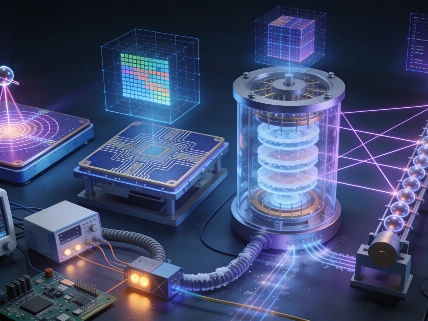
The company's MDI-QKD hardware is designed for high-rate optical quantum state generation and centralized detection. It targets use in metropolitan fiber networks, data center links, and government or defense communications. The platform is made in Europe and supports digital sovereignty goals under the European Quantum Communication Infrastructure (EuroQCI) initiative. Falqon's growth has included pilots in critical infrastructure, such as a quantum security trial at the Port of Rotterdam, which tested the system in a real-world setting beyond the lab.
Integrated key management and orchestration
Falqon Systems has unified its products under one brand, combining hardware, key lifecycle management, and network orchestration software. The Falqon Key Manager supports both QKD and post-quantum cryptography (PQC), offering a hybrid key management approach that meets ETSI GS QKD 014 standards. This setup is aimed at enterprise IT, financial networks, and sovereign cloud infrastructure, where both quantum and classical cryptographic resilience are needed. The inclusion of PQC algorithms, which are being standardized by groups like NIST and reviewed in journals such as Science, reflects a wider move toward layered security as quantum computing advances.
Network orchestration is handled by the Falqon Domain Controller, which uses software-defined networking (SDN) to allocate keys and route optical signals across multi-site quantum networks. This orchestration layer is built to support complex systems, including national backbone networks and energy grids, by enabling cross-domain key distribution and dynamic reconfiguration. Falqon's approach aligns with recommendations from CERN and other European research groups working on quantum-safe networking.
Deployments and European context
Falqon Systems' deployments include the Madrid Quantum Communication Infrastructure (MadQCI), developed with Universidad Politécnica de Madrid. The company's European manufacturing and deployment strategy is designed to meet EuroQCI's goal of a pan-European quantum communication backbone. The MDI-QKD architecture is intended to scale beyond key distribution, with future uses in quantum interconnects, distributed quantum computing, and networked quantum sensors. In May 2024, Falqon raised €2.5 million from Ground State Ventures, Cottonwood Technology Fund, and InnovationQuarter to expand its quantum security network, reflecting investor confidence in its technology.
Falqon has not published specific performance data such as key rates, node counts, or operational distances. Its focus on MDI-QKD and hybrid key management follows a broader industry trend of combining quantum and post-quantum security. This is different from efforts to build quantum-resistant cryptography directly into hardware, as seen in recent developments in post-quantum ASIC platforms. The gradual rollout of the Falqon brand is meant to avoid disruption for current customers, with all contracts and service agreements staying valid during the transition.
Engineering and scalability
Moving from lab demonstrations to operational networks is a major engineering challenge for quantum communication. MDI-QKD reduces some vulnerabilities but brings new requirements for synchronization, loss management, and network calibration. Adding SDN-based orchestration and hybrid key management increases complexity and requires reliable integration between quantum and classical systems. Falqon's decision to keep its leadership, ownership, and technical roadmap through the rebranding suggests continuity, but scaling up quantum networks will depend on ongoing improvements in device performance, error management, and system integration. Regular benchmarking and transparent reporting, as called for by journals like Nature and Science, will be important for showing the real-world impact of these deployments.
Falqon's move to unify its brand and product lineup reflects a maturing phase for quantum communication in Europe. Its deployments and alignment with EuroQCI position it as a notable player in the region's quantum infrastructure. However, without independently verified performance data and given the complexity of multi-node quantum networks, the practical impact of these deployments will depend on continued engineering progress and open benchmarking. For now, Falqon's adoption of MDI-QKD and hybrid key management offers a technically credible response to the demands of secure quantum communication, though the field is still evolving.
Quantum key distribution (QKD) is a method for securely sharing cryptographic keys using quantum states, usually photons, sent over optical fiber or through free space. Measurement-device-independent QKD (MDI-QKD) removes the need to trust measurement devices at each network node by routing quantum signals through a central, potentially untrusted hub. This setup is designed to prevent detector-side channel attacks, a known weakness in standard QKD systems. MDI-QKD supports star-shaped network layouts, letting multiple users share keys securely without exposing raw key material at the central node. The protocol's security relies on quantum mechanics, but practical deployment requires careful engineering to handle loss, synchronization, and device imperfections.