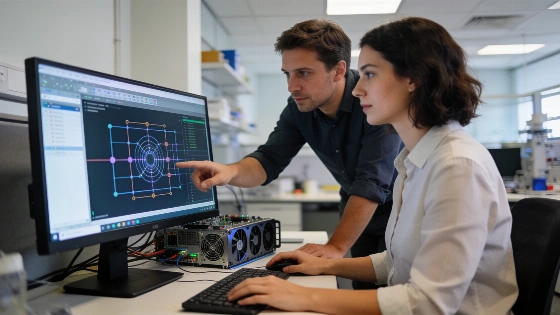
Two Hands Corporation has released its EntangleX quantum circuit simulation software for external beta testing, allowing selected partners to evaluate browser-based GPU-accelerated modeling of quantum circuits without physical quantum hardware
Two Hands Corporation, which is in the process of rebranding as Quantum X Inc., has begun external beta testing of its internally developed quantum circuit simulation platform, EntangleX. The company is making the base user interface available to a group of selected third-party partners, marking the first time the software will be evaluated outside its own development team. EntangleX is designed as a browser-accessible, GPU-accelerated environment for simulating quantum circuits using classical computing resources, with the aim of supporting technical teams, researchers, and educators who do not have access to physical quantum processors.
Simulation Platform Features
The EntangleX platform includes a visual circuit builder, a library of standard quantum algorithm templates, programmatic submission APIs, usage tracking, and collaborative team workspaces. The software is engineered to accommodate both cloud-hosted and on-premises deployments, addressing data privacy and institutional security requirements that are common in research and education settings. According to the company, the simulation environment is strictly classical, with the scale and depth of simulated quantum circuits limited by the available GPU memory and classical processing power rather than by quantum hardware constraints.
Beta Testing Scope and Limitations
The external beta phase is intended to assess the usability of the platform, the clarity of the circuit-building workflow, the presentation of simulation results, and the stability of the system across different user environments. No physical quantum processors are involved; all quantum behavior is modeled algorithmically on classical hardware. The company has not released figures for the maximum circuit size or depth achievable in practice, but such limits are typically determined by the memory and computational bandwidth of the GPUs used for simulation. No commercial release date, pricing, or customer contracts have been announced, and the company states that further software enhancements are planned for 2026 based on feedback from this beta phase.
Context in Quantum Simulation
Classical simulation of quantum circuits remains a critical tool for algorithm development, education, and benchmarking, especially as access to physical quantum hardware is still limited and expensive. While EntangleX is positioned as a flexible and accessible simulation environment, it does not attempt to provide quantum advantage or to simulate quantum systems at a scale beyond the reach of current classical supercomputers. For comparison, recent efforts in the field have focused on both hardware and software approaches to quantum simulation and networking, such as the deployment of entanglement-based quantum networks for secure communication and protocol testing. For example, four quantum technology companies recently evaluated hardware and software integration on an open-access entanglement-based network in New Mexico, as described in this report on real-world quantum network testing.
Engineering and Scalability Challenges
Simulating quantum circuits on classical hardware is fundamentally limited by the exponential growth of required resources with the number of qubits and circuit depth. Even with GPU acceleration, practical simulations are typically restricted to circuits with fewer than 40 qubits, depending on the available hardware and the complexity of the quantum operations involved. EntangleX does not circumvent these scaling limits, and its utility will depend on how efficiently it can model circuits within these constraints, as well as on the usability and flexibility of its interface for different user groups. The company has not provided independent benchmarking data or peer-reviewed technical documentation for the platform at this stage.
Quantum circuit simulation refers to the use of classical computers to model the behavior of quantum circuits-sequences of quantum gates acting on qubits-without requiring access to actual quantum hardware. Because the state space of a quantum system grows exponentially with the number of qubits, simulating even modestly sized circuits quickly becomes computationally intensive. GPU acceleration can extend the practical limits of simulation, but does not eliminate the exponential scaling. Such simulators are essential for developing and testing quantum algorithms, validating quantum hardware, and providing educational access to quantum computing concepts, but they cannot demonstrate quantum advantage or replace the need for physical quantum processors in large-scale or fault-tolerant applications.