Qedma's QESEM error mitigation platform is now directly accessible on Quantinuum's trapped-ion quantum computers, aiming to reduce noise and improve circuit fidelity for complex quantum workloads in chemistry, materials, and finance
Qedma, a quantum software developer, has announced the integration of its Quantum Error Suppression and Error Mitigation (QESEM) platform with Quantinuum's trapped-ion quantum computing hardware. This technical collaboration enables users of Quantinuum's systems to access QESEM's noise-reduction algorithms directly within their existing software workflows, targeting improved circuit accuracy for research and enterprise applications.
Trapped-Ion Hardware and Noise Challenges
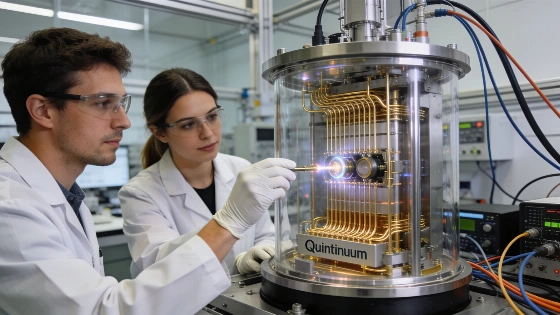
Quantinuum's quantum computers are based on trapped-ion technology, specifically employing a quantum charge-coupled device (QCCD) architecture. These systems are recognized for their high average two-qubit gate fidelities, which are essential for running quantum circuits that approach the limits of classical simulation. However, as quantum circuits increase in depth and the number of qubits grows, cumulative hardware noise remains a significant barrier to achieving practical, utility-scale quantum computation. Even with high-fidelity gates, errors from decoherence, crosstalk, and control imperfections accumulate, limiting the depth and complexity of circuits that can be executed reliably.
QESEM Integration and Technical Approach
The QESEM platform, developed by Qedma, is designed to be hardware-agnostic and applies a combination of characterization, transpilation, and unbiased error mitigation techniques. By integrating QESEM directly into Quantinuum's job submission pipeline, users can apply these methods without substantial changes to their workflow. The approach aims to suppress and mitigate errors in quantum output, reducing the effective error rate without requiring excessive sampling or additional quantum resources. Initial validation runs on Quantinuum hardware have shown measurable improvements in output fidelity for complex quantum simulations, including tasks relevant to quantum chemistry, materials science, and financial modeling.
Benchmarking and Ecosystem Context
While Quantinuum's trapped-ion systems have demonstrated average two-qubit gate fidelities above 99%, the practical execution of deep quantum circuits remains constrained by residual noise and error accumulation. QESEM's integration is intended to address these bottlenecks, but the extent of improvement depends on the specific algorithm, circuit depth, and noise profile of the hardware. The integration was developed as part of Qedma's participation in the Quantinuum Startup Partner Program, reflecting a broader industry trend toward combining specialized error mitigation software with advanced quantum hardware. Similar efforts to address noise and scalability challenges have been reported elsewhere in the quantum sector, such as the deployment of trapped-ion computers in hybrid network environments described in recent coverage of regional quantum networking initiatives.
Limitations and Remaining Barriers
Despite the integration of advanced error mitigation tools, current trapped-ion quantum computers remain in the noisy intermediate-scale quantum (NISQ) regime. QESEM and similar platforms can reduce the impact of certain error sources, but they do not provide full quantum error correction or fault tolerance. As a result, the ability to run deep, classically intractable circuits is still fundamentally limited by hardware noise, calibration drift, and the overhead of repeated measurements. The integration represents an incremental step toward more reliable quantum computation, but substantial engineering and scientific challenges remain before large-scale, fault-tolerant quantum computing becomes practical.
Quantum error mitigation refers to a set of techniques that reduce the impact of noise and errors in quantum computations without implementing full error correction codes. Unlike quantum error correction, which encodes logical qubits across many physical qubits to detect and correct errors actively, error mitigation methods typically rely on characterizing the noise, adjusting circuit compilation, and post-processing measurement results to suppress or compensate for errors. These approaches can improve the accuracy of quantum computations on current hardware, but their effectiveness is limited by the underlying noise rates and the scalability of the mitigation protocol. As quantum processors advance, error mitigation is expected to remain an important tool for extracting useful results from NISQ devices until full fault-tolerant architectures are realized.