Galileo Robotics has introduced Galileo X, a modular ground robot platform that merges wheeled, legged, and off-road mobility in a single system, aiming to simplify deployment across warehouses, rough terrain, and complex environments
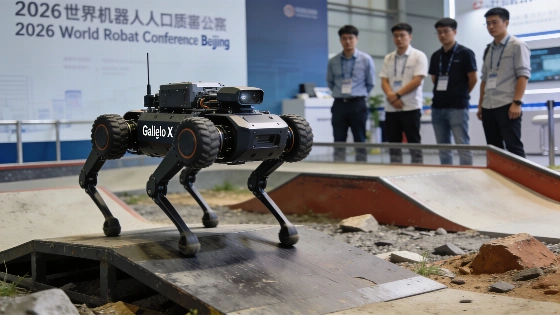
Galileo Robotics has set out to erase the traditional boundaries between warehouse robots, off-road vehicles, and legged machines with the public debut of Galileo X at the 2026 World Robot Conference in Beijing. The company claims its new platform can handle precise indoor transport, traverse rough outdoor terrain, and adapt to complex surfaces-all within a single unified hardware and control system. If the technical claims hold, this would mark a significant departure from the fragmented approach that has long defined ground robotics.
Most ground robots are built for a narrow set of tasks, with specialized hardware and software that rarely transfer between environments. Galileo X is pitched as a direct challenge to this model. The company says its Unified Embodied Ground Mobility System integrates mechanical design, actuation, perception, and motion control, allowing the same robot to operate as a wheeled AGV (automated guided vehicle), an off-road platform, or a legged robot depending on the task. The underlying architecture is designed to coordinate these modes through a single control framework, rather than relying on separate kinematic models or movement algorithms for each configuration.
Technical details remain limited, but Galileo Robotics reports that the platform's modular hardware and software interfaces will be opened to external developers and partners. This would allow third parties to build custom applications, perception modules, or control algorithms on top of the core mobility system. The company positions Galileo X as a foundation for a broader all-terrain robotics ecosystem, with potential roles in logistics, inspection, mobile manipulation, and as a base for humanoid robots.
In practical terms, Galileo X is intended to reduce the operational complexity and cost that comes from deploying multiple specialized robots across different environments. The company claims the system can be configured for heavy-duty off-road handling, warehouse logistics, directional transfer, or as a mobile base for other robotic systems. By consolidating these functions, Galileo argues that organizations could avoid the need to purchase, maintain, and coordinate separate fleets for each environment.
Measured performance figures have not been independently verified. Galileo Robotics has not disclosed payload, battery life, or maximum range, nor has it published systematic test results across the full range of environments it targets. The company's demonstration at WRC 2026 was limited to controlled conditions, and no third-party evaluation has yet been reported. This stands in contrast to recent deployments by other robotics firms, such as the nearly 1,000 RealBOT units planned for remote-controlled operation in diverse settings, as reported earlier.
Galileo Robotics emphasizes its full-stack development approach, stating that it designs and manufactures core hardware, motion control, and system integration in-house rather than relying on third-party components. The company says this vertical integration is essential for achieving the level of coordination required by its unified mobility architecture. However, without published technical documentation or independent testing, it remains unclear how the system performs under real-world variability, mechanical stress, or software failure modes.
Galileo X is not the first attempt to bridge the gap between wheeled, legged, and off-road robots, but previous efforts have often struggled with reliability, cost, or integration complexity. The company's decision to open hardware and software interfaces could encourage broader experimentation and application development, but it also introduces new challenges for safety, interoperability, and lifecycle management. The absence of disclosed safety certification or regulatory compliance details leaves open questions about deployment in safety-critical or public environments.
Galileo Robotics has announced plans to expand its overseas distribution network as it seeks commercial adoption beyond China. The company's strategy appears to hinge on positioning Galileo X as a flexible, general-purpose platform rather than a single-purpose robot. Whether this approach can deliver reliable, cost-effective performance across the full spectrum of environments remains to be demonstrated. Until independent evaluations and operational data are available, Galileo X should be viewed as a technically ambitious prototype with unproven claims of universal ground mobility.
Unifying multiple forms of robot mobility in a single platform is a longstanding goal in robotics, but the engineering challenges are substantial. Each mode-wheeled, legged, tracked-requires different mechanical, sensing, and control strategies. Integrating these into a single architecture demands careful coordination of hardware, software, and real-time decision-making. The promise of a universal ground robot is appealing, but the evidence for reliable, safe, and cost-effective operation across diverse environments will depend on systematic testing, transparent reporting, and independent verification.