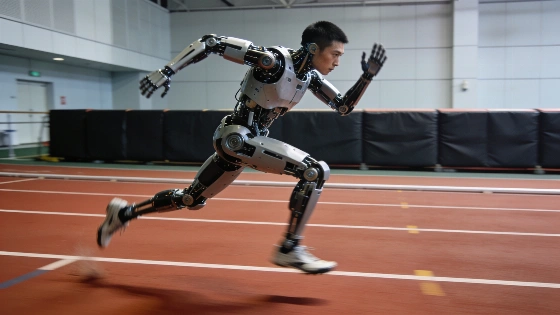
A Chinese-built humanoid robot named Lightning has reportedly completed a 100-meter sprint in 9.32 seconds during a controlled test in Beijing, surpassing the human world record and raising new questions about the limits and risks of high-speed bipedal robotics
A humanoid robot developed by the Chinese technology company Honor has reportedly completed a 100-meter sprint in 9.32 seconds during a test event in Beijing, exceeding the men's world record set by Jamaican sprinter Usain Bolt in 2009. The robot, named Lightning, was evaluated ahead of the second World Humanoid Robot Games (WHRG), an event designed to benchmark the physical capabilities of advanced bipedal machines. According to Honor, Lightning reached a peak speed of 14.5 meters per second during the run, with the result based on a single demonstration rather than a systematic series of trials.
The reported time is 0.26 seconds faster than Bolt's 9.58-second record, but the demonstration was conducted under controlled conditions and has not been independently verified by external technical observers. The test took place on an indoor track, and the robot's performance was measured as part of a pre-competition showcase rather than a formal, regulated sporting event. The WHRG itself has seen a significant increase in participation, with the number of competing robots doubling compared to the previous year and overall entries rising by 138 percent, reflecting growing interest in humanoid robotics research and demonstration.
Technical Capabilities and Design
Lightning is a purpose-built, high-performance humanoid robot engineered for speed, endurance, and autonomous navigation. The robot stands 169 centimeters tall and features a 95-centimeter leg length, which was extended by 10 centimeters for the WHRG to improve stride efficiency. Its design incorporates long-stride biomechanics, active arm movement for balance, and a stabilized torso. Honor reports that Lightning's actuators can deliver up to 400 newton-meters of peak leg torque, and the robot uses a liquid-cooling system adapted from smartphone thermal management, with a flow rate exceeding 4 liters per minute. The system integrates vision, inertial measurement, and terrain estimation to support autonomous navigation and obstacle avoidance, though Honor has not disclosed the full sensor suite or the robot's degrees of freedom. Battery capacity and total weight remain undisclosed.
In April 2026, Lightning reportedly completed the 21-kilometer Beijing E-Town half-marathon in 50 minutes and 26 seconds while operating autonomously, with a second, remotely controlled unit finishing in 48 minutes and 19 seconds. These results suggest the platform is capable of sustained high-speed locomotion in outdoor environments, but the company has not released detailed data on reliability, failure rates, or the number of human interventions required during these runs.
Benchmarking and Safety Concerns
The WHRG event has highlighted both the technical progress and the persistent risks associated with high-speed bipedal robots. In preliminary rounds, another Chinese humanoid robot, Tiangong Ultra, reportedly completed the 100 meters in 9.39 seconds. However, not all attempts have been successful: video footage from the event shows a humanoid robot crashing into a padded barrier at high speed after failing to decelerate, resulting in a dramatic collapse and visible sparks. Such incidents underscore the ongoing challenges of balance, control, and safety in autonomous or semi-autonomous bipedal systems, especially at speeds that exceed typical human running.
While Lightning's performance demonstrates the mechanical potential of specialized humanoid robots, the demonstration does not establish routine reliability or safety for real-world deployment. The company has not disclosed the number of test runs, the frequency of falls or collisions, or the extent of human oversight during the trials. Without systematic reporting of failures and interventions, it is difficult to assess whether such robots could operate safely outside controlled environments. Related demonstrations at other robotics events, such as those described in recent coverage of Chinese robotics firms presenting humanoids for aviation and security tasks, have similarly highlighted the gap between laboratory performance and operational reliability.
Research Context and Limitations
Honor positions Lightning as a research platform for high-speed robotics, embodied artificial intelligence, and advanced motion control, rather than as a general-purpose or consumer product. The robot's architecture is optimized for running and navigation tasks, with a focus on mechanical efficiency and real-time control rather than manipulation or social interaction. The company has not released technical documentation, peer-reviewed publications, or independent evaluations of Lightning's performance, and the demonstration results should be interpreted as preliminary until further evidence is available.
As humanoid robots become more capable of high-speed locomotion, questions remain about their safety, reliability, and the regulatory frameworks needed to govern their deployment in public or industrial settings. The absence of standardized benchmarks for bipedal robot safety, as well as the lack of independent verification for headline-grabbing performance claims, makes it difficult to compare systems or assess their readiness for real-world use. Until such standards and evidence are established, demonstrations like Lightning's 100-meter sprint should be viewed as research milestones rather than indicators of imminent commercial capability.
Understanding the distinction between automation and autonomy is essential in robotics. Automation refers to the execution of predefined tasks with minimal human input, often in controlled environments. Autonomy, by contrast, involves the ability of a system to make decisions and adapt to changing conditions without direct human intervention. In bipedal robotics, achieving reliable autonomy at high speeds requires not only advanced mechanical design but also robust perception, real-time control, and fail-safe mechanisms to handle unexpected events. The gap between controlled demonstrations and dependable autonomous operation in unstructured environments remains a central challenge for the field.