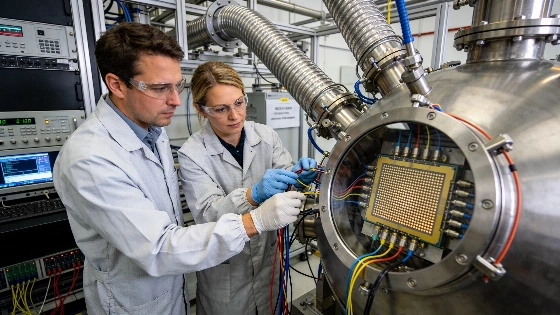
Diraq has launched its first US laboratory in Chicago, equipping the site with cryogenic infrastructure to accelerate the measurement and validation of silicon spin qubit chips and integrated cryo-CMOS electronics
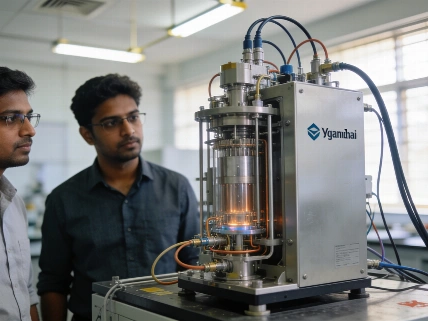
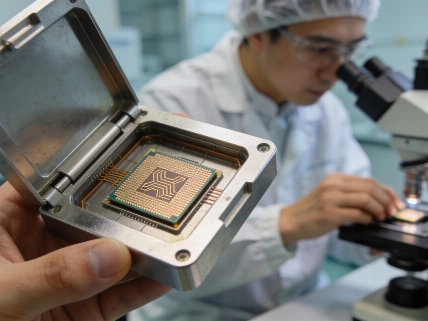
Diraq, a developer of silicon spin qubit hardware, has established its first US-based research and measurement laboratory in Chicago, Illinois. The new facility, located within the Illinois Quantum and Microelectronics Park (IQMP) On-Ramp program at mHUB, is designed to expand the company's experimental capacity beyond its Sydney headquarters. The site is equipped with dedicated cryogenic measurement infrastructure, including two dilution refrigerators, to support the testing and characterization of silicon spin qubit devices and integrated cryogenic CMOS (cryo-CMOS) control electronics.
Experimental Infrastructure
The Chicago laboratory provides Diraq's US engineering team with the ability to perform low-temperature measurements essential for evaluating quantum device performance. Dilution refrigerators at the site enable experiments at millikelvin temperatures, where electron spin coherence and gate operations can be reliably assessed. This infrastructure is critical for benchmarking qubit quality, measuring coherence times, and validating the integration of cryo-CMOS control circuits with quantum dot devices. The facility is intended to support continuous device iteration and rapid feedback between fabrication and measurement cycles.
Continuous Measurement Workflow
By operating across time zones between Sydney and Chicago, Diraq aims to maintain a 24-hour experimental workflow. This approach allows for near-continuous device testing, with measurement data from one site informing fabrication and calibration at the other. The On-Ramp program, supported by IQMP and the Illinois Economic Development Corporation (IEDC), provides immediate laboratory access while the permanent 128-acre IQMP campus is under construction on Chicago's South Side. The integration into the regional quantum ecosystem is expected to facilitate collaboration with national laboratories and academic centers.
Silicon Spin Qubit Roadmap
Diraq's device architecture is based on electron spin qubits confined in quantum dots, fabricated using standard silicon CMOS semiconductor processes. This approach leverages established industrial manufacturing techniques, with the goal of scaling to rack-level quantum systems containing thousands of physical qubits by 2029. The company ultimately targets the integration of millions of qubits per chip, but significant engineering challenges remain in scaling, control, and error correction. The roadmap is ambitious, and the transition from laboratory prototypes to large-scale, fault-tolerant quantum processors will require advances in device yield, wiring, calibration, and error management.
Recent developments in quantum hardware infrastructure have seen similar investments in regional fabrication and measurement capacity. For example, QpiAI recently opened a superconducting quantum chip foundry in Bengaluru, reflecting a broader trend toward geographically distributed quantum R&D hubs. However, the practical realization of scalable, high-fidelity quantum processors remains a major technical challenge across all hardware platforms.
Silicon spin qubits are a leading candidate for large-scale quantum computing due to their compatibility with established semiconductor manufacturing and potential for high-density integration. In these devices, the quantum information is encoded in the spin state of single electrons confined within electrostatically defined quantum dots. Achieving long coherence times and high-fidelity gate operations at millikelvin temperatures is essential for practical quantum computation. However, scaling from a handful of well-characterized qubits to thousands or millions on a single chip will require overcoming significant obstacles in device uniformity, control electronics, cryogenic integration, and error correction. The distinction between physical and logical qubits is central: while physical qubits are the building blocks, logical qubits-protected by error-correcting codes-are necessary for fault-tolerant operation. Progress in silicon spin qubit technology will depend on advances in both device physics and large-scale engineering.