Researchers at Cornell University have demonstrated a low-temperature process for fabricating tantalum-based superconducting qubits, using krypton gas to enable high-quality films compatible with commercial semiconductor foundries
A research group led by Valla Fatemi at Cornell University has experimentally demonstrated a method for depositing high-quality tantalum films for superconducting qubits at a substrate temperature of just 200°C. This approach, detailed in a recent peer-reviewed publication in Nature Materials, addresses a longstanding fabrication challenge for superconducting quantum processors by enabling integration with standard semiconductor manufacturing lines.
Superconducting Qubits and Material Constraints
Superconducting qubits, particularly transmon devices, rely on thin films of materials such as niobium or tantalum to achieve long coherence times and low dielectric loss. Tantalum in its body-centered cubic (α-phase) form has emerged as a leading candidate due to its stable oxide and favorable surface properties. However, conventional deposition methods using argon gas require substrate temperatures above 400°C to stabilize the α-phase on silicon, exceeding the thermal limits of back-end-of-line (BEOL) processes in commercial foundries and risking intermixing at the tantalum-silicon interface.
Krypton Sputtering and Process Engineering
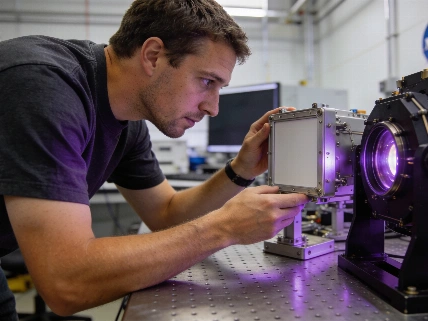
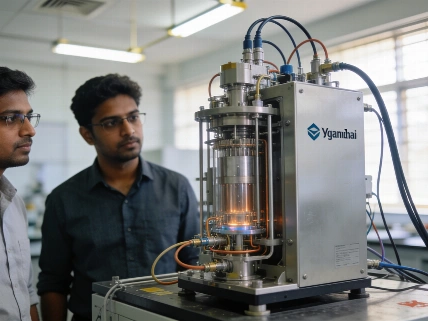
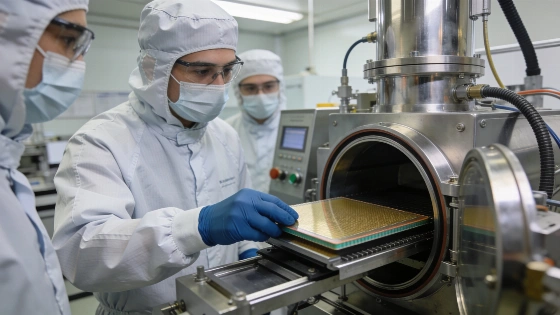
The Cornell team substituted krypton for argon as the sputtering gas during magnetron deposition. Krypton ions, being heavier than argon, transfer greater momentum to tantalum atoms, promoting the formation of the desired α-phase at significantly lower temperatures. This adjustment allowed the researchers to deposit high-purity tantalum films on standard silicon substrates at 200°C, well within the BEOL thermal budget. The process also suppressed the formation of a tantalum-silicon intermixing layer, which can degrade qubit performance.
Device Performance and Foundry Compatibility
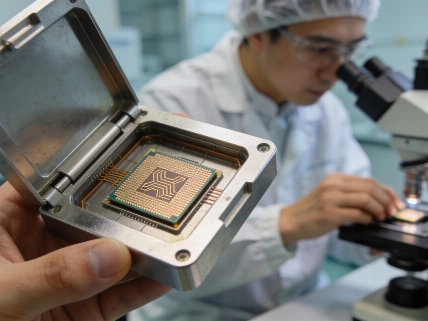
Transmon qubits fabricated with krypton-sputtered tantalum films achieved internal quality factors (Q) up to 16.9 million, measured at millikelvin temperatures in dilution refrigerators. These devices featured compact capacitor gaps of 20 micrometers and demonstrated minimal microwave energy loss, indicating that the low-temperature process did not compromise qubit coherence. By operating at 200°C, the method is compatible with automated semiconductor tool lines and does not damage underlying CMOS control circuits or interconnects, a key requirement for scalable quantum processor manufacturing.
Scaling and Industrial Implications
The research was supported by the U.S. Department of War's Microelectronics Commons Program, the Air Force Office of Scientific Research, and the Cornell NanoScale Science and Technology Facility. The ability to deposit high-quality tantalum films at low temperatures opens a practical pathway for integrating superconducting qubits into commercial foundry workflows. This development addresses a critical bottleneck for scaling up quantum hardware, as foundry-compatible processes are essential for moving beyond laboratory prototypes. Related efforts to industrialize superconducting quantum processor fabrication, such as the establishment of dedicated quantum chip foundries, have also been reported, including the launch of a quantum chip facility in Bengaluru.
In the context of quantum hardware development, the distinction between laboratory-scale demonstrations and scalable, reproducible manufacturing is central. While the krypton-sputtering process has been validated on test devices, further work will be needed to assess device yield, long-term stability, and integration with multi-layer quantum-classical architectures at industrial scale.
Superconducting qubits are quantum bits realized in circuits cooled to millikelvin temperatures, where electrical resistance vanishes and quantum coherence can be maintained for microseconds or longer. The quality factor (Q) of a qubit is a measure of how many oscillations or gate operations can be performed before decoherence dominates. Achieving high Q values requires careful control of material purity, interface quality, and fabrication conditions. Foundry compatibility refers to the ability to manufacture devices using standard industrial processes, which is essential for scaling quantum processors from laboratory prototypes to commercially relevant systems.