Bengaluru startup Quanfluence has raised $10 million to combine photonic chips, custom control silicon, optics and software into one architecture, with a four-qubit processor targeted for the near term and a larger prototype planned for 2029.
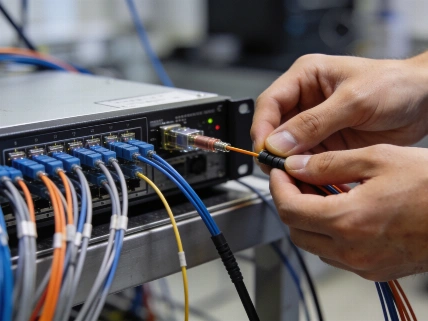
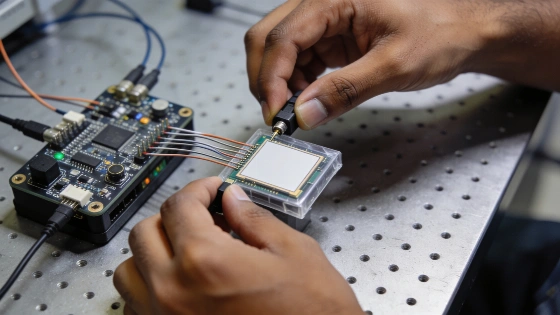
Quanfluence has raised $10 million to build a photonic quantum computing architecture from the chip upward. The Bengaluru startup plans to combine indigenously fabricated photonic integrated circuits with custom electronic control silicon, optical components and software algorithms rather than treat the optical processor as an isolated component.
The financing was led by Chiratae Ventures, with Pi Ventures investing again after leading Quanfluence's $2 million seed round in 2024. Rainmatter by Zerodha also participated in the new round. The earlier seed financing included Golden Sparrow, Reena Dayal and other investors, according to published company-financing reports.
That distinction matters because the company has not announced a completed fault-tolerant machine. The Economic Times reported a near-term plan for a four-qubit quantum computer, while CEO and co-founder Sujoy Chakravarty told Moneycontrol that a relatively small processor is expected by early 2027 and a larger prototype of about 100 qubits is planned for 2029. These are roadmap milestones funded by the new round rather than demonstrated results.
Quanfluence was founded in 2021 by Sujoy Chakravarty, Ravi Mehta, Biman Chattopadhyay, Aditi Vaidya, Anil Prabhakar and Sandeep Goyal. The company was incubated at the IIT Madras Incubation Cell and focuses on photonic quantum technologies for optimization problems. Its stated objective is to develop a full-stack system spanning device fabrication, control electronics, optical assembly and application software.
Photonic quantum computing uses photons as carriers of quantum information. Information may be encoded in properties such as a photon's path, polarization or arrival time, while integrated waveguides, interferometers and optical modulators manipulate those states. A Nature photonic study illustrates how programmable optical processors can implement quantum circuits, but laboratory demonstrations of this kind do not by themselves establish a commercial, fault-tolerant computer.
The practical challenge is not simply producing light. Optical loss, photon-source quality, routing complexity, detector performance, synchronization and the interface between optical and electronic components all determine whether a system can perform a useful computation. In photonic platforms, the loss of even a small fraction of photons can reduce the probability that a complete computational event is detected, making efficient sources, low-loss circuits and high-performance detectors central engineering requirements.
Quanfluence says its approach combines custom silicon photonic chip layout with proprietary light-matter interaction modules intended to reduce signal loss and simplify routing. The available announcement does not provide wavelengths, coupling efficiencies, detector specifications, gate fidelities or measured error rates, so the technical performance of those modules cannot yet be assessed independently.
The new capital is intended to integrate photonic chips, control electronics, optics and software into a single system. That integration resembles the systems challenge faced in other advanced laboratories, including MIT and CERN, where performance depends not only on an individual device but also on calibration, timing, readout and reliable operation across many interconnected components.
The company's current commercial activity is closer to quantum-inspired optimization hardware than to a demonstrated universal fault-tolerant quantum computer. Over the past two years, Quanfluence has commercialized a time-multiplexed Optical Coherent Ising Machine, or CIM, designed for combinatorial optimization problems in logistics and financial services.
A CIM uses optical dynamics to seek solutions to certain optimization formulations. That makes it relevant to the company's hardware development, but it should not be treated as evidence that Quanfluence has already built the photonic processor described in its longer-term plan. The available announcement supplies no benchmark against a current classical optimizer and no runtime, energy or solution-quality comparison.
Photonic quantum processors and coherent optical optimizers also represent different computational models. A CIM can be useful for exploring specialized optimization landscapes without demonstrating the universal gate operations, error correction or logical-qubit performance expected of a fault-tolerant quantum computer. The distinction is important when comparing commercial optimization products with research platforms discussed in journals such as Nature.
The funding can accelerate fabrication, integration and engineering work, but it is not itself a measurement of quantum advantage. Nor does a commercialized near-term machine establish logical qubits, error correction or fault tolerance. A credible performance claim would require reproducible measurements, clearly defined workloads and comparisons with strong classical baselines.
Quanfluence's founding team combines semiconductor design experience with quantum-optics expertise. That combination gives the company a stated route across device design, optical physics, control electronics and software rather than limiting development to one layer of the system. The company's history also explains why its roadmap emphasizes integrated hardware instead of a standalone optical experiment.
The harder test will be integration. A photonic processor must preserve usable optical signals while coordinating sources, modulators, detectors and electronic controllers. As systems grow, the engineering burden shifts from demonstrating an optical effect to manufacturing repeatable devices, calibrating many channels and managing loss across the entire data path. None of those system-level figures has been reported for the planned Quanfluence processors.
The planned 2027 and 2029 milestones therefore describe intended development stages. They do not establish that a processor will be delivered on either date or that the proposed architecture will reach fault tolerance. The four-qubit target and the approximately 100-qubit 2029 prototype are useful indicators of development scale, but qubit count alone does not specify circuit depth, connectivity, fidelity, error rates or computational usefulness.
Quanfluence's financing arrives within India's expanding domestic quantum ecosystem under the National Quantum Mission. Its focus on photonic integration places the company alongside regional efforts spanning quantum optics, sensing and communications while keeping the immediate work firmly in semiconductor and systems engineering.
The funding also illustrates why quantum roadmaps need to be read as engineering plans rather than scientific results. Germany's proposed trapped-ion effort shows a different hardware path in an earlier quantum project, while Quanfluence is pursuing optical integration and custom silicon. Neither comparison supplies evidence that one architecture has already solved the central problems of scale, reliability or useful computation.
For now, the strongest verified conclusion is financial and organizational: Quanfluence has secured $10 million and intends to use it to unify photonic chips, electronics, optics and algorithms. The company has a defined set of engineering tasks and roadmap dates, but no reported processor benchmark that would justify claims of quantum advantage or fault-tolerant operation. The funding is meaningful because it backs full-stack development in India; it is not proof that the proposed machine has crossed from architecture into useful quantum computing.
A physical photonic component is not the same as a logical qubit. A logical qubit requires an error-correction scheme that spreads information across multiple physical degrees of freedom and demonstrates that errors can be detected and controlled as the system grows. In optical hardware, photon loss and imperfect detection are central constraints, so the path from an integrated chip to a reliable computation depends on measured system performance rather than the number of components alone. That is the standard Quanfluence's roadmap will eventually have to meet.