A land-use dispute near SpaceX’s Starbase in Texas has led Cards Against Humanity to propose a public monument targeting Elon Musk, sharpening tensions between commercial space operations and local landowners.
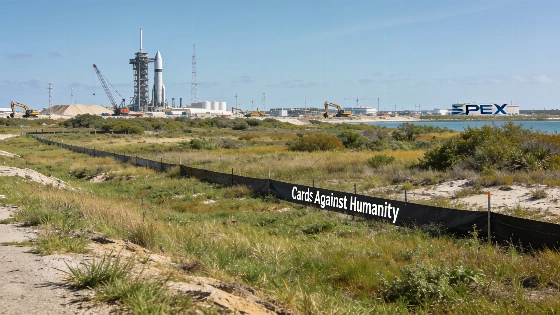
SpaceX’s expansion at its Starbase facility in southern Texas has sharpened a conflict with neighboring landowners. Cards Against Humanity, the Chicago-based creators of the adult card game, has announced plans for a monument on its property near Starbase after a legal dispute over SpaceX’s alleged use of the land without permission.
Land Dispute and Legal Settlement
Cards Against Humanity bought just under one acre near Boca Chica in 2017 as part of a campaign intended to make construction of the U.S.-Mexico border wall “as time-consuming and expensive as possible.” The parcel was not originally purchased for a dispute over space development. In a petition reported by KRGV, the company alleged that SpaceX entered the property without authorization and “has treated the property as its own for at least six months.” The alleged activity included clearing vegetation and compacting soil, as well as laying gravel and operating vehicles on the site.
By 2024, Cards Against Humanity had filed a $15 million lawsuit seeking damages and the removal of SpaceX equipment, workers and materials from the parcel. SpaceX settled the case in 2025, agreeing to remove the materials before the area was annexed into the newly incorporated city of Starbase. The suit put a small privately owned parcel at the center of a much larger change around SpaceX’s Starship development site.
Starbase, at the southern tip of Texas near Boca Chica, became a municipality after a May 3, 2025 election. KRGV, citing Cameron County election information, reported that 212 residents voted in favor of incorporation and six opposed it. About 300 eligible voters lived in the area, most of them SpaceX employees. The disputed parcel’s inclusion in the annexation intensified Cards Against Humanity’s opposition to SpaceX’s activities in the region.
Monument Proposal and Public Involvement
After the settlement and annexation, Cards Against Humanity invited the public to join a design committee for a monument titled “Elon Musk is a Sad Little B----- with No Friends.” The company is seeking $10 contributions from supporters and has pledged 10% of profits from new game expansion decks to fund the project. It says the aim is to prompt reflection from SpaceX’s CEO and draw attention to the effects of large-scale commercial space development on nearby communities.
The proposed monument would stand on the company’s remaining land near Starbase, which the article describes as surrounded by SpaceX-owned property and executive housing. The campaign extends Cards Against Humanity’s use of public engagement and legal strategies to challenge high-profile figures and projects, including its earlier effort to complicate border-wall construction during the Trump administration.
SpaceX Expansion and Community Impact
SpaceX’s presence in Boca Chica has turned the area into a hub for rocket development and testing. Since breaking ground in 2014, the company has launched Starship prototypes and built infrastructure that includes a second launch pad. The influx of employees and the development of company housing have changed the local demographic and economic field, bringing questions about governance and environmental impacts into sharper focus, along with the rights of existing landowners.
Starbase’s incorporation established a local government with authority over taxes and ordinances, as well as zoning and subdivision decisions. The city may create its own police and fire departments or continue relying on neighboring entities. It is also subject to the Texas Open Meetings Act and Texas Public Information Act. Ray Pedraza, a spokesperson for the Texas Department of Transportation, said that “Any closure of a state highway, including SH 4, requires TxDOT approval.” That distinction matters to public-access concerns around Boca Chica Beach and the road serving it.
Residents’ concerns about access featured in the public debate over incorporation. Brownsville resident Rene Medrano raised the prospect of decisions affecting the road to the beach, while reporting by Governing noted that Texas legislation gave Starbase authority to decide whether the beach is open or closed. The Rio Grande Valley Business Journal reported that Starbase’s land area grew from roughly 1,000 acres to about 8,000 through annexation. The city has also formed an economic development corporation and begun a school system, while using a former school building as city hall.
The site’s remoteness and proximity to the Gulf of Mexico offer advantages for rocket testing, but the scale of operations has drawn scrutiny from regulators and the public. The Federal Aviation Administration’s environmental review of Starbase in 2021 received more than 18,000 public comments. It led to additional requirements for SpaceX to mitigate environmental effects before receiving launch approval.
Broader Context and Ongoing Tensions
The dispute reflects broader tensions as commercial space operations expand into new regions. SpaceX’s development of the fully reusable Starship rocket and its role in NASA’s Artemis program have attracted wide attention. At the same time, some residents and advocacy groups have criticized land use and local governance around Boca Chica. The planned monument is a symbolic protest against what Cards Against Humanity describes as corporate interests encroaching on individual property rights and community autonomy.
As of 2026, SpaceX has conducted 13 Starship test flights from Starbase, with varying degrees of success. The facility remains central to the company’s ambitions for lunar and Mars missions, while its expansion continues to prompt debate over scientific progress and commercial interests, as well as the rights of local stakeholders.
The FAA’s environmental review process includes public input and mitigation measures addressing concerns such as noise and debris, along with ecological impacts. These regulatory frameworks aim to balance space exploration with the interests of affected communities. Their effectiveness depends on transparent enforcement and meaningful engagement with those communities.