Bloq Quantum has formalized partnerships in Kerala to establish an undergraduate quantum computing laboratory and expand quantum workforce training, aiming to address regional skills gaps and support India's National Quantum Mission
Bloq Quantum, a developer of enterprise quantum software infrastructure, has announced two new partnerships in Kerala, India, intended to expand access to quantum computing education and workforce training. The company has signed a Memorandum of Understanding with Sree Buddha College of Engineering (SBCE) to create an undergraduate quantum computing laboratory, and has also named QClairvoyance as its official Quantum Skilling Partner for broader institutional outreach.
Quantum Lab Infrastructure
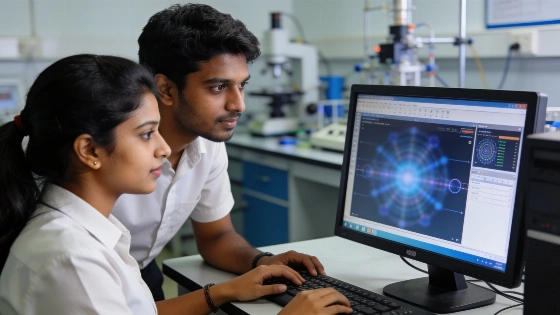
The agreement with SBCE's Department of Electronics and Communication Engineering establishes a dedicated undergraduate laboratory for quantum computing on the college campus. Under this arrangement, Bloq Quantum will provide both faculty and students with cloud-based access to its low-code quantum development platform. The partnership is structured to support several operational tracks, including faculty development programs, student research projects, and co-hosted hackathons. The initiative also aims to integrate quantum topics into the curriculum and facilitate student clubs focused on quantum technologies.
To support workforce development, the collaboration will offer masterclasses led by industry practitioners, interview preparation resources, and merit-based internships within the Bloq Quantum ecosystem. The partners plan to jointly draft research and development grant proposals targeting India's National Quantum Mission, with the goal of securing funding for quantum research, co-authoring scientific publications, and filing joint patents. The laboratory is expected to provide hands-on experience with quantum software tools, but the announcement does not specify the number of students or faculty involved, nor does it detail the hardware resources or the specific quantum algorithms to be taught.
Scaling Quantum Skills
Bloq Quantum's alliance with QClairvoyance is designed to extend quantum education beyond a single institution by integrating Bloq's software stack into training modules across multiple technical colleges. QClairvoyance will standardize student certification programs and faculty training initiatives, aiming to create a regional talent pipeline for quantum technologies. The partnership also includes a framework for deploying QClairvoyance's proprietary algorithms on the Bloq Quantum platform, with the intention of making these tools available to enterprise users. Collaborative activities will include joint research publications, project-specific software development, and coordinated grant applications.
While the partnerships are positioned as a response to India's growing demand for quantum skills, the announcement does not provide quantitative targets for workforce development or specify how learning outcomes will be measured. The focus remains on lowering barriers to entry for engineering students and expanding the pool of developers familiar with quantum programming environments. These efforts align with broader trends in quantum workforce development, as seen in other industry-academic collaborations. For example, recent industry moves such as IBM's acquisition of HRL Laboratories to integrate silicon-spin qubit expertise reflect a similar emphasis on building technical capacity for scalable quantum hardware (see coverage of IBM's HRL acquisition).
Research and Policy Context
The partnerships are framed within the context of India's National Quantum Mission (NQM), a government initiative to advance quantum science and technology through research funding, infrastructure, and workforce development. By supporting joint R&D proposals and patent activity, Bloq Quantum and its partners aim to position Kerala as a contributor to national quantum research priorities. However, the announcement does not specify the scale of anticipated funding, the timeline for laboratory deployment, or the criteria for evaluating research impact. The effectiveness of these programs will depend on sustained investment, access to up-to-date quantum hardware, and the ability to adapt curricula as the field evolves.
At present, most quantum computing education initiatives in India and globally rely on cloud-based simulators or remote access to prototype quantum processors, as local hardware remains limited. The practical skills developed through these programs will be shaped by the fidelity, coherence, and error rates of the available quantum systems, as well as by the integration of classical and quantum software tools. The partnerships do not address the challenge of scaling from educational prototypes to research-grade or commercial quantum devices, which remains a significant engineering hurdle across the sector.
Quantum workforce development refers to the process of equipping students, engineers, and researchers with the skills needed to design, program, and operate quantum devices and software. Unlike classical computing, quantum systems require familiarity with concepts such as superposition, entanglement, and quantum measurement, as well as practical experience with error-prone hardware and specialized programming languages. Effective quantum education programs must balance theoretical foundations with hands-on training, and must adapt to rapid changes in hardware capabilities and software standards. The transition from educational labs to deployable quantum technologies depends not only on curriculum design, but also on access to reliable devices, reproducible experiments, and ongoing collaboration between academia and industry.