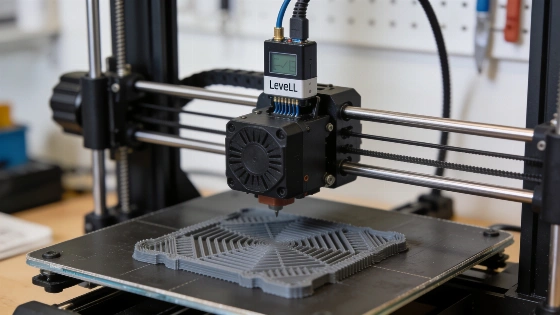
Researchers have explored whether standard bed-leveling sensors in FDM 3D printers can be repurposed to automate pressure advance calibration, a process critical for consistent extrusion during variable-speed printing tasks
Ensuring precise material extrusion remains a central challenge in fused deposition modeling (FDM) 3D printing, especially as print speeds and filament types vary. Traditionally, users calibrate extrusion flow rates and pressure advance parameters manually, a process that can be time-consuming and prone to error. Recent experiments have investigated whether existing bed-leveling sensors-specifically load cells-can be used to automate this calibration, potentially improving print quality and reducing manual intervention.
Pressure advance, sometimes referred to as the K-value, compensates for the lag between changes in nozzle speed and the actual flow of molten filament. This lag arises because the filament behaves like a compressible spring under the extruder's force, leading to over-extrusion or under-extrusion at speed transitions. The optimal K-value depends on the printer's hardware, the filament material, and environmental factors, making direct measurement preferable to relying on presets.
Sensor Repurposing
Some commercial printers, such as the Bambu Lab X1, have implemented automated pressure advance calibration using dedicated sensors like Lidar to scan printed test patterns. However, most consumer FDM printers lack such specialized hardware. Instead, they are typically equipped with bed-leveling sensors-often load cells-designed to measure the force between the print head and the build plate for leveling purposes. The question is whether these sensors can also detect the subtle force changes associated with extrusion pressure, enabling automated calibration without additional hardware.
Open-source platforms such as the Snapmaker U1 and certain Prusa models, which use load cells for bed leveling, have provided a test bed for this approach. By analyzing load cell data during controlled extrusion tests, researchers have attempted to correlate sensor readings with extrusion pressure changes, and thus infer the appropriate K-value for different materials and print speeds. Early results suggest that, under controlled conditions, load cell data can reflect extrusion dynamics, but the method remains experimental and sensitive to noise and mechanical variation.
Calibration Tools and Limitations
To facilitate broader testing, a calibration tool has been developed for select Prusa printers, compatible with stock firmware. This tool collects load cell data during extrusion transitions and attempts to estimate the optimal pressure advance setting. While promising, the approach is still under development and has not been widely validated across different printer models or filament types. Similar open-source projects, such as Auto PA Calibration, are also exploring direct measurement techniques, but none have yet achieved standardized, robust performance in diverse real-world conditions.
Quantitative results remain limited. In controlled tests, load cell readings have shown measurable changes-on the order of a few grams of force-during rapid extrusion transitions. However, the signal-to-noise ratio can be low, and mechanical tolerances, sensor calibration, and environmental factors introduce variability. No large-scale, peer-reviewed study has yet established the reliability or repeatability of this method across the range of consumer FDM printers.
Broader Implications
If proven reliable, automated pressure advance calibration using existing sensors could reduce the technical barrier for high-quality 3D printing, especially for users without advanced calibration experience. However, the approach raises questions about sensor durability, firmware compatibility, and the risk of false calibration due to mechanical artifacts or sensor drift. As with any automated adjustment, meaningful human oversight remains necessary, particularly when deploying new calibration routines on unsupervised or production printers.
Beyond pressure advance, the possibility of repurposing bed-leveling sensors for additional diagnostic or quality-control tasks is being explored. Lateral force sensing, for example, could enable printers to detect nozzle clogging, filament jams, or other mechanical issues in real time. However, these applications remain speculative until validated by systematic testing and independent review.
Pressure advance calibration is a process in which a 3D printer compensates for the delay between changes in nozzle movement and the actual flow of filament. This delay is caused by the compressibility and elasticity of the filament as it is pushed through the extruder. By adjusting the pressure advance parameter, the printer can synchronize extrusion with movement, reducing defects at corners and speed transitions. Automated calibration aims to measure this delay directly, but the accuracy of such methods depends on sensor quality, mechanical consistency, and robust software interpretation of sensor data.