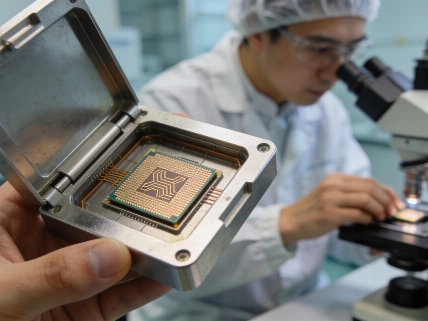

Quantum Elements has introduced Orbit, an automated error suppression suite now available as a Qiskit Function in the IBM Qiskit Functions Catalog, aiming to improve circuit fidelity and reduce manual noise management for quantum developers
Quantum Elements has released Orbit, an automated error suppression tool designed to improve the fidelity of quantum circuits executed on IBM Quantum processors. Orbit is now accessible as a callable Qiskit Function within the IBM Qiskit Functions Catalog, offering developers a way to address noise and error sources without the need for manual, circuit-specific tuning. The tool is positioned for use by enterprise engineering teams, algorithm researchers, and academic scientists seeking to maximize computational output from their allocated quantum runtime on IBM's cloud-accessible hardware.
Integrated Error Suppression Methods
Orbit combines three established error mitigation techniques-dynamical decoupling, hardware-aware transpilation, and measurement error mitigation-into a single workflow. Unlike some automated tools that obscure their internal processes, Orbit allows users to selectively enable or disable each optimization, making it possible to assess the impact of individual controls on circuit performance. The system modifies submitted quantum circuits directly, avoiding the need for additional calibration runs, increased shot counts, or extensive classical post-processing that can inflate resource costs and extend compilation times.
Dynamic Circuits and Mid-Circuit Measurement
A notable technical feature of Orbit is its compatibility with dynamic circuits and mid-circuit measurements, which are increasingly important for advanced quantum algorithms and error correction protocols. In dynamic circuits, mid-circuit readouts and conditional operations can introduce idle periods where qubits not actively involved in computation are vulnerable to decoherence. Orbit addresses these scheduling gaps by automatically inserting higher-order dynamical decoupling sequences, aiming to preserve quantum coherence during periods where traditional static error mitigation is less effective.
Benchmark Results and Performance Evidence
Performance benchmarks on IBM Quantum hardware indicate that Orbit can extend the useful circuit size and improve fidelity in both static and dynamic algorithmic regimes. For example, in dynamic Quantum Fourier Transform (QFT) experiments on the ibm_aachen device, unprotected circuits lost fidelity at 15 qubits, while circuits processed with Orbit maintained approximately 50% process fidelity at 15 qubits and 29% at 20 qubits. In Bernstein-Vazirani algorithm benchmarks on the 156-qubit ibm_kingston processor, raw execution failed to recover the target bitstring beyond 26 qubits, but the full Orbit workflow enabled successful recovery at 70 qubits. These results suggest that Orbit's automated approach can extend the practical reach of current noisy intermediate-scale quantum (NISQ) devices, though the underlying hardware limitations remain.
Integration with Error Detection and Application Scope
Orbit's workflow also supports integration with quantum error detection protocols, moving toward operational regimes relevant for future fault-tolerant quantum computing. In experiments preparing two entangled logical qubits using a [[4,2,2]] quantum error detection code, logical Bell-state fidelity decayed to 44% with error detection alone, but combining error detection with Orbit maintained fidelity at 95.3% over comparable timescales. By embedding these capabilities within the Qiskit infrastructure, Quantum Elements aims to make advanced error suppression accessible for quantum chemistry, optimization, financial modeling, and cryptography applications. For context on the broader quantum hardware landscape, see how other companies are expanding quantum device capabilities in initiatives such as Innolume's recent investment in quantum dot laser production.
Orbit is currently available to members of the IBM Quantum Network through the Qiskit Functions Catalog. While the tool streamlines error suppression for a range of algorithms and hardware configurations, its effectiveness remains bounded by the underlying physical qubit quality, coherence times, and device-specific noise sources. Independent benchmarking and peer-reviewed validation will be important for assessing Orbit's impact as quantum processors and error correction protocols continue to evolve.
Quantum error suppression and error correction are distinct strategies for managing noise in quantum computers. Error suppression techniques, such as dynamical decoupling and measurement error mitigation, aim to reduce the impact of noise during computation without fundamentally correcting errors after they occur. In contrast, quantum error correction encodes logical qubits across multiple physical qubits, detecting and correcting errors in real time to enable scalable, fault-tolerant computation. While error suppression can extend the useful circuit depth and improve fidelity on current noisy devices, full fault tolerance will require robust error correction codes, high-fidelity operations, and stable hardware. Understanding the interplay between these approaches is central to advancing practical quantum computing.