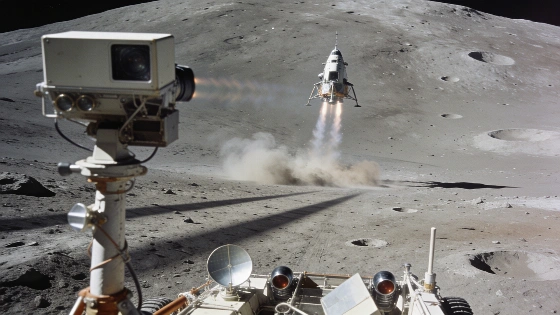
On Aug. 2, 1971, Apollo 15 transmitted the first live television view of a spacecraft leaving the moon, using a rover-mounted camera that revealed both the mission's ingenuity and its limits
On Aug. 2, 1971, Apollo 15 achieved a deceptively difficult communications milestone: television viewers on Earth watched a spacecraft lift off from the moon. Astronauts David Scott and James Irwin had spent three days on the lunar surface before departing in the lunar module Falcon, while a camera mounted on their rover recorded the ascent.
The view from the surface
The camera was attached to the Apollo 15 Lunar Roving Vehicle, which had made its own debut during the mission. Scott drove the rover roughly 300 feet from Falcon and positioned the camera toward the lunar module. The arrangement gave flight controllers in Mission Control Houston a remote vantage point over the departure, rather than relying on footage captured by the astronauts themselves.
Controllers had the option of moving the camera as Falcon rose. Technical problems, however, meant they left it fixed in place. The broadcast therefore did not follow the lunar module smoothly into the sky. Instead, viewers saw the vehicle begin its ascent, accompanied by a brief burst of light and sparks, before it quickly moved out of the camera's field of view.
That imperfect framing is part of what makes the footage scientifically and historically useful. It documents the actual departure sequence with a surface-based instrument, while also showing how limited remote operations were when a camera had to be controlled across the distance between Earth and the moon.
Apollo 15's mission
Apollo 15 launched on July 26, 1971, with David Scott commanding the mission, James Irwin serving as lunar module pilot and Al Worden remaining aboard the command module Endeavour as command module pilot. Falcon landed on the moon on July 30, after which Scott and Irwin conducted three moonwalks and used the lunar rover to travel across the surface.
The lunar liftoff came on Aug. 2, after the astronauts had completed their surface operations. Falcon then rendezvoused with Endeavour in lunar orbit. The crew remained there until Aug. 4, when Apollo 15 began its return to Earth, ending with a splashdown in the Pacific Ocean on Aug. 7.
The key numbers are straightforward: the mission lasted from July 26 to Aug. 7, the rover camera was placed about 91 meters from Falcon, and Scott and Irwin spent three days on the lunar surface. Those figures describe the engineering setting for the broadcast, but they do not imply that the camera produced a continuous or fully tracked record of the ascent.
What the broadcast showed
Apollo 11 had already demonstrated that live television could transmit human activity from the moon, including Neil Armstrong and Buzz Aldrin taking their first steps on the surface. Apollo 15 extended that capability to a more technically demanding event: a launch from another world, observed from the ground by equipment that had to survive and operate in the lunar environment.
The footage also provided engineers with a visual record of how Falcon behaved during liftoff in the moon's gravity, which is about one-sixth as strong as Earth's. It was not a complete engineering dataset: the camera's fixed orientation and limited resolution prevented detailed measurements of every stage of the ascent. Its value came from combining direct visual evidence with spacecraft telemetry and mission records.
The remote-control concept anticipated techniques later used for robotic operations beyond Earth. A camera could be placed at a useful distance from a vehicle, then operated from a control room far away. The same broad idea remains familiar in space exploration, including the use of remotely directed surface vehicles and cameras to document spacecraft activity. A later orbital example, a satellite's recorded view of a spacecraft in flight, illustrates how unusual camera positions can reveal vehicle behavior that is difficult to observe from the ground.
From Apollo to Artemis
The Apollo 15 broadcast established a precedent for live visual coverage rather than a new physical principle. Its importance lay in mission operations, communications and observation: NASA showed that a spacecraft could be filmed leaving the moon while the camera remained on the surface. The technical limitations were equally clear, because the most memorable view ended almost as soon as Falcon climbed away.
That approach has since been expanded through improved cameras, communications systems and autonomous spacecraft. During NASA's Artemis II mission in April 2026, the Orion spacecraft carried cameras inside and outside the vehicle as astronauts traveled around the moon and returned to Earth. The comparison is not exact-Artemis II was a crewed lunar-orbit mission, not a surface landing-but it shows how far live space video has progressed since Apollo 15.
Artemis II also does not erase the distinction between seeing an event and fully measuring it. A camera records light from a scene, while a spacecraft's instruments and telemetry provide the timing, position, velocity and system data needed for detailed analysis. Apollo 15's televised liftoff was therefore both a public broadcast and a limited scientific observation: direct evidence of departure, but not a substitute for the mission's complete engineering record.
In a television image, brightness and motion are converted into electronic signals and then reconstructed for display. The camera does not measure every property of a spacecraft automatically; it records only what falls within its optical view and technical range. For Apollo 15, the fixed camera angle meant that the lunar ascent could be seen but not continuously followed. That limitation is a useful reminder that a dramatic image can document an event without capturing all the data needed to explain it in detail.