Apollo 15's Lunar Roving Vehicle gave astronauts their first way to travel extensively across the moon's surface, extending scientific exploration beyond the immediate landing site in July 1971
On July 31, 1971, Apollo 15 astronauts David Scott and James Irwin drove across the moon for the first time. Their Lunar Roving Vehicle did more than add mobility to a moonwalk: it expanded the area that could be examined, sampled and photographed during a mission constrained by oxygen, battery power and time.
The first lunar drive
Scott, Apollo 15's commander, and Irwin, the lunar module pilot, unfolded the battery-powered rover after landing. The vehicle had been stowed inside the lunar module in a compact configuration, then assembled and deployed on the surface. Al Worden, the command module pilot, remained in lunar orbit aboard the mission's command module.
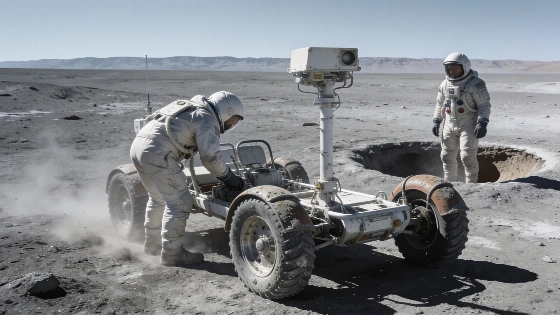
For the first drive, Scott and Irwin traveled to Elbow Crater to collect geological samples and document the surrounding terrain. The rover enabled them to move well beyond the walking range available to earlier Apollo crews, while still allowing them to return to the lunar module within their operational limits.
Apollo 15 launched on July 26, 1971, and landed on July 30. Scott and Irwin completed three moonwalks, including the rover's initial test drive, before leaving the lunar surface on August 2. The crew departed lunar orbit on August 4, returned to Earth on August 7, and splashed down in the Pacific Ocean.
Engineering for the moon
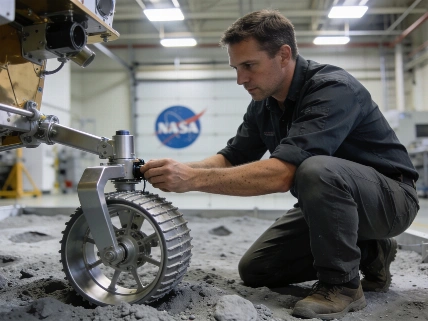
The rover's central design problem was mass. Every kilogram had to be carried from Earth, launched toward the moon and delivered to the surface, yet the vehicle also had to support two astronauts and their scientific equipment. Engineers therefore built an aluminum vehicle that could fold into the lunar module's limited storage space.
Unpacked, the rover measured about 3 meters long, 2.1 meters wide and 1.14 meters high. It could reach approximately 13.8 kilometers per hour and carry up to 490 kilograms of cargo, roughly twice its own weight, while transporting two astronauts. Those figures describe the vehicle's engineering capability, not the speed or payload used continuously during every traverse.
During their stay, Scott and Irwin drove more than 27 kilometers in total. The vehicle's four-wheel layout, low mass and battery power were suited to the moon's vacuum and reduced gravity, but it was not a conventional automobile: there was no atmosphere for cooling by air and no road network to guide its movement. Navigation depended on visual landmarks, mission planning and communication with controllers.
Why the rover mattered
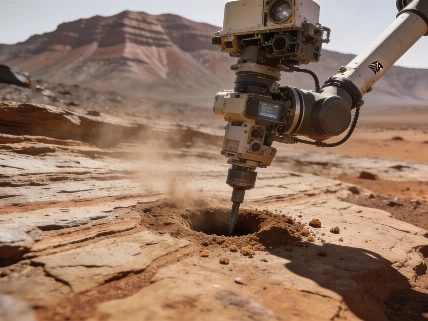
The Lunar Roving Vehicle was the first human-driven rover used on the moon and on any world beyond Earth. Its value was scientific as much as practical. By increasing the distance astronauts could cover, it allowed them to compare surface materials across a broader area and to reach sites that would have been impractical to visit on foot.
The design was used again on Apollo 16 and Apollo 17. The three vehicles remain on the lunar surface, where their batteries are no longer operational. Their fixed locations also preserve a physical record of the routes and working areas associated with the final three Apollo surface missions.
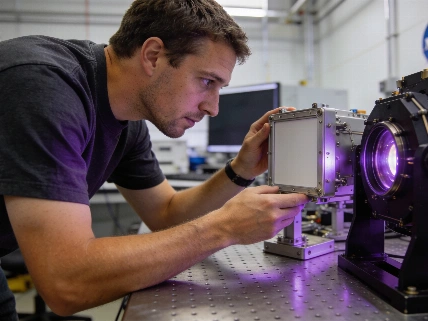
The same engineering logic remains visible in current planetary missions, where spacecraft must extract useful measurements from strict limits on mass, power and communications. NASA's ESCAPADE spacecraft, for example, has used paired observations of Earth and the moon to calibrate its cameras, as described in recent imaging from the mission. Calibration is a less visible milestone than driving on another world, but it serves the same broader principle: reliable science depends on matching instruments and operations to the environment.
From Apollo to Artemis
NASA is now pursuing new unpressurized lunar rovers modeled in broad terms on the idea of the Lunar Roving Vehicle, alongside larger pressurized vehicles. An unpressurized rover requires astronauts to wear spacesuits, while a pressurized vehicle could provide a shirt-sleeve environment during travel. These are proposed capabilities for future Artemis operations, not vehicles already demonstrated on the lunar surface.
That distinction matters because Apollo 15's achievement was a completed mission operation with a specific, tested machine. Future rovers will face different requirements, including longer surface stays, more demanding navigation, greater autonomy and the need to operate as part of a sustained lunar exploration program. Their eventual scientific contribution will depend on how successfully those engineering constraints are solved.
The Apollo 15 rover did not transform the moon into an easily accessible landscape. It extended human reach by a limited but consequential amount, allowing astronauts to connect observations from multiple locations during a few days on the surface. That combination of compact design, careful planning and direct geological work made July 31, 1971, a turning point in lunar field science.
A rover changes planetary exploration by converting the astronaut or instrument from a fixed-site observer into a mobile sampler. Movement does not automatically improve science; each traverse must be planned around power, communications, terrain and the time available for observations. On the moon, where there is no atmosphere and the surface offers few familiar visual cues, mobility is useful only when engineers can keep the vehicle within a safe return range and scientists can relate each sample or image to its location.