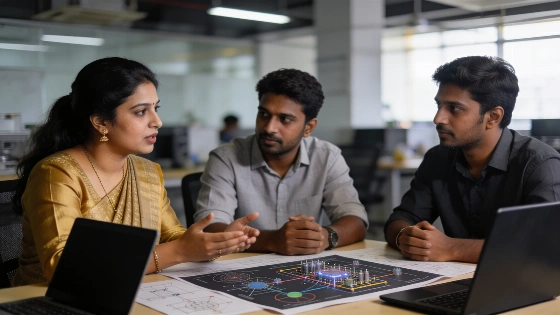
A new partnership between the Ratan Tata Innovation Hub, WISER, and QISE aims to expand quantum education, research commercialization, and startup incubation across Andhra Pradesh, targeting regional integration with national and global quantum ecosystems
The Ratan Tata Innovation Hub (RTIH), established under the Government of Andhra Pradesh's Innovation & Startup Policy (2024–2029), has signed a Memorandum of Understanding with The Washington Institute for STEM, Entrepreneurship and Research (WISER) and its quantum division, the Quantum Institute And STEM Education (QISE). This collaboration is designed to build a distributed quantum startup ecosystem across Andhra Pradesh, focusing on deep-tech infrastructure, research commercialization, and workforce development. The initiative forms part of the Amaravati Quantum Valley strategy, which seeks to connect local academic talent with international quantum research and industry networks.
Distributed Quantum Education and Startup Support
RTIH operates from Mayuri Tech Park in Mangalagiri (Amaravati) and coordinates regional spoke centers in Visakhapatnam, Vijayawada, Rajahmundry, Tirupati, and Anantapur. The partnership will introduce several core programs, including a hardware-agnostic quantum education curriculum developed by QISE and co-certified with the Andhra Pradesh State Council of Higher Education.
This curriculum is intended to train students and researchers on a range of quantum hardware platforms, such as superconducting, trapped-ion, photonic, and quantum annealing systems. The initiative also integrates quantum research teams into RTIH's startup support structure, which includes the SPARK ideation bootcamp, a six-week Future Founders pre-incubation program, and the Catalyst incubation track.
Commercialization Links Research With Industry
One of the partnership's stated goals is to facilitate technology transfer and commercialization by connecting local innovators with India's National Quantum Mission and international industry partners. This approach is intended to support the translation of academic research into commercial products in sectors such as energy, healthcare, defense, manufacturing, and financial services.
The collaboration is led by RTIH CEO Smt. Dhatri Reddy (IAS) and QISE Head of AI & Quantum Ecosystems Phanindra Mandavilli, who emphasize the importance of dedicated quantum incubation pathways for regional development.
While the partnership focuses on education and incubation, it also aims to address the challenge of extending quantum infrastructure and expertise beyond major urban centers. By deploying a distributed model, RTIH and its partners seek to reach Tier-2 and Tier-3 cities, broadening access to quantum skills and resources.
This regional approach is consistent with recent efforts in other countries to integrate quantum hardware and classical computing resources, as seen in Japan's launch of the ROQUO hybrid supercomputer, which links trapped-ion quantum processors with advanced GPUs for benchmarking and quantum chemistry workloads.
Hardware Access and Measurable Outcomes Remain Unclear
At present, the RTIH-WISER-QISE partnership has not announced specific hardware deployments, processor specifications, or measurable quantum benchmarks. The focus remains on educational program rollout, startup incubation, and ecosystem integration.
The effectiveness of these efforts will depend on the ability to deliver high-quality training, facilitate access to quantum hardware, and support the transition from research to commercial application. Independent evaluation of program outcomes and reproducibility of educational and incubation models will be important for assessing long-term impact.
Workforce Development Must Reflect Technical Reality
Quantum education and workforce development are critical for the growth of national and regional quantum technology sectors. Unlike classical computing, quantum systems require specialized knowledge of quantum mechanics, device physics, and error mitigation techniques.
Hardware-agnostic curricula aim to prepare students for a rapidly evolving landscape in which superconducting, trapped-ion, photonic, and other platforms coexist. However, the translation of academic training into commercial innovation depends on access to real hardware, reproducible device performance, and sustained support for early-stage startups.
As quantum infrastructure expands, the challenge will be to ensure that educational and incubation programs remain aligned with the technical realities and engineering constraints of quantum devices.