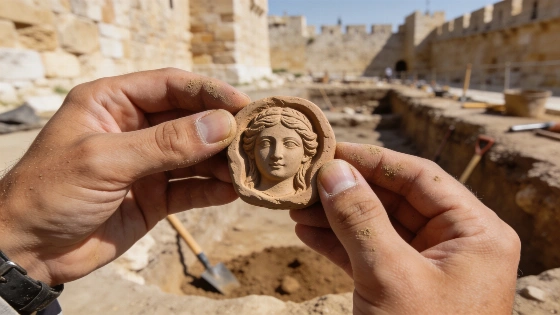
Archaeologists have identified a rare clay mould from the First Temple period at Jerusalem's Tower of David Museum, providing the first direct evidence that distinctive female figurines were produced locally rather than imported
For the first time, archaeologists have recovered direct evidence that clay figurines common in Iron Age Jerusalem were manufactured within the city itself. The discovery centers on a rare clay mould, used to form the head of a female figurine, unearthed during excavations beneath the Tower of David Museum. This find challenges previous assumptions that such objects might have been imported or produced elsewhere in ancient Judah.
Excavation Context and Recovery
The clay mould was identified during systematic sifting of soil from the Qishla complex, a fortified area adjacent to Jerusalem's Old City walls. The excavation, led by the Israel Antiquities Authority, targeted fills and deposits securely dated to the First Temple period, spanning the eighth to sixth centuries BCE. While hundreds of figurine fragments have been documented from Jerusalem and the wider region, this is the first production mould of its type recovered from a controlled archaeological context in the city.
Following its recovery, the object underwent conservation and cleaning, revealing fine details of a stylized female face and elaborate curly hairstyle. Using the mould, conservators produced a replica head, confirming the mould's function and providing a rare glimpse into the manufacturing process behind these distinctive artifacts.
Figurines of this type typically measure 10-20 centimeters in height. Surviving examples often show the head and body as separate components, with the head formed in a mould and the body shaped by hand. The prevalence of detached heads among archaeological finds reflects this two-part production technique.
Material Evidence and Interpretation
Archaeologists classify First Temple period figurines into three main categories: female figures, horse-and-rider figures, and animal representations, especially horses. The female figurines-sometimes called Judean pillar figurines-are characterized by prominent hairstyles and hands positioned beneath the breasts. Some retain traces of colored pigments, including white, yellow, red, and black, suggesting that they were originally decorated.
The function of these figurines remains debated. Their presence in domestic, funerary, and public contexts has led to competing interpretations: fertility symbols, representations of the goddess Asherah, children's toys, or household amulets intended to offer protection or blessing. The new evidence from the Qishla mould does not resolve this question, but it does confirm that at least some figurines were produced locally, rather than arriving as finished goods from other sites.
In terms of numbers, figurine fragments from the First Temple period have been recovered from nearly every major excavation in Jerusalem and Judea, but until now, no production moulds had been securely identified within the city. The Qishla find therefore provides a missing link in the chaîne opératoire-the operational sequence-of Iron Age craft production in Jerusalem.
Broader Archaeological Implications
The Qishla excavations form part of a larger project to document the archaeological layers beneath the Tower of David Museum, with evidence spanning from the Iron Age through the British Mandate period. The site's stratigraphy has yielded a wide range of material, but the clay mould stands out for its direct connection to ancient manufacturing practices. The museum's ongoing public engagement program allows visitors to participate in sifting activities, offering a rare opportunity to observe the recovery of artifacts from these complex deposits.
Comparable discoveries elsewhere in the region have sometimes lacked secure context, limiting their interpretive value. In contrast, the Qishla mould's stratigraphic association strengthens the case for local production. This approach echoes the importance of context in other recent finds, such as the previous investigation of armor fragments from a Polish palace moat, where secure recovery conditions allowed for more confident historical interpretation.
While the new evidence does not clarify the precise meaning or use of the figurines, it does shift the discussion from speculation about trade and import to questions of local craft organization, resource procurement, and the social role of artisans in Iron Age Jerusalem. The find also highlights the value of careful excavation and conservation in reconstructing ancient technological processes.
Uncertainties and Future Research
Despite the significance of the Qishla mould, several uncertainties remain. The mould represents only one stage in the production process, and it is unclear how widespread local manufacturing was or whether other workshops operated in the city. The absence of kiln remains or associated production debris limits the ability to reconstruct the full scale of figurine production. Further, the function of the figurines themselves remains unresolved, with no direct evidence linking them to specific rituals, beliefs, or household practices.
Researchers hope that continued excavation and analysis of the Qishla deposits will yield additional production tools, workshop features, or associated artifacts that could clarify the organization of craft activity in First Temple Jerusalem. For now, the clay mould stands as the strongest direct evidence yet for local figurine manufacture in the city's Iron Age layers.
Understanding the significance of this discovery requires attention to archaeological provenance. Provenance refers to the documented origin and context of an artifact, including its recovery location, stratigraphic association, and relationship to other finds. Secure provenance allows archaeologists to interpret objects within their historical and cultural setting, while unprovenanced artifacts-those lacking reliable context-offer limited insight and are more vulnerable to misinterpretation or forgery. The Qishla mould's controlled recovery and documented context make it a valuable addition to the study of ancient Jerusalem's material culture.