
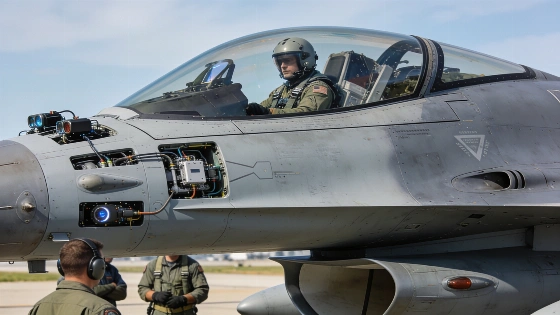
A modified F-16 fighter jet was flown under AI control in a supervised test by DARPA and the US Air Force, using the VENOM Autonomy Kit to enable remote operation without altering the aircraft's core flight software
The Defense Advanced Research Projects Agency (DARPA) and the United States Air Force (USAF) have conducted a supervised flight test in which a modified F-16 fighter jet was controlled by an artificial intelligence (AI) system. The demonstration used the Viper Experimentation and Next-generation Operations Model (VENOM) Autonomy Kit, a hardware and software package designed to enable AI-driven flight in legacy aircraft without requiring changes to the jet's core flight software. This marks the first reported instance of an AI system piloting a retrofitted F-16, expanding on previous work with the X-62A VISTA testbed.
During the test, a human pilot performed takeoff and remained in the cockpit throughout the flight, monitoring the AI's actions and retaining the ability to intervene if necessary. Once airborne, control was transferred to the VENOM system, which managed flight operations and monitored onboard sensors and mission systems. The test was conducted under a "human-on-the-loop" supervision model, meaning the human operator could oversee and override the AI but was not required to approve every action in real time. This approach differs from "human-in-the-loop" systems, where human approval is mandatory for each decision, and from fully autonomous operation, which was not attempted in this demonstration.
A Retrofit Designed for Existing Fighter Aircraft
The VENOM kit was installed on the F-16 without modifying the aircraft's core flight software, a technical constraint that allows for rapid retrofitting of existing airframes. According to DARPA, this method could enable scalable testing of AI agents across multiple aircraft, supporting experiments with different tactics, agent cooperation, and responses to simulated aerial and electronic warfare threats. The system's ability to operate on standard F-16s is intended to accelerate the development and evaluation of AI-driven combat capabilities without requiring new aircraft or extensive software redevelopment.
While the demonstration confirms that the VENOM system can assume control of a legacy fighter jet under human supervision, it does not establish the reliability or safety of fully autonomous combat flight. The test environment, number of flights, and intervention rate were not disclosed, and no independent verification of the system's performance has been reported. The human pilot's continuous presence and authority to override the AI remain essential for safety and compliance with current operational and regulatory standards. The demonstration did not involve live combat or uncrewed operation, and the VENOM system's behaviour in complex, adversarial scenarios remains untested in public documentation.
Limited Data on Performance and Reliability
DARPA and the USAF have stated that the VENOM programme will inform the Artificial Intelligence Reinforcements (AIR) initiative, which aims to develop and evaluate AI agents for operationally relevant air combat scenarios. The long-term vision includes the possibility of human pilots commanding groups of AI-controlled aircraft in beyond-visual-range engagements, but this remains a research goal rather than a demonstrated capability. The VENOM test provides a platform for further investigation of AI-agent cooperation, human oversight, and the technical and institutional challenges of integrating AI into military aviation.
In the reported test, the VENOM system was installed on a standard F-16 airframe, with a human pilot conducting takeoff and landing. The AI assumed control during the airborne phase, managing flight controls and sensor monitoring. The number of test flights, duration, and specific performance metrics were not disclosed by DARPA or the USAF. No information was provided on failure rates, intervention frequency, or the range of scenarios tested. The demonstration did not include live weapons or autonomous engagement decisions.
The Challenge of Meaningful Human Oversight
Understanding the distinction between "human-on-the-loop" and "human-in-the-loop" control is central to evaluating the safety and accountability of AI-driven systems in high-risk environments. In a "human-on-the-loop" setup, the human operator supervises the AI and can intervene or abort actions but does not approve every decision in advance. This model can increase operational speed but may reduce the operator's situational awareness or ability to prevent errors if the AI acts unexpectedly.
The effectiveness of this approach depends on the reliability of the AI, the quality of human-machine interfaces, and the clarity of responsibility in the event of failure. As AI systems are integrated into critical applications, the design of oversight mechanisms and the limits of meaningful human control remain active areas of research and policy debate.