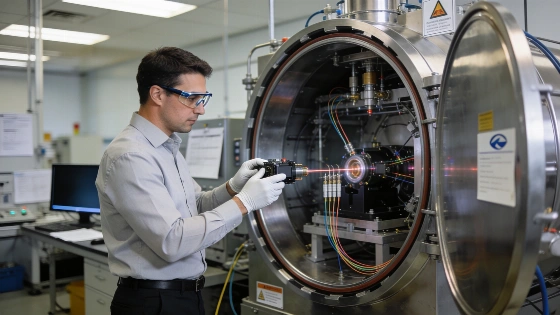
The Department of War has outlined a $350 million quantum initiative with up to $150 million in conditional financing for PsiQuantum's Milpitas manufacturing hub and approximately $200 million for independent hardware validation under DARPA's Stage C program.
The United States is putting federal capital behind the least glamorous part of fault-tolerant quantum computing: building, integrating and testing the hardware. The Department of War has announced a $350 million quantum initiative that includes a conditional loan commitment of up to $150 million for PsiQuantum's manufacturing and integration facility in Milpitas, California.
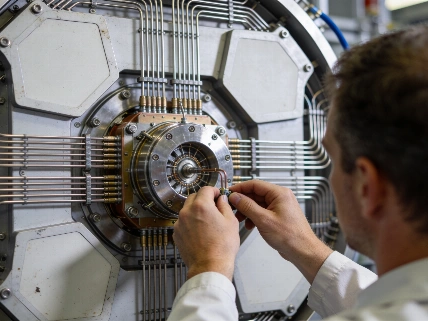
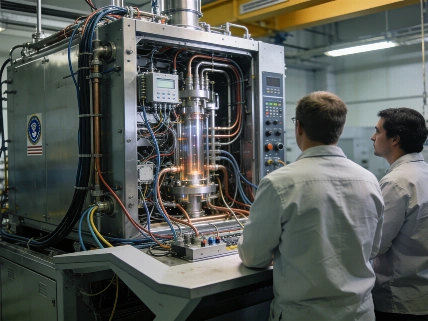
The loan would target specialized validation equipment, subassembly integration infrastructure and advanced cryogenic systems for large-scale photonic prototype testing. PsiQuantum plans to combine the federal debt facility with co-investment from other sources. The stated objective is to reduce dependence on external supply chains while creating an American base for validating the components that a larger system would require.
The commitment is conditional rather than final. PsiQuantum must satisfy customary legal, financial, technical and regulatory due-diligence conditions before the loan is executed. That distinction matters: government financing can make a manufacturing program possible, but it is not itself evidence that the underlying quantum architecture has met the performance requirements for useful fault-tolerant computing.
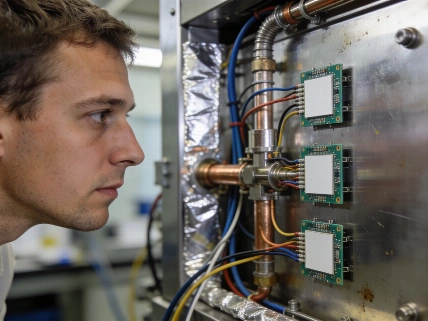
Stage C should therefore be read as an engineering verification milestone, not as a declaration that any participant already operates a useful or fault-tolerant quantum computer. The central question is whether a proposed utility-scale system can actually be built and operated in accordance with its design. In practical terms, that means testing the chain from sources and optical components to detectors, control electronics, packaging, calibration and software. It also means measuring whether the system remains usable as its size and operating complexity increase.
That change addresses a central weakness in quantum roadmaps. A proposed architecture can specify how photons, detectors, control systems and error-correction procedures should work without demonstrating that the full chain can be assembled, calibrated and operated together. The available announcement does not provide comparative benchmark results, qubit counts, logical-qubit counts, error rates, fidelities, circuit depths, runtimes or classical baselines. It also does not report independent replication or a peer-reviewed experimental result.
PsiQuantum said on July 22, 2026, that its expanded DARPA Stage C agreement could be worth up to $125 million. The stated work covers hardware designs, components, system performance and software; the company had previously disclosed a $31.8 million agreement in September 2025 for on-site testing and evaluation. These contracts indicate a broader validation effort, but contract value is not a substitute for measured processor performance.
Application workshops will also be organized by the Office of the Under Secretary of War for Research and Engineering and DARPA with the Department of Energy, the National Nuclear Security Administration and the Laboratory for Physical Sciences. The series is scheduled to begin before January 2027 and will focus on mission-critical problems in chemistry, materials science and physics. These workshops may help define target workloads, but they are not demonstrations that quantum hardware has solved those problems.
PsiQuantum is continuing construction of its Moreton Bay Central utility-scale facility in Queensland, Australia, and has an anchor site at the Illinois Quantum and Microelectronics Park in Chicago. California's industrial context was also described in an earlier infrastructure report, which covered state legislation and funding for quantum and fusion research. These developments establish a substantial infrastructure program, but they do not supply the missing measurements needed to judge processor quality.
Those measurements would normally include the performance of photonic sources, optical components and detectors, as well as system-level loss, interference quality, control stability and the behavior of error-correction routines. For a credible comparison, researchers would also need clearly defined sample sizes, repeated trials, uncertainty estimates and confidence intervals for key metrics. Results should be reported in a form that independent laboratories can reproduce and compare with the standards of peer-reviewed journals such as Nature and with work from quantum-information groups at MIT and Stanford.
For photonic quantum computing, manufacturing scale is inseparable from physics. Optical loss can remove photons before they contribute to a computation, while imperfect sources, detectors and switching elements can propagate errors through a circuit. Cryogenic systems may be required for parts of the detection and control stack, adding thermal, packaging and maintenance constraints. A larger factory can improve the ability to produce and test components, but it cannot by itself show that the complete architecture has crossed an error-correction threshold.
A physical qubit is an individual controllable quantum system; a logical qubit stores information across multiple physical components so that errors can be detected or corrected. The distinction is central to how laboratories such as CERN, MIT and Stanford would evaluate claims about scale: a larger inventory of physical devices is not equivalent to a demonstrated increase in reliable logical computation. The relevant evidence must connect component-level performance to system-level error suppression and useful algorithmic workloads.
A manufacturing hub can help produce the components needed for both physical and logical qubits, yet it does not demonstrate a logical qubit, a useful algorithm or a fault-tolerant processor. The federal package is best read as a bet on the infrastructure required to test those claims rigorously, not as proof that PsiQuantum's intended system already works at utility scale. By funding factories and verification together, the program is moving the industry toward evidence that can be measured rather than merely promised.