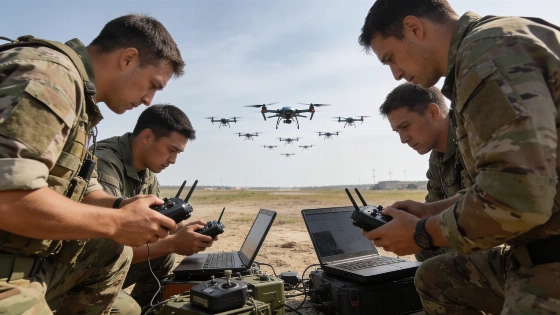
Recent demonstrations show how AI enables military drone swarms to coordinate, navigate without GPS, and share sensor data. These advances highlight both technical progress and unresolved risks in autonomous battlefield systems
Military drone swarms are moving from research prototypes toward operational testing, with artificial intelligence now central to their coordination and resilience. Unlike traditional remotely piloted drones, swarms are designed to operate as distributed groups, sharing information and adapting to changing battlefield conditions. This shift is enabled by a set of AI-driven technologies that allow multiple uncrewed aerial vehicles (UAVs) to communicate, process sensor data, and make limited decisions without continuous human input or centralized control.
Swarm Coordination and Distributed Control
At the core of these systems is swarm intelligence, a field that draws on decentralized algorithms to manage how individual drones interact, maintain formations, and divide tasks. Inspired by collective animal behavior, these algorithms allow swarms to remain functional even if some drones are lost or communications are disrupted. Programs such as DARPA's Offensive Swarm-Enabled Tactics (OFFSET) have tested these approaches in simulated and controlled urban environments, demonstrating that distributed control can improve resilience compared to single-point command structures. However, most current systems still require human operators to set objectives and boundaries, with autonomy limited to task execution within those constraints.
Edge AI and distributed onboard computing further reduce dependence on remote command centers. By processing imagery and sensor data locally, drones can identify objects, navigate obstacles, and react to threats even when communication links are degraded by electronic warfare or environmental interference. This approach lowers latency and allows swarms to adapt more quickly, but it also raises questions about verification, error propagation, and the limits of onboard processing power.
Communication, Navigation, and Sensor Fusion
Reliable communication remains a technical challenge for swarms operating in contested environments. AI-enabled mesh networking allows each drone to act as a node, relaying data across the group and rerouting around failed links. The US Navy and other organizations have conducted field exercises with mesh-networked unmanned systems, but real-world performance under active jamming or physical obstruction remains an area of ongoing research. Loss of connectivity can degrade swarm effectiveness, and fallback procedures for degraded operation are not always transparent.
Navigation without GPS is another critical capability. Adversaries can jam or spoof satellite signals, so swarms increasingly rely on AI-driven alternatives such as visual-inertial odometry, terrain-relative navigation, and LiDAR-based mapping. These methods combine multiple sensor inputs to estimate position, but their accuracy can vary with environmental conditions and sensor quality. AI-based sensor fusion further enhances situational awareness by integrating data from electro-optical, infrared, radar, and electronic warfare sensors. This multi-perspective approach can improve threat detection and reduce false positives, but it also increases system complexity and the risk of cascading errors if one sensor fails or is deceived.
Human-Swarm Teaming and Target Recognition
Managing large swarms presents a workload challenge for human operators. Human-swarm teaming shifts the operator's role from direct piloting to high-level mission management, allowing a single person to supervise dozens or hundreds of drones by setting objectives and constraints. Research programs have demonstrated that this approach can scale, but it depends on reliable interfaces, clear feedback, and robust fail-safes to prevent automation bias or loss of situational awareness. The degree of meaningful human control remains a subject of debate, especially as autonomy increases.
AI-based target recognition and threat classification are now standard in advanced drone swarms. Machine learning models process sensor data to detect, classify, and track objects of interest, with cross-verification among multiple drones to improve reliability. While these systems can support reconnaissance and surveillance, their accuracy depends on training data quality and environmental variability. False positives, adversarial deception, and untested edge cases remain significant risks, particularly in high-stakes military contexts where misclassification can have severe consequences.
Deployment Status and Measured Performance
Most AI-enabled drone swarms remain in the experimental or limited pilot phase, with operational deployments subject to strict oversight and regulatory review. For example, DARPA's OFFSET program tested swarms of up to 250 simulated and physical drones in controlled environments, focusing on urban navigation and coordinated task execution. Field trials have reported improved resilience and adaptability compared to conventional single-drone operations, but comprehensive data on failure rates, human intervention frequency, and real-world adversarial performance is limited. No public evidence confirms fully autonomous lethal engagement without human approval in current Western military systems.
Technical progress in swarm autonomy is matched by unresolved questions about safety, accountability, and compliance with international law. The complexity of distributed AI systems complicates verification, audit, and attribution of errors or unintended actions. As research continues, policymakers and engineers face the challenge of ensuring that advances in autonomy do not outpace the development of effective oversight, fail-safe mechanisms, and clear lines of human responsibility.
Understanding the distinction between automation and autonomy is essential in evaluating military drone swarms. Automation refers to the execution of predefined tasks with minimal human input, while autonomy involves the ability to make context-dependent decisions within set boundaries. In practice, most current swarms operate with conditional autonomy, executing tasks independently but under human-defined objectives and with the possibility of intervention. The degree of meaningful human control-defined by situational awareness, authority to intervene, and reliable communication-remains a central concern for both safety and accountability in autonomous weapon systems.