A trio of spherical radio astronomy probes from Africa is set to launch aboard China's Chang'e 8 lander in 2029, aiming to deploy at the moon's south pole and test low-frequency radio observations beyond Earth's atmospheric limits
Africa is preparing to send its first scientific payload to the lunar surface, with a set of three spherical radio astronomy probes scheduled to launch aboard China's Chang'e 8 lander in 2029. The mission, known as the Bounced African Low Lunar Sphere (BALLS), will target the moon's south pole, where the probes are designed to operate as a pathfinder radio array for low-frequency astronomical observations inaccessible from Earth.
Mission Design and Scientific Goals
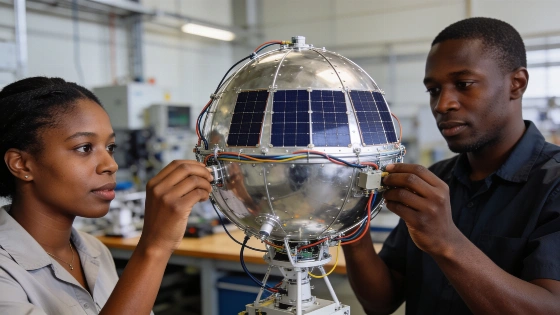
The BALLS project is part of the Africa2Moon initiative, which was selected by the China National Space Administration in April 2025 as one of several international payloads for Chang'e 8. Each BALLS unit is a metal sphere equipped with low-frequency radio antennas, intended to detect signals from the early universe that are blocked by Earth's ionosphere and terrestrial radio interference. By deploying the trio of probes across the lunar surface, the mission aims to demonstrate the feasibility of lunar-based radio interferometry and gather data on cosmic phenomena at frequencies below 20 megahertz (MHz).
The lunar far side and polar regions are considered the most radio-quiet environments in Earth's vicinity, making them ideal for sensitive astronomical measurements. The BALLS array will attempt to capture signals from some of the oldest and most distant sources in the universe, providing a testbed for future, larger-scale lunar radio observatories.
Engineering and International Collaboration
The BALLS hardware features a gyroscope-like frame of interlocking rings, housing two triangular solar panel arrays oriented in opposite directions. This design supports power generation and stability on the lunar surface. The mission is led by the Foundation for Space Development Africa, in partnership with the South African Radio Astronomy Observatory (SARAO), the South African National Space Agency, and research institutions across Kenya, Ghana, Botswana, and South Africa.
Component manufacturing and assembly have involved teams at Petrawell in Cape Town, the Aerospace Systems Research Institute at the University of KwaZulu-Natal, and the Electronic Systems Laboratory at Stellenbosch University. The functional models were completed in April 2026 and are scheduled for delivery to the Chang'e 8 team for integration and testing. Once on the moon, the probes will relay their data to the Chinese lander, which will transmit the information back to Earth for analysis.
Pathfinder for Future Lunar Arrays
The BALLS deployment is intended as a technology demonstrator for a more ambitious Africa2Moon mission, which envisions an array of 55 antennas on the lunar far side. The current mission will test deployment strategies, instrument performance, and data transmission under lunar conditions. For the larger array, engineers are considering design changes such as larger-diameter antennas and self-deploying mechanisms to enable wider and more randomized placement, enhancing scientific coverage.
Funding for the BALLS project has relied heavily on volunteer contributions and limited resources, highlighting the challenges and collaborative spirit of African space science. The broader lunar science community has expressed support for the initiative, recognizing its potential to expand global participation in lunar exploration and radio astronomy.
Scientific and Technical Context
The BALLS array will operate at frequencies below 20 MHz, a range that is inaccessible from Earth due to ionospheric absorption and human-made radio noise. These low-frequency radio waves are of particular interest for studying the cosmic dark ages and the formation of the first stars and galaxies. The mission's success could inform the design of future lunar radio telescopes, which may eventually rival ground-based facilities such as the Square Kilometre Array.
As lunar exploration accelerates, the scientific community continues to debate the merits of different landing sites and mission architectures. For example, NASA's Artemis IV mission is weighing the risks and benefits of targeting the lunar south pole versus equatorial regions, as discussed in a recent Science Report analysis of Artemis IV landing site decisions. The BALLS project adds a new dimension to this conversation by demonstrating how international partnerships and novel instrument concepts can shape the future of lunar science.
Radio astronomy relies on detecting electromagnetic waves at frequencies that are often blocked or distorted by Earth's atmosphere. The ionosphere, a layer of charged particles high above the planet, absorbs and reflects low-frequency radio waves, making ground-based observations below about 20 MHz impossible. By placing radio antennas on the moon, especially in radio-quiet regions such as the far side or polar areas, scientists can access a previously hidden window on the universe. Lunar-based arrays could eventually reveal signals from the cosmic dawn, map the structure of the early universe, and test models of cosmic evolution with unprecedented sensitivity.