An integrated silicon nitride photonic chip transferred a skyrmion pattern from a single-photon state into correlations between two photons. The reported topological number remained measurable under noise even after concurrence fell to zero-a result about state structure, not proof of a functioning quantum network.
A photonic chip has transferred a topological feature from a single photon into a two-photon state, and the feature persisted in the researchers' noise analysis even after entanglement, as measured by concurrence, fell to zero. Reported by an international team in Nature Physics, the result makes the skyrmion number a candidate witness of structured non-classical correlations. It does not show that a quantum network can keep useful communication working after its entanglement link fails.
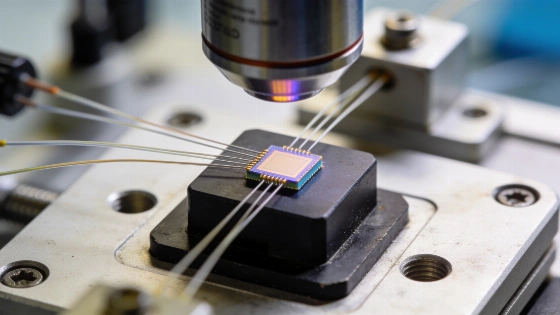
Photon-pair architecture. The team led by the University of Pennsylvania worked with researchers from the University of the Witwatersrand, Nanyang Technological University, and South China University of Technology. Their integrated circuit uses silicon nitride (Si3N4) spiral waveguides and microring resonators. Spontaneous four-wave mixing in waveguides 650 nm wide generates photon pairs in distinct optical paths, which provide the resource for the state-transfer protocol. Earlier photonic skyrmion demonstrations treated single-photon states and entangled photon pairs in separate, larger optical arrangements; this platform brings preparation and control together on an integrated chip and demonstrates a transition between the two forms.
A photonic skyrmion is a structured polarization pattern: across a beam profile, the polarization texture wraps around the Poincaré sphere. The integer-valued quantity used to characterize that wrapping is the skyrmion number, Nsk. Here, spin-orbit-locked microring resonators with asymmetric inner and outer sidewall gratings encode the local pattern on photon A. The transfer operation measures two properties of the first photon in a spin-momentum Bell basis. Afterward, the topological pattern is described by correlations between the two photons, rather than by the state of one photon alone. The reported research paper record provides further technical context for the experiment.
This work sits within a wider effort to put optical functions on chip, including the earlier microcomb-chip report. The present experiment addresses a different task: encoding and transferring a topological polarization structure, rather than generating a frequency ruler.
What the measurements show. The measured skyrmion number was Nsk = 1.981 ± 0.002 for the local single-photon state and Nsk = 1.981 ± 0.001 for the two-photon entangled state. For a target skyrmion with Nsk = 2, the transferred values were approximately 1.98. Across four variants, the reported fidelity relative to target states ranged from 87% to 89%. These results support transfer of the measured topological invariant with little change; fidelity is a state-overlap measure, not a measure of network throughput, transfer rate, or end-to-end communication performance. The available reporting does not provide sample sizes, p-values, or confidence intervals for these results, so those should not be inferred from the quoted measurement uncertainties.
The team also examined depolarizing, phase-flip, and bit-phase-flip noise channels. As noise increased, concurrence-the entanglement measure used in the analysis-could reach zero while quantum discord, which captures a broader class of non-classical correlations, remained. The skyrmion number persisted for a further range of noise, with the account placing its loss at approximately γ ≈ 0.25. The available description does not establish whether these noise-channel tests were implemented physically or evaluated through a model; they therefore should not be treated as a demonstrated operating tolerance for a deployed link. The reported finding is narrower: this topological invariant remained observable in a regime where concurrence no longer detected entanglement.
Topology is not a network. Conventional teleportation protocols rely on shared entanglement, whereas this study tracks a topological observable that can persist when concurrence no longer identifies entanglement. That persistence is scientifically notable: it suggests the invariant can retain information about a structured state under some forms of noise. But preserving a number is not the same as preserving a usable quantum channel. The experiment does not establish successful quantum communication after the entanglement resource has been lost, nor does it show that useful information can be transmitted in that regime.
Nor does the chip demonstration by itself establish scalable interconnects for distributed quantum computing. The reported account gives no photon-pair rate, optical loss, detector efficiency, operating conditions, repeated-device results, or independent replication. Those omissions leave important engineering questions open: how often the states can be generated and detected, how reliably the circuit performs across devices, and whether the protocol remains useful when losses and errors affect a full link. The evidence supports a focused laboratory result, not a deployment claim.
The work's strongest contribution is a testable way to track topological structure in photonic quantum states under noise, with closely matching skyrmion-number measurements before and after transfer. That is a meaningful result for quantum photonics, but the distinction between a robust observable and a robust communication system must remain firm. Until rates, losses, and full-link performance are established, this chip is a promising experimental platform rather than a demonstrated quantum-network component.
A topological invariant summarizes a property of a field pattern that can remain unchanged under certain continuous distortions. Here, the skyrmion number describes how polarization covers the Poincaré sphere; it is not itself a guarantee that all information in the photon state survives. Its persistence is useful evidence about the pattern, while practical networking still depends on generating, transmitting, and measuring photons reliably. A concise account of the reported measurements and interpretation is available in the experiment overview.