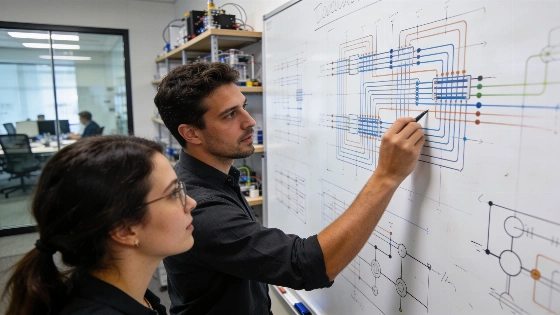
After a failed SPAC deal in 2024 left Zapata Quantum with new debt and little fresh capital, the company restructured and shifted its focus. Zapata now highlights progress in quantum resource estimation and cancer research, but faces ongoing engineering and scalability hurdles.
When Zapata Quantum's 2024 SPAC deal closed with almost no new equity and over $20 million in added liabilities, the company's future was immediately uncertain. CEO Sumit Kapur confirmed the financial hit in a public interview, and by the end of 2024, Zapata had to cut costs, reorganize, and rethink its technical priorities. Instead of shutting down, Zapata shifted its focus to quantum software and partnerships, aiming to show value outside of speculative hardware timelines. This move mirrored a broader trend in the quantum sector, as several SPAC-backed startups faced similar funding gaps between 2024 and 2026.
Financial crisis and strategic reset
The failed SPAC left Zapata with a funding shortfall and significant debt. The restructuring at the end of 2024 was a last resort to avoid collapse, not a planned change. This episode shows how volatile quantum startups can be when they try to scale before reaching technical maturity or steady revenue. In response, Zapata narrowed its focus to quantum application development and technical collaborations, stepping back from its earlier goal of becoming a full-stack quantum computing provider. This reset matches what researchers at MIT and Stanford have observed: quantum software and hybrid approaches are more likely to deliver near-term results than hardware breakthroughs.
After restructuring, Zapata positioned itself as a quantum software and applications company, aiming to deliver practical tools for quantum resource estimation and workflow acceleration. The company now divides its enterprise quantum work into two phases: Quantum Application Intelligence, which identifies use cases and timing, and Quantum Application Engineering, which builds proofs of concept and co-develops intellectual property with customers. This approach is meant to align technical work with customer needs, rather than chasing hardware advances. In May 2026, Zapata announced the return of Harvard Quantum Lab co-founders Yudong Cao (as CTO) and Jonathan Olson (as VP of Strategy and Operations), linking their leadership to the restructuring and describing it as a sign of renewed direction.
Technical collaborations and research claims
Despite financial setbacks, Zapata has continued to pursue technical partnerships and research. The company points to its work with NVIDIA on agentic AI for quantum resource estimation, aiming to automate and speed up processes that previously required extensive manual effort from PhD-level researchers. Zapata says this work builds on experience from the DARPA benchmarking program, where resource estimation for quantum algorithms was a major bottleneck. The company claims that AI-driven tools could cut the time needed for resource estimation from over a year to much less, though independent benchmarks are not yet available. Similar efforts have been reported by research teams at CERN and in peer-reviewed studies in Nature Biotechnology, reflecting a global push for scalable quantum algorithm assessment.
One of Zapata's most visible research projects involved a partnership with Dana-Farber Cancer Institute, University of Toronto, and St. Jude Children's Research Hospital. The project focused on KRAS-driven cancer pathways and led to a paper featured on the cover of Nature Biotechnology in December 2025. Zapata reports that the work was named a top 10 paper of 2025, but the technical details of the quantum contribution are still under peer review. The research used quantum-inspired algorithms for drug discovery, but it is not yet clear if quantum computation provided a real advantage over classical methods. This is a common pattern in the field, as noted by researchers at Harvard and the Max Planck Society, where quantum-inspired techniques often come before true quantum advantage in biomedical applications.
Engineering challenges and the quantum ecosystem
Zapata's leadership acknowledges that the main challenges in quantum computing have shifted from basic physics to engineering and application development. The company's Massachusetts location gives it access to a regional quantum ecosystem, but the industry as a whole still faces hardware limits, high error rates, and a lack of large-scale fault-tolerant quantum processors. Zapata now presents itself as a products company, focusing on technical rigor and co-developing intellectual property with customers. However, the real impact of its software depends on hardware progress and the ability to deliver reproducible, scalable results. As of September 2026, Zapata continues to file public disclosures with the SEC, including Form 8-K filings, and lists its headquarters in Broomfield, Colorado.
While Zapata points to its cancer research and AI-driven resource estimation as signs of technical progress, the company's future depends on turning these projects into sustainable revenue and real utility. The quantum software sector is crowded, with many firms competing to set standards and workflows as hardware matures. As reported earlier, other quantum companies are also adjusting their strategies in response to hardware bottlenecks and uncertain commercial timelines.
Limits of current quantum applications
In public statements, Zapata lists drug discovery, materials research, cryptography, and simulation as promising areas for quantum applications. However, the company does not claim to have achieved quantum advantage or practical utility in these fields. Instead, it describes its work as laying the foundation for future applications, with a focus on technical rigor and customer engagement. The difference between quantum-inspired algorithms and true quantum computation is important, since many current results can be matched or surpassed by advanced classical methods. Zapata's focus on agentic AI for resource estimation reflects a wider industry move toward hybrid quantum-classical workflows, but the path to scalable, fault-tolerant quantum computing is still unresolved. This challenge is echoed in recent reviews by the journal Science and in technical briefings from NASA's Quantum Artificial Intelligence Laboratory.
Zapata's experience highlights the risks of trying to commercialize quantum technology too soon. The company's survival after a failed SPAC and its shift to software partnerships show the need for technical evidence and reproducible results, rather than relying on financial engineering. Until quantum hardware reaches the reliability and scale needed for practical advantage, claims of major impact should be examined closely for both technical and commercial substance.
To understand the stakes of Zapata's pivot, it is important to distinguish between physical and logical qubits. Physical qubits are the actual quantum systems-such as trapped ions, superconducting circuits, or neutral atoms-used to encode quantum information. Logical qubits, on the other hand, are error-corrected constructs built from many physical qubits to protect against noise and operational errors. The gap between today's physical-qubit devices and the logical-qubit architectures needed for fault-tolerant computation remains the main engineering challenge for the field. Progress in quantum software and resource estimation only matters if hardware can support large-scale, reliable logical qubits.