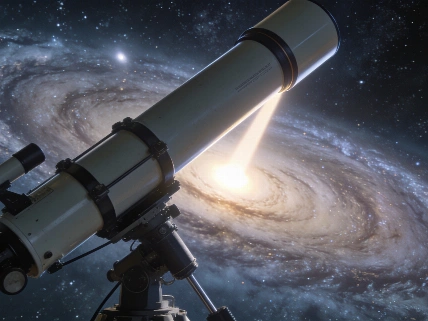
Astronomers use the parsec to measure vast cosmic distances, relying on precise observations of stellar parallax to determine how far away stars are from Earth. The unit is central to mapping the Milky Way and beyond
The parsec is a fundamental unit in astronomy, yet its meaning is often misunderstood outside the scientific community. While popular culture sometimes treats the parsec as a measure of time, especially in references to "Star Wars: Episode IV - A New Hope," astronomers have always used it as a unit of distance. The parsec is essential for translating observations of stellar positions into reliable measurements of how far away stars and other objects are from Earth.
Defining the Parsec
The term "parsec" combines "parallax" and "arcsecond," reflecting its origin in the method astronomers use to determine stellar distances. One parsec is defined as the distance at which an object would show a parallax shift of exactly one arcsecond when observed from opposite sides of Earth's orbit around the Sun. An arcsecond is 1/3,600 of a degree, a tiny angle that requires precise measurement. This definition links the parsec directly to the geometry of Earth's orbit and the apparent motion of stars against the background sky.
In practical terms, one parsec equals approximately 3.26 light-years, or about 30.9 trillion kilometers (19.2 trillion miles). This scale is necessary because even the nearest stars are so distant that their parallax angles are extremely small. For example, Proxima Centauri, the closest known star to the Sun, is about 1.3 parsecs away. The parsec allows astronomers to express these vast distances in a way that is directly tied to observable quantities.
Measuring Stellar Parallax
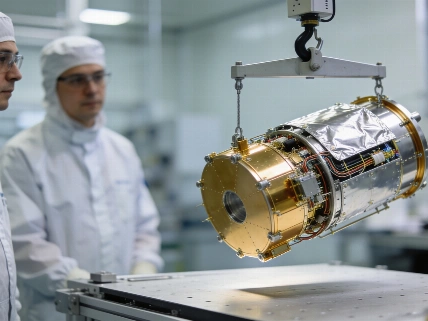
Stellar parallax is the apparent shift in a star's position caused by Earth's movement around the Sun. By observing a star at two points six months apart, astronomers can measure this tiny angular displacement. The smaller the parallax angle, the farther away the star is. Modern instruments, such as the European Space Agency's Gaia spacecraft, have dramatically improved the precision of parallax measurements, enabling distance estimates for more than a billion stars in the Milky Way.
Accurate parallax measurements are foundational for building the cosmic distance ladder, which underpins much of modern astrophysics. The method is most effective for relatively nearby stars, as parallax angles become too small to measure reliably for objects thousands of parsecs away. For more distant targets, astronomers rely on other techniques, such as standard candles and redshift measurements, but the parsec remains the standard unit for expressing astronomical distances.
Parsecs in Context
The parsec is not just a technical convenience; it is central to how astronomers map the structure of the galaxy and beyond. For example, the Milky Way's disk is about 30,000 parsecs in diameter, and the center of the galaxy lies roughly 8,000 parsecs from Earth. These measurements are critical for understanding the distribution of stars, the dynamics of galactic rotation, and the location of key features such as spiral arms and the galactic bulge.
Understanding the parsec also clarifies common misconceptions in popular media. The famous claim that the Millennium Falcon completed the Kessel Run in less than 12 parsecs is often cited as an error, since parsecs measure distance, not time. While later films attempted to reinterpret the line, the scientific definition remains unchanged. For those interested in how the Sun's environment shapes our view of the cosmos, research into the heliosphere's protective role, as discussed in recent studies of the solar system's boundary with interstellar space, also relies on precise distance measurements expressed in parsecs and astronomical units.
Limits and Uncertainties
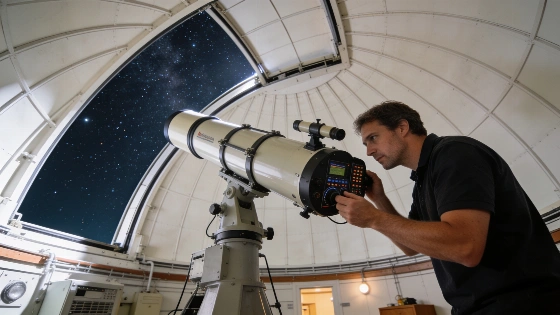
Despite advances in instrumentation, measuring parallax remains challenging. Atmospheric turbulence, instrumental noise, and calibration errors can all affect the accuracy of ground-based observations. Space-based missions like Gaia have reduced many of these uncertainties, but even so, the precision of parallax measurements decreases with distance. For stars beyond a few thousand parsecs, the parallax angle becomes so small that alternative methods must be used to estimate distance.
Uncertainties in distance measurements propagate through many areas of astrophysics, affecting estimates of stellar luminosity, mass, and age. As a result, astronomers continually refine their techniques and cross-check results using independent methods. The parsec remains a cornerstone of astronomical measurement, but its application always involves careful attention to observational limits and error analysis.
To understand why the parsec is so central to astronomy, it helps to grasp the concept of parallax itself. Parallax is the apparent shift in the position of an object when viewed from different locations. In astronomy, this effect is used to measure the distances to nearby stars by observing them from opposite sides of Earth's orbit. The angle of this shift, measured in arcseconds, is inversely proportional to the star's distance in parsecs. This geometric method provides a direct, model-independent way to establish the scale of the universe, forming the first rung of the cosmic distance ladder and enabling more complex measurements of galaxies, clusters, and the large-scale structure of the cosmos.