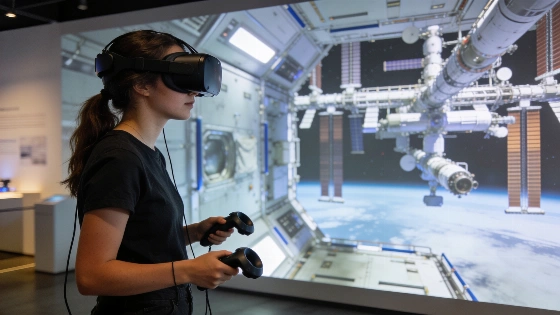
A new VR experience, Space Explorers: The ISS Experience, uses real footage and astronaut collaboration to simulate life aboard the International Space Station, offering the public an immersive look at orbital science and daily routines.
For most people, the International Space Station (ISS) remains a distant object, visible only as a moving point of light in the night sky or through images released by space agencies. Now, a virtual reality (VR) project called Space Explorers: The ISS Experience offers a detailed simulation of the station's interior and exterior, using real footage captured during multiple NASA expeditions. This immersive exhibit, currently available at Eclipsio in Manhattan, allows visitors to explore the ISS environment and observe daily life in orbit, bridging the gap between Earth and low-Earth orbit for the general public.
How the Simulation Was Created
The development of Space Explorers: The ISS Experience required extensive planning and technical adaptation. Over a period of nearly two years, the production team at Felix & Paul Studios worked with NASA to design and deliver specialized VR cameras capable of operating both inside the ISS and in the vacuum of space. Three cameras were ultimately sent to the station: two for interior recording and one engineered for external use, which was mounted on the Canadian robotic arm. This external camera could be remotely controlled from the ground, enabling high-quality cinematic sequences of the station's exterior and Earth below.
Filming took place across six NASA expeditions, with astronauts themselves participating in the recording process. To minimize disruption to ongoing scientific work, the production team provided detailed daily "shooting scripts" specifying camera positions and desired scenes. Astronauts adjusted these plans as needed to accommodate operational constraints, ensuring that the VR content reflected authentic station routines and environments. The result is a simulation that combines computer-generated navigation with real video segments, each linked to specific locations within the ISS.
Inside the Virtual ISS
Visitors to the exhibit wear VR headsets and interact with the digital environment using hand-tracking controllers. The simulation presents a life-size, navigable model of the ISS interior, rendered in translucent gray to approximate the station's true scale. As users move through the modules, they encounter floating orbs that trigger short video clips-each filmed on location aboard the ISS. These segments include scenes from the cupola, exercise sessions with astronauts such as Artemis II mission specialist Christina Koch, and views of spacewalks and robotic arm operations.
What distinguishes this VR experience from previous simulations is its reliance on actual footage rather than purely digital reconstructions. The lighting, spatial arrangement, and even the sense of exposure to the vacuum of space are informed by real conditions. While some technical limitations remain-such as occasional glitches in hand tracking-the overall effect is to place the viewer within the operational environment of the ISS, offering perspectives previously reserved for astronauts and mission controllers.
Astronaut Collaboration and Emotional Impact
The involvement of astronauts in both filming and planning was central to the project's authenticity. By positioning the VR cameras at human height and integrating them into daily routines, the production aimed to replicate the experience of being physically present on the station. According to the project's creators, astronauts responded positively to the simulation, describing it as a meaningful way to share their unique environment with family members and the public. The U.S. premiere of the exhibit was held in Houston, Texas, home to NASA's Johnson Space Center, and was attended by current and former astronauts who described the experience as a virtual return "home."
As the ISS approaches its planned deorbit in 2030, the VR project may serve as a digital time capsule, preserving the lived reality of orbital science for future generations. The simulation's creators suggest that advances in VR and artificial intelligence could eventually enable even more interactive and open-ended experiences, but emphasize that the ISS project's value lies in its documentation of a unique era of international cooperation in space.
Preserving the ISS Legacy
The International Space Station, a product of collaboration among multiple space agencies, has hosted continuous human presence in orbit since 2000. Its modules, solar arrays, and scientific facilities represent decades of engineering and diplomacy. As the station nears the end of its operational life, efforts to document its environment and culture have taken on new urgency. Projects like Space Explorers: The ISS Experience offer a way to maintain public engagement with orbital science even after the station itself is retired.
For those interested in the daily realities of ISS missions, the VR simulation complements ongoing coverage of crew activities and scientific research. For example, recent missions have included experiments on cancer therapies, semiconductor materials, and robotics, as highlighted in a report on astronaut Chris Williams' return from the ISS. The VR project adds a new dimension to public understanding by making the station's environment accessible in a direct, experiential way.
Virtual reality simulations of space environments rely on a combination of real footage, computer-generated models, and interactive controls. In the case of Space Explorers: The ISS Experience, the use of VR cameras aboard the ISS allowed for the capture of immersive, 360-degree video segments that can be integrated into a navigable digital environment. This approach differs from traditional video or photography by enabling users to control their viewpoint and movement, creating a sense of presence within the simulated space. The fidelity of the experience depends on both the quality of the original footage and the accuracy of the digital reconstruction, as well as the responsiveness of the VR hardware. As technology advances, such simulations may become increasingly realistic, but their scientific value will continue to depend on the authenticity and transparency of the underlying data.