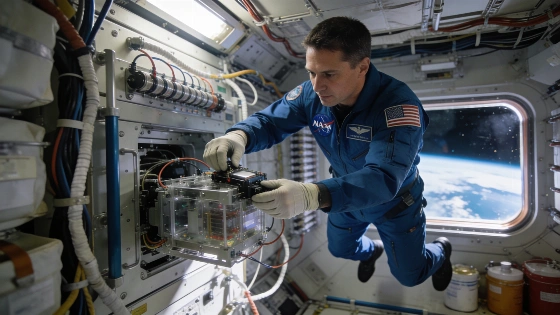
Chris Williams is set to return from his first mission aboard the International Space Station, where he supported experiments on cancer therapies, semiconductor materials, and robotic systems during an eight-month stay
NASA astronaut Chris Williams is preparing to conclude his first mission aboard the International Space Station (ISS) after spending eight months in orbit. During his time on the station, Williams participated in a range of experiments designed to advance biomedical research, materials science, and the operational capabilities of future space missions. His work forms part of ongoing efforts to use the ISS as a platform for scientific investigation that cannot be replicated on Earth.
Biomedical and Materials Research
One of the central scientific objectives of Williams' mission was to support research into new cancer therapies. By processing DNA-inspired materials in microgravity, researchers observed that these rod-shaped constructs formed with greater uniformity than on Earth, potentially improving their effectiveness for targeted drug delivery. The ISS environment also enabled the growth of high-quality protein crystals, which are essential for developing pharmaceuticals that may be administered orally and could improve treatment outcomes for cancer and other diseases.
Williams contributed to semiconductor research by assisting with the growth of composite crystals in the station's microgravity conditions. These crystals, which are difficult to produce with the same consistency on Earth, may enhance the performance of future computers, artificial intelligence systems, and medical devices. The experiments lay groundwork for commercial semiconductor manufacturing in space, though practical applications remain subject to further validation and scaling.
Operational Experiments and Spacewalks
In addition to laboratory work, Williams participated in two extravehicular activities (EVAs), or spacewalks, to maintain and upgrade the ISS. In March, he helped prepare the station for the installation of new solar arrays, which are expected to increase the station's power generation capacity by approximately 30% once fully deployed. In June, Williams assisted with repairs to Canadarm2, the station's robotic arm used for cargo capture and external research deployment.
Williams also worked with robotic systems inside the station, testing the performance of small robotic arms under microgravity. These experiments are intended to inform the design of future automated systems that could handle delicate tasks, freeing astronauts to focus on mission-critical operations. The mission included routine collection and storage of biological samples at ultra-cold temperatures, supporting long-term studies of how spaceflight affects human physiology.
Earth Observation and Cargo Operations
Throughout his mission, Williams contributed to Earth observation campaigns by capturing images of atmospheric phenomena such as auroras and monitoring changes in terrestrial landscapes. These observations support ongoing efforts to track environmental changes and natural disasters from orbit, complementing data from dedicated Earth-observing satellites.
Williams and fellow astronaut Jack Hathaway played key roles in the capture and unloading of Northrop Grumman's Cygnus XL cargo spacecraft, which delivered approximately 5,000 kilograms of supplies, including scientific equipment and fresh food. Cargo missions are essential for sustaining ISS operations and enabling the diverse range of experiments conducted in orbit.
Microbial Control and International Collaboration
Another focus of the mission was the study of microbial biofilms, which can form on surfaces and pose risks to both equipment and crew health. Williams supported experiments testing ultraviolet light as a method to inhibit biofilm formation, potentially reducing the need for chemical disinfectants and improving long-term habitability for future missions.
Williams' work was conducted alongside international partners, including the European Space Agency, reflecting the collaborative nature of ISS science. The mission's results add to a growing body of research on how microgravity affects biological, chemical, and physical processes, and complement recent advances in remote sensing, such as the detailed Antarctic ice fracture mapping reported in recent NISAR satellite data releases.
Understanding the impact of microgravity on materials and biological systems is central to the ISS's scientific agenda. Microgravity alters the way fluids behave, how crystals grow, and how living organisms respond to their environment. These differences allow researchers to isolate variables that are difficult to control on Earth, leading to insights that can inform both space exploration and terrestrial applications. However, translating these findings into practical technologies or therapies requires further ground-based validation and, in many cases, additional missions to confirm reproducibility and safety.