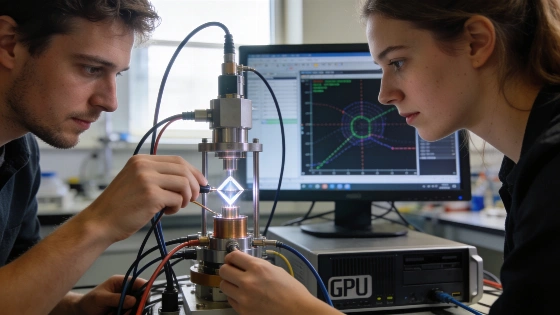
A team led by MITRE has developed a GPU-accelerated simulation tool that pinpoints how different physical mechanisms limit sensitivity, accuracy, and robustness in quantum sensors.
Maximizing a quantum sensor's sensitivity doesn't always lead to more accurate or stable measurements. A new GPU-accelerated digital twin framework, developed by MITRE in collaboration with Quantum Brilliance, NVIDIA, and SandboxAQ, makes this tradeoff clear by mapping how different error sources become bottlenecks depending on the performance metric. The project uses recent advances in open-source quantum computing platforms, including NVIDIA's CUDA-Q, which added support for fault-tolerant quantum computing in September 2026 and cited MITRE's work on GPU-accelerated digital twins for quantum sensors.
The team's open-system simulation framework, described in a preprint on arXiv (arXiv:2608.28519), automates detailed error budgeting for quantum sensors. With a single run of the Tangent Master Equation (TME), the method evaluates three main performance measures: sensitivity (ηB), systematic accuracy bias (β), and robustness to parameter drift (Rlin). The simulations run on NVIDIA GPUs using the cuQuantum cuDensityMat backend, allowing efficient modeling of complex open quantum system dynamics. By applying Shapley value allocations from cooperative game theory, the framework quantifies how different physical error sources combine and interact in the sensor. This approach reflects a broader move in quantum technology research to use advanced simulation and error analysis for developing next-generation quantum devices.
When applied to nitrogen-vacancy (NV) diamond ensemble magnetometers, the simulation shows that the main error source depends on the metric. For sensitivity, T₂* spin dephasing makes up about 89% of the error budget. If systematic accuracy is the focus, ground-state thermal zero-field splitting shifts (ΔDgs(T)) become the main limitation, with a bias between 8 and 1500 nanotesla at a temperature drift of 0.1 kelvin. For robustness against parameter drift, acousto-optic modulator leakage (ε) dominates, accounting for 96% of the error. These results highlight that optimizing for one metric can leave other important aspects-like accuracy or drift resistance-unaddressed. The methodology follows best practices in quantitative error analysis, as seen in journals like Nature.
The framework was also tested on a 26-channel scalar cesium optically pumped magnetometer (OPM) array from SandboxAQ, used for magnetocardiography (MCG) in unshielded settings. In this case, the digital twin showed that clinical arrhythmia localization at the millimeter scale is not limited by atomic spin-projection noise (~1.1 fT/√Hz), but by the system's ability to reject ambient noise. Software common-mode rejection (CMR) reduced noise to about 4.4 pT/√Hz, meeting the 5 mm localization target for surgical ablation. This cross-platform evidence supports the idea that error attribution must be tailored to the specific sensing context. The approach is similar to validation strategies used by NASA and the Max Planck Society in their quantum sensing and metrology programs.
Unlike earlier methods that focused on a single error metric or device type, this framework offers a unified way to attribute error sources across different quantum sensor platforms. The results echo themes from previous work on quantum resource estimation, but here the focus is on practical sensing performance rather than cryptography. However, these results are based on simulation and digital twin validation, not direct hardware tests. The framework's usefulness for experimental optimization will depend on how closely the modeled error mechanisms match real device behavior. Peer review and independent replication will be important to confirm the method's reliability for engineering future quantum sensors.
Quantum sensors are extremely sensitive to external fields, but this also makes them vulnerable to noise, drift, and systematic error. In open quantum systems, decoherence and environmental coupling reduce performance, while device-specific imperfections introduce bias and instability. Accurate error attribution means not only identifying the main noise source for a given metric, but also understanding how different mechanisms interact as the sensor is tuned for sensitivity, accuracy, or robustness. Engineering a useful quantum sensor requires balancing these competing error sources under real-world conditions, rather than maximizing a single figure of merit.