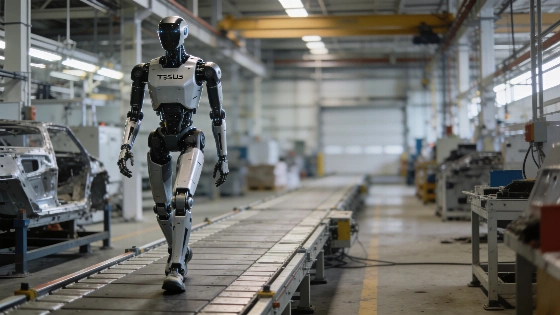
Tesla says its Fremont lines have begun producing Optimus to production standards, but the 20,000-a-week ambition depends on a slow ramp and further work on reliability and software, alongside battery supply
Tesla reported third-quarter 2026 revenue of $28.04 billion, compared with $28.09 billion a year earlier. Quarterly profit fell 43%, to $787 million from $1.37 billion. The company announced the start of Optimus production on October 21, the same day it released its results, as it invests in robotics and computing while its automotive business faces pressure.
Tesla has begun building Optimus humanoid robots on high-volume production lines in Fremont, California. The factory space previously used to make electric vehicles has been repurposed for robotics. In its third-quarter shareholder update, Tesla said the robots coming off the line were its first Optimus units made to production standards and described the current manufacturing process as suitable for a commercial product. The company also said it would continue to refine both the robot's hardware and its manufacturing methods. TeslaNorth's report details the announcement.
CEO Elon Musk described the operation as early production and said the ramp would be slow and uneven because Optimus is a radically new product. Tesla has not disclosed a current production rate. The production-standard milestone concerns manufacturing; it does not by itself establish how consistently the robot can perform workplace tasks. Tesla's update presents the production process as commercially suitable while development of the hardware and assembly process continues.
Tesla is targeting a production rate of 20,000 robots per week, equivalent to roughly one million a year. Musk said on the third-quarter earnings call that reaching that weekly rate would take at least a year, possibly longer. Tesla has also described a long-term plan to scale Fremont production to one million Optimus robots annually. Those figures are future targets, not reported current output.
Musk said the production ramp would depend on many interrelated operations and components working together, identifying battery availability and manufacturing efficiency among the challenges. He characterized the process as one in which production would move at the pace of its least-ready constraint. Tesla is continuing to refine the robot and its production process as it works toward higher output.
Reliability is also central to practical deployment. Tesla wants Optimus to operate safely for extended periods without frequent repairs or component failures, while Musk has acknowledged that the design still needs work. The company has not published a measured failure rate or operating duration, and the update does not report task-specific evaluation results. The manufacturing milestone therefore does not establish how consistently the robot handles work in a real workplace.
Software is another area of continuing development. Tesla says it must build capabilities that allow Optimus to handle unfamiliar tasks reliably, and Musk indicated that considerable work remains before the robot can perform a broad range of activities independently. The material presented alongside the production announcement does not give task-by-task results, rates of human intervention or a current autonomy measure. Production-line output and task performance are distinct measures: a robot must also sense changing surroundings and act safely without assistance.
Musk said Tesla expected deliveries to companies outside Tesla around the end of 2027. That is a forecast, rather than an announced contract or guaranteed delivery schedule. The company has not announced a price or named external customers for Optimus.
Other companies are also testing humanoid machines in industrial settings. Earlier coverage of factory humanoid trials described joint development and testing for logistics, a different stage from routine autonomous deployment. Tesla's production announcement marks the start of early manufacturing, while its target for outside deliveries remains a future projection.
The robotics effort is tied to a broader computing buildout. Tesla plans to reach 400 megawatts of training-computing capacity by the end of 2026 to support software development for its vehicles and Optimus. Construction of the company's Austin fabrication facility is continuing, with equipment commissioning expected to begin in 2027. These are company plans and timelines, not reported evidence that the infrastructure has already changed Optimus's capabilities.
Battery supply is relevant across Tesla's manufacturing ambitions. The company is expanding battery-pack capacity in Berlin. In Texas, projects include cathode-material production and lithium refining; Nevada is the site of planned lithium iron phosphate cell manufacturing. Tesla has also shipped its first Megapack energy-storage systems built exclusively with its own LFP cells. Production of its 4680 cells is increasing, with those cells intended to support the Cybertruck and Tesla Semi ramps as well as higher Model Y volumes.
A production target measures intended factory output; it does not measure task success, reliability or independence. For a humanoid system, those capabilities are assessed through defined tasks and operating conditions, including how often people need to intervene. Tesla's third-quarter update reported the manufacturing start and the company's future production ambitions as its hardware and manufacturing process continue to evolve.