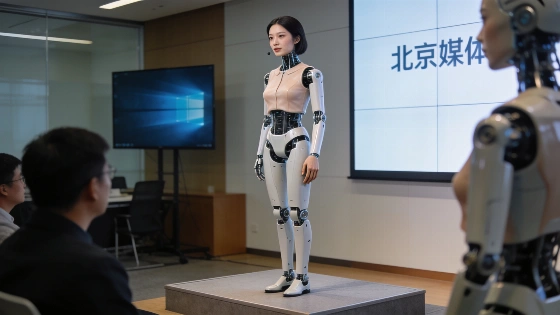
The life-sized robots read news at a Beijing forum, while Xinhua says they will assist staff under human editorial control. Their public appearance showed presentation capability rather than newsroom independence
At the seventh World Media Summit in Beijing, the female humanoid robot Xinyan greeted attendees before reading an opening news bulletin from a raised platform. Xinhua unveiled Xinyan and her male counterpart, Xinyu, on November 5-6, 2026, during the summit's Artificial Intelligence and Chinese-Style Modernization Forum. The event ran from November 5 to 9. Xinhua presented the pair as the world's first bionic humanoid robot news anchors. The demonstration showed the robots presenting news in public; it did not show them independently reporting or authoring it.
Xinhua says the two life-sized machines will support staff by presenting information in multiple languages and interacting with audiences in real time. Journalists and editors will retain editorial responsibility, Qian Tong, director of Xinhua's New Media Center, said. The agency described the robots as assistants rather than independent news authors.
Xinhua and UBTECH Robotics jointly developed the anchors. UBTECH supplied manufacturing and technologies including biomimetic skin, operating-system components, an emotion-oriented large language model and embodied-intelligence hardware. Xinhua says it fully owns the anchors' intellectual property. Its Xinhua Yudian AI current-affairs platform provides material for the robots. Xinhua said the arrangement makes content "traceable, secure and controllable."
UBTECH chairman Zhou Jian described the system as an integrated "brain-expression-control" framework, connecting information processing with expressive behavior and physical control. The company says it retrieves vetted news in real time. The robots are intended for news-dissemination settings, including on-site presentation and audience interaction.
Film director Zhang Yimou served as chief image designer, shaping the robots' visual identity. Their human-like appearance is a design choice, not evidence of human-like judgment. A separate report on Figure's factory claims examined production footage rather than newsroom use.
Xinhua's project follows its 2018 introduction of synthetic news presenters based on human anchors. Those screen-based figures used synthesized voices and digitally composited or animated appearances. The 2026 pair brings news presentation into a physical setting: Xinyan appeared onstage, greeted the audience and read the opening bulletin, while Xinyu completed the two-robot lineup. Xinhua and UBTECH describe the machines as tools to assist reporting and editing staff, including in presenting news in different languages.