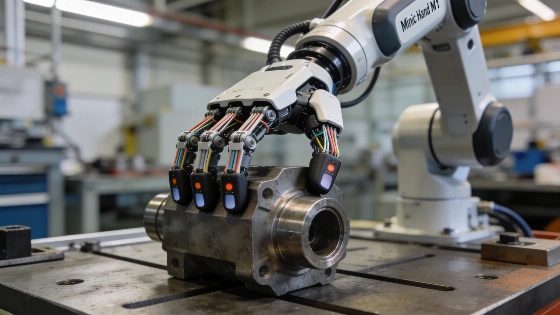
Mimic Robotics has introduced the Mimic Hand M1, a tendon-driven robotic hand designed for industrial automation, featuring advanced tactile sensing and a human-like joint structure to improve manipulation of diverse objects in real-world settings
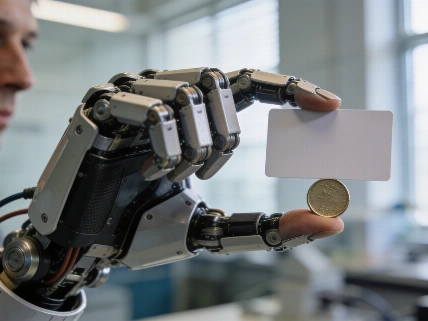
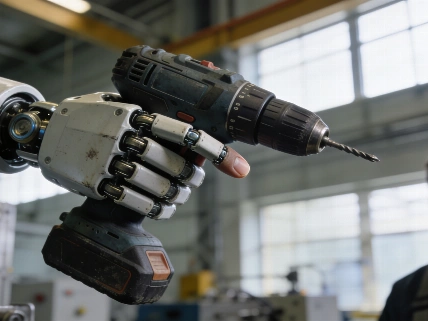
Swiss company Mimic Robotics has announced the Mimic Hand M1, a robotic hand engineered to replicate key aspects of human dexterity for industrial automation. The M1 is built around a tendon-driven mechanism, with actuators positioned in the forearm rather than the palm or fingers. This design choice allows the hand to remain compact while supporting higher payloads and accommodating larger, industrial-grade actuators. According to the company, the M1 is intended to address the persistent challenge of general-purpose manipulation in robotics, where conventional two-finger grippers often struggle to handle the variety and complexity of real-world factory tasks.
The Mimic Hand M1 features 15 active degrees of freedom distributed across 21 joints, including finger abduction and an opposable thumb. The joint configuration was selected based on analysis of industrial task requirements, aiming to balance functional versatility with mechanical reliability. The hand's fingertips are equipped with tactile sensors capable of detecting both normal and tangential forces, as well as the precise location of contact. This sensory feedback is designed to enable the hand to manipulate both fragile and heavy objects, adjust grip in real time, and interact safely with unfamiliar items-capabilities that are difficult to achieve with vision systems alone.
Technical Capabilities
Weighing approximately 1.8 kilograms, the Mimic Hand M1 is reported to maintain a stable cylindrical grip on objects exceeding 25 kilograms. Its tendon-driven joints are highly backdrivable, allowing the system to detect forces as small as 0.1 newtons through motor current measurements. The combination of low-friction actuation, dual joint encoders, and minimal mechanical backlash is intended to support precise motion control and continuous force feedback during manipulation. The company states that these features collectively enable the M1 to perform both delicate assembly tasks and robust industrial handling.
Unlike many robotic hands that integrate motors directly into the hand structure, the M1 routes tendons over bearings and pulleys, reducing friction and wear compared to guide-tube-based designs. This approach is inspired by human anatomy and is intended to improve long-term durability and sensing accuracy. The system is positioned as a platform for what Mimic Robotics calls "Physical AI," where the same hand morphology is used throughout data collection, AI training, and deployment, aiming to reduce the gap between human demonstration and robotic execution.
Integration and Platform Approach
The Mimic Hand M1 is part of a broader robotics platform that includes the U1 wearable exoskeleton for capturing human demonstration data and proprietary software for real-time robot control. By maintaining consistent hand morphology across demonstration, training, and deployment, the company aims to improve the transfer of manipulation skills from humans to robots. This approach is intended to address the "cross-embodiment gap" that often limits the effectiveness of imitation learning in robotics.
Recent developments in the field, such as the introduction of 25-degree-of-freedom tendon-driven hands for the NEO robot by Norwegian firm 1X, reflect a broader trend toward more dexterous and sensor-rich robotic manipulators. These advances are intended to support safer, more reliable, and more versatile automation in industrial environments. For context, efforts to benchmark and evaluate general-purpose robot policies, such as those described in Science Report's coverage of NVIDIA's RoboLab simulation platform, highlight the ongoing challenge of translating laboratory advances into robust real-world performance.
Limitations and Open Questions
While the Mimic Hand M1's technical specifications suggest significant progress in robotic manipulation, independent evaluation of its performance in diverse factory settings has not yet been published. The company's claims are based on internal testing and engineering demonstrations, and it remains to be seen how the system will perform under the full range of conditions encountered in industrial deployment. Key questions include the reliability of tactile sensing over extended use, the robustness of the tendon-driven architecture under high-duty cycles, and the effectiveness of AI-based manipulation policies when transferred from demonstration to production environments.
As with other advanced robotic hands, the M1's integration into existing automation workflows will depend on compatibility with industrial safety standards, ease of programming, and the ability to recover from unexpected failures. The broader impact of such systems will also be shaped by regulatory requirements, workforce adaptation, and the evolving standards for human-robot collaboration in manufacturing.
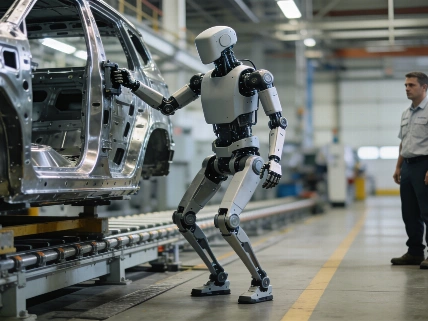
Robotic manipulation in unstructured environments remains a central challenge for industrial automation. While advances in hardware, sensing, and AI-based control have enabled significant progress, the gap between laboratory demonstrations and reliable factory deployment persists. The Mimic Hand M1 represents an effort to bridge this gap by combining human-inspired mechanics with sensor-rich feedback and a platform approach to skill transfer. However, the ultimate test will be sustained, independently verified performance in real-world industrial settings.
Understanding the concept of the "cross-embodiment gap" is essential for interpreting developments in robotic manipulation. This term refers to the difficulty of transferring skills learned from human demonstrations to robots with different physical structures or sensing capabilities. Even when AI models are trained on high-quality demonstration data, differences in robot morphology, actuation, or sensor placement can lead to failures or degraded performance during deployment. Addressing this gap requires careful alignment of hardware, software, and training protocols, as well as ongoing evaluation in the target environment.