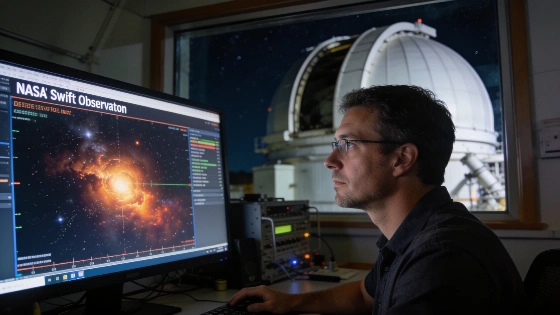
NASA's Swift Observatory has observed a rare tidal disruption event caused by a supermassive black hole devouring a star on the outskirts of a distant galaxy, challenging assumptions about where such events occur
Astronomers using NASA's Neil Gehrels Swift Observatory have identified a supermassive black hole consuming a star far from the center of its host galaxy, marking one of the most distant off-nuclear tidal disruption events (TDEs) yet confirmed. The detection, supported by multi-instrument follow-up, provides new evidence that massive black holes can exist and remain active well outside galactic cores, raising questions about their origins and the frequency of such wandering objects.
Unusual Flare on a Galactic Fringe
The event was first flagged in November 2025 by the Zwicky Transient Facility (ZTF), which monitors the sky for sudden changes in brightness. Among hundreds of thousands of nightly detections, an artificial intelligence algorithm identified an unusually bright ultraviolet flare in the outskirts of a galaxy approximately 750 million light-years away. The flare's intensity and spectral features suggested a star was being torn apart by a black hole's tidal forces-a process known as a tidal disruption event.
Subsequent observations with ground-based telescopes, including the SOAR telescope in Chile, confirmed the spectral signatures consistent with a TDE. NASA's Swift Observatory, equipped with ultraviolet and X-ray instruments, measured the flare's temperature at about 30,000 degrees Celsius (54,000 degrees Fahrenheit). For several months, the event outshone its entire host galaxy in ultraviolet light, radiating with the energy of roughly 10 billion Suns.
Evidence for a Wandering Black Hole
Most known supermassive black holes reside at the centers of galaxies, where they are thought to anchor galactic structure. Tidal disruption events are rare, typically occurring once every 100,000 years per galaxy, and have almost always been observed in galactic nuclei. The newly detected event, however, occurred more than 30,000 light-years from its galaxy's core, suggesting the presence of a massive black hole far from the central region.
The black hole responsible for the flare is estimated to have a mass around one million times that of the Sun. Its off-center location challenges conventional models of black hole formation and migration. Researchers propose that such a black hole may have originated in a smaller galaxy that merged with the current host, or it could have been ejected to the outskirts during a multi-galaxy merger. The possibility of multiple supermassive black holes coexisting in a single galaxy, with some displaced from the core, is now under active investigation.
Multi-Instrument Follow-Up and Future Prospects
The confirmation of this off-nuclear TDE relied on coordinated observations across several observatories. Swift's ultraviolet and X-ray data were crucial for ruling out alternative explanations, such as supernovae or active galactic nuclei. The event's temperature, luminosity, and spectral evolution matched theoretical predictions for a star being disrupted by a massive black hole.
Routine science operations with Swift's ultraviolet and X-ray instruments are currently paused as the spacecraft prepares for an orbit-raising maneuver, which is expected to extend its operational lifetime. Once normal observations resume, Swift will continue to search for similar off-center events. Meanwhile, upcoming facilities like the Vera C. Rubin Observatory and NASA's Nancy Grace Roman Space Telescope are expected to expand the search for TDEs, potentially revealing a larger population of wandering black holes.
Implications for Black Hole Demographics
The discovery of a supermassive black hole consuming a star far from its galaxy's center adds to a growing body of evidence that such objects may be more common than previously thought. In 2024, astronomers reported a similar event 2,600 light-years from a galactic core, prompting renewed interest in off-nuclear black holes. The ability to detect and confirm these events depends on wide-field surveys, rapid data analysis, and multi-wavelength follow-up.
For context, the study of galactic structure and black hole dynamics has also benefited from observations of galaxies shaped by gravitational interactions, such as those captured by the Hubble Space Telescope. For example, a recent Hubble image of an asymmetric spiral galaxy highlighted the impact of cluster forces on galactic evolution, illustrating the complex environments in which black holes may migrate.
As more off-nuclear TDEs are identified, astronomers hope to build a more complete census of supermassive black holes, including those that have been displaced by mergers or gravitational interactions. These findings will inform models of galaxy assembly and the long-term fate of massive black holes in the universe.
Tidal disruption events occur when a star passes close enough to a black hole that gravitational forces tear it apart. The resulting debris forms an accretion disk, heating up and emitting intense radiation across multiple wavelengths. The flare's brightness and spectral evolution provide clues about the black hole's mass, spin, and environment. Detecting TDEs outside galactic centers requires sensitive, wide-field surveys and rapid follow-up, as these events are both rare and short-lived. Understanding the mechanisms that displace black holes from galactic cores remains a key challenge in astrophysics.