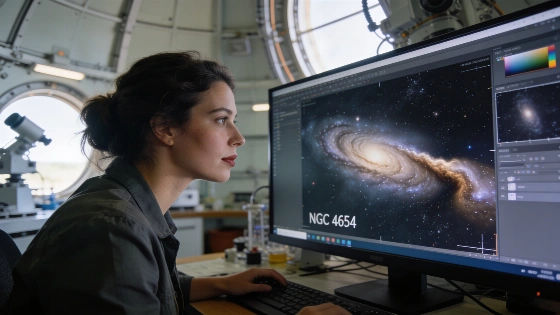
A new Hubble Space Telescope image captures NGC 4654, a spiral galaxy in Virgo, showing dramatic asymmetry caused by ram pressure stripping and past gravitational encounters
NGC 4654, a spiral galaxy located about 72 million light-years away in the Virgo Cluster, has been imaged by the Hubble Space Telescope in striking detail. The galaxy's unusual, lopsided structure offers a rare opportunity to study how interactions within dense galaxy clusters can reshape galactic disks and influence star formation. The latest Hubble observations highlight both the physical processes at work and the limits of current understanding.
Asymmetry in the Virgo Cluster
Unlike the classic two-armed spiral, NGC 4654 displays a pronounced spiral arm on one side and a long, trailing extension of gas on the other. This asymmetry is not just a visual oddity-it reflects the galaxy's ongoing interaction with its environment. NGC 4654 is classified as an intermediate spiral, with a weak central bar and a disk that is neither fully barred nor unbarred. Its location within the populous Virgo Cluster exposes it to forces rarely experienced by isolated galaxies.
The most prominent feature is a sharply defined leading edge, contrasted by a diffuse tail of gas extending beyond the field of view. This tail is a signature of ram pressure stripping, a process that occurs when a galaxy moves rapidly through the hot, thin gas that fills the space between cluster members. As NGC 4654 plows through this intracluster medium, the pressure compresses its leading edge and strips gas from the trailing side, leaving behind a wake of material.
Star Formation and Gas Loss
Hubble's imaging reveals that the galaxy's stars are also distributed unevenly. The spiral arm facing into the cluster is rich in both stars and gas, while the opposite side is depleted, lacking a matching arm. This lopsidedness is unusual for spiral galaxies, where symmetry is more common. The evidence suggests that ram pressure alone cannot account for the full extent of the asymmetry.
Researchers propose that a past gravitational encounter with another Virgo Cluster galaxy, NGC 4639, played a significant role. Although the two galaxies are now separated by a considerable distance, models indicate that a close flyby roughly 500 million years ago could have stripped gas from one side of NGC 4654, suppressing star formation and amplifying the asymmetry. This scenario is consistent with the observed distribution of stars and gas.
Hubble Observations and Ongoing Activity
The Hubble Space Telescope collected the latest data on NGC 4654 as part of two observing programs designed to link gas dynamics with star formation in nearby galaxies. The observations include imaging in a red wavelength sensitive to hydrogen emission, which highlights regions of active star formation. Across the galaxy, bright pink bubbles mark sites where new stars are forming, particularly along the leading spiral arm and around the weak central bar.
Despite the loss of gas from ram pressure stripping, NGC 4654 continues to form stars at a rate of nearly two solar masses per year-comparable to other galaxies of similar size. This ongoing activity demonstrates that even in the face of environmental disruption, spiral galaxies can sustain significant star formation. The Hubble data provide a detailed map of where gas remains dense enough to collapse into new stars, and where it has been removed or depleted.
Cluster Environments and Galaxy Evolution
NGC 4654's case illustrates how cluster environments can drive galaxy evolution through both gradual and violent processes. Ram pressure stripping is a well-established mechanism for removing gas from galaxies, often leading to reduced star formation and eventual transformation into gas-poor systems. However, the combination of ram pressure and gravitational encounters can produce more complex outcomes, including the pronounced asymmetry seen here.
Comparisons with other cluster galaxies, as well as with isolated spirals, help astronomers test models of galaxy evolution. The detailed structure of NGC 4654, as revealed by Hubble, provides a benchmark for understanding how external forces shape galaxies over hundreds of millions of years. For context, the impact of imaging on planetary science was highlighted when NASA's Viking 1 lander transmitted the first direct surface image from Mars, marking a milestone in robotic exploration (see this report).
Understanding the interplay between gas dynamics, star formation, and gravitational interactions remains a central challenge in extragalactic astronomy. NGC 4654's ongoing transformation offers a window into the processes that govern the life cycles of galaxies in dense cosmic environments.
Ram pressure stripping occurs when a galaxy moves through the hot, diffuse gas that permeates galaxy clusters. The pressure exerted by this intracluster medium can remove gas from the galaxy's disk, especially from the trailing side, while compressing the leading edge. This process is most effective in clusters where galaxies move at high velocities relative to the surrounding gas. The removal of cold gas limits the material available for new star formation, gradually altering the galaxy's structure and stellar population. Observations of galaxies like NGC 4654 help astronomers quantify the impact of ram pressure and distinguish it from other mechanisms, such as tidal interactions, that also shape galactic evolution.