Rigetti Computing has used a superconducting quantum processor to run an optimization algorithm that packs more classical variables into each qubit, letting the hardware tackle larger problems with fewer resources. The team benchmarked the approach against standard methods.
Rigetti Computing has shown that a quantum optimization algorithm can encode more classical variables per physical qubit than usual, directly addressing a key challenge in scaling quantum hardware for real-world use. Instead of mapping each problem variable to its own qubit, the new method compresses information, so a nine-qubit superconducting processor can handle optimization problems that would otherwise need much more hardware. This work builds on earlier research in quantum information theory from groups like MIT and the Max Planck Society.
Algorithmic compression
The main idea is a variational algorithm that groups classical variables and stores their configurations as entangled quantum states in a smaller Hilbert space. This introduces a tradeoff: using fewer physical qubits means the circuit must be deeper, and vice versa. The team tested the algorithm on the Sherrington-Kirkpatrick spin-glass model, a standard benchmark for hard classical optimization, and found that it could reach solution quality close to the widely used Quantum Approximate Optimization Algorithm (QAOA), even with fewer qubits.
Unlike QAOA, which needs a physical qubit for every problem variable, Rigetti's method splits N variables into K groups of D bits, encoding the problem as a superposition across these groups. This lets the processor represent a larger problem space with a fixed number of qubits, but requires deeper circuits and is more sensitive to noise and decoherence. The approach is similar to recent work reported in Nature on resource-efficient encoding for near-term quantum devices.
Experimental validation
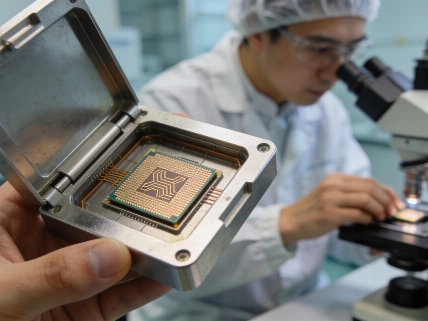
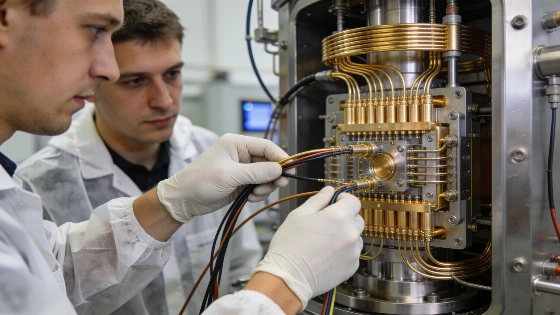
The experiment ran on a nine-qubit superconducting quantum processor built by Rigetti. The team checked the algorithm's performance by running it on hardware and comparing the results to classical simulations and standard QAOA. The processor operated at cryogenic temperatures, and the experiment focused on parameter concentration-a phenomenon where optimal circuit parameters can be reused across related problem instances, reducing the classical optimization work needed for each new problem.
The results showed that the qubit-efficient algorithm could approach the solution quality of standard 1:1 QAOA mapping, even as the number of physical qubits was reduced. However, the deeper circuits needed for compressed encoding introduce more errors, including gate infidelity and decoherence, which remain major challenges for current devices. Rigetti's superconducting systems achieve two-qubit gate speeds of 50-70 nanoseconds, which the company says is about 10,000 times faster than trapped-ion systems and 100 times faster than neutral-atom systems, according to their investor communications.
Resource constraints and benchmarks
The demonstration used resources from DARPA and the U.S. Department of Energy's NERSC facility, reflecting growing interest in algorithms that can push the limits of current and early fault-tolerant quantum hardware. The experiment used a nine-qubit superconducting processor, with the algorithm mapping N classical variables into fewer than N physical qubits. The team benchmarked performance on Sherrington-Kirkpatrick spin-glass instances and found that solution quality stayed competitive with standard QAOA, even with fewer qubits. Parameter concentration was observed, allowing reuse of optimized parameters across related problems and reducing classical runtime overhead.
While these results are promising for scaling quantum optimization on hardware with limited qubit counts, the approach does not remove the need for high-fidelity gates and long coherence times. The deeper circuits required by compressed encoding make the system more sensitive to noise, and the method's practical value will depend on continued improvements in device performance and error mitigation. Ongoing research at CERN and other labs highlights the importance of these engineering advances.
Comparisons and remaining challenges
Rigetti's experiment offers a concrete way to extend the reach of superconducting quantum processors in the noisy intermediate-scale quantum (NISQ) era. By compressing variable encoding, the algorithm lets larger optimization problems run on existing hardware, but the tradeoff between qubit count and circuit depth remains. As with other NISQ-era proposals, the method's effectiveness is limited by hardware noise, calibration drift, and the overhead of repeated measurements.
Other groups have also worked on estimating quantum resource requirements for practical tasks, including recent modeling of quantum attacks on cryptographic systems. The field is still working to show clear, reproducible quantum advantage for useful problems, and every new algorithm must be tested against real device limits and fair classical baselines.
Rigetti's qubit-efficient optimization algorithm is a step toward more resource-aware quantum computing, but it does not solve the core engineering barriers that separate lab demonstrations from practical, scalable quantum systems. The results show that clever encoding can stretch current hardware further, but the path to fault-tolerant, large-scale quantum optimization still depends on steady progress in device physics, error correction, and reproducibility. For now, the main outcome is a better understanding of how algorithmic and hardware constraints interact-and a reminder that every claimed advance must be measured against the realities of noise, calibration, and fair benchmarking.
Physical qubits are the individual quantum systems-such as superconducting circuits or trapped ions-that can be directly controlled and measured in a quantum processor. Logical qubits, by contrast, are encoded across multiple physical qubits using error-correcting codes to protect information from noise and decoherence. In current devices, the number of available physical qubits limits the size of problems that can be mapped directly onto hardware. Algorithms that compress more information into fewer qubits can extend the reach of near-term processors, but only if the increased circuit depth and error rates do not outweigh the benefits. The distinction between physical and logical qubits is central to understanding both the promise and the limits of today's quantum computing experiments. In September 2026, Rigetti announced a CHIPS Act agreement with the U.S. Department of Commerce, securing up to $100 million in federal funding to speed up R&D in superconducting quantum technologies, including cryostat architectures, readout electronics, and highly connected chip designs, as reported by the National Institute of Standards and Technology (NIST).