Archaeologists have recovered a carefully worked sandstone prism at the Ollape site in Peru's Amazonas region. The object's resemblance to Andean dice raises new questions about games, ritual, and social practice among the Chachapoya.
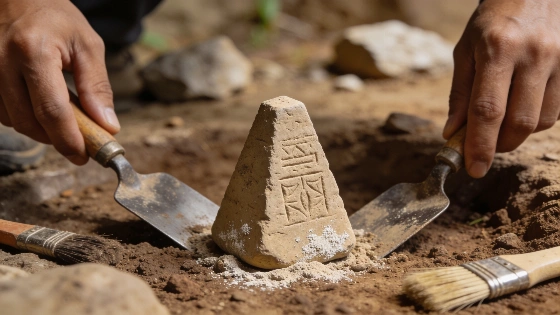
A small sandstone prism, recently uncovered at the Ollape archaeological site in northern Peru, is prompting archaeologists to rethink what can be known about the daily life of the Chachapoya-an Andean group often called the "Warriors of the Clouds." The object's shape and carved lines are similar to ancient Andean dice, known as pishca or pichca, but its actual use is still unclear. The find was confirmed by the Peruvian news agency Andina on September 15, 2026, and updated the next day, drawing attention from researchers.
Context at Ollape
Ollape sits in the upper Utcubamba River basin, in the district of La Jalca. Archaeological evidence places the Chachapoya here between about 800 and 1500 CE, before the Inca arrived, as supported by independent Spanish-language reports. The site includes more than 200 round buildings, one of which features two carved stone heads built into its walls-a detail shown in Andina's official photos from September 15, 2026. The prism was found in Excavation Unit 05, outside a structure where straight-edged stones, possibly cornices, had been stacked without mortar. This suggests the stones were moved and reused after their original purpose.
The excavation was led by researchers from the Kuélap Institute of Archaeology and Anthropology Research (INAAK) at the National University Toribio Rodríguez de Mendoza in Amazonas. The artifact was not found in a spot where it was clearly used, but among stones that may have been gathered and redeposited. This makes it difficult to say whether the object was used for games, rituals, decision-making, or something else-a common challenge in archaeology.
Material evidence and interpretation
The artifact is a carefully shaped sandstone prism with horizontal grooves cut into its sides. It looks much like pishca, dice linked to games, chance, and possibly ceremonies in the Andes. The Quechua word pichqa means "five," which is the root of the name, but the rules or uses of these dice are not well recorded. The Ollape prism shares features with known examples, but its function cannot be confirmed just by its shape. This kind of caution is standard in archaeological research, as noted in journals such as Nature.
Artifacts thought to be gaming pieces or ritual dice are rare in Chachapoya sites, and their identification is often uncertain. This uncertainty is not a flaw in the evidence, but a reminder of the limits of archaeology when there are no written records. Unlike monumental buildings, small objects like this prism might offer a glimpse into personal or social life-if their use can be pinned down.
Comparative discoveries and limitations
Ollape's many round structures and carved stone heads show the site's complexity, but the prism is a rare possible example of a gaming or ritual object from this area. Similar finds elsewhere in the Andes have been linked to games of chance and ceremonies, but the context at Ollape-found among reused building stones-makes it hard to draw firm conclusions about its purpose. This careful approach matches the standards of scientific research, where context and provenance are key.
Objects tied to games or social activities are hard to identify in archaeology, especially when not found with other related items. The uncertainty around the Ollape prism is similar to problems faced in other regions, such as interpreting aquatic animal remains in Maya burials reported earlier, where it is difficult to separate ritual from everyday use based on the material evidence alone.
What the evidence cannot show
The sandstone prism from Ollape remains an open question. Its shape and markings match known Andean dice, but without direct evidence of use, its role in Chachapoya society is unknown. The fact that it was found outside a building, among redeposited stones, means it was likely not in its original place. This limits what can be said about its social or ritual meaning.
Each artifact from sites like Ollape adds to the incomplete record of pre-Hispanic Amazonian societies, but also shows the limits set by preservation, context, and the lack of written sources. Researchers are right to be cautious: it is tempting to assign a clear function to ambiguous objects, but the evidence does not always allow it. The Ollape prism is a reminder that archaeology often leaves us with more questions than answers, and that even ordinary-looking objects can challenge what we think we know about ancient lives.
Archaeological provenance means the documented origin and context of an artifact-where it was found, what it was found with, and how it was recovered. Secure provenance is essential for understanding an object's use, age, and cultural meaning. When artifacts are found in secondary or disturbed contexts, as with the Ollape prism, it becomes harder to interpret them. Without a clear link to their original setting, even well-preserved objects may resist confident classification, highlighting the importance of context in archaeological work.