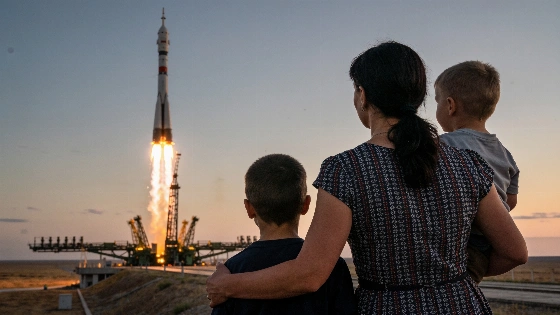
A Soyuz rocket has launched from Baikonur Cosmodrome, carrying NASA astronaut Anil Menon and Roscosmos cosmonauts Pyotr Dubrov and Anna Kikina to the International Space Station for a long-duration mission focused on scientific research
On July 14, 2026, a Soyuz rocket lifted off from the Baikonur Cosmodrome in Kazakhstan, sending NASA astronaut Anil Menon and Roscosmos cosmonauts Pyotr Dubrov and Anna Kikina toward the International Space Station (ISS). The launch, which took place at 19:47 local time, marks the start of the Soyuz MS-29 mission, a long-duration expedition intended to support ongoing scientific research and technology demonstrations in low Earth orbit.
Journey to the ISS
The Soyuz MS-29 spacecraft, a workhorse of crewed spaceflight since the late 1960s, is designed to transport up to three astronauts or cosmonauts to the ISS. Following a standard launch profile, the vehicle entered orbit and began its approach to the station, where the crew will join the existing ISS contingent for an extended stay. The mission is part of the ongoing international partnership that maintains continuous human presence aboard the ISS, enabling a range of experiments in microgravity and space environment conditions.
During their time on the station, Menon, Dubrov, and Kikina are scheduled to participate in a variety of scientific investigations. These include studies of human physiology in microgravity, materials science experiments, and technology demonstrations aimed at improving future space exploration capabilities. The ISS provides a unique platform for such research, allowing scientists to observe phenomena that cannot be replicated on Earth and to test new systems in a real operational environment.
Mission and Crew
The launch was observed by NASA astronaut candidate Anna Menon and her children, who watched from Baikonur as the rocket ascended into the evening sky. Their presence highlights the personal and international connections that underpin modern crewed spaceflight, as well as the ongoing collaboration between NASA and Roscosmos in maintaining and utilizing the ISS.
The Soyuz MS-29 mission is expected to last several months, with the crew conducting experiments, maintaining station systems, and supporting visiting vehicles. The precise duration of the mission will depend on the broader ISS schedule and the timing of subsequent crew rotations. As with all ISS expeditions, the mission's success will be measured not only by the safe return of the crew but also by the quality and quantity of scientific data returned to Earth.
The Soyuz MS-29 launch continues a long tradition of international cooperation in space, even as new commercial vehicles and international partners expand the range of options for reaching low Earth orbit. The mission underscores the importance of reliable crew transport and the value of the ISS as a scientific laboratory and testbed for future exploration beyond Earth orbit.
Rendezvous and Docking
Spacecraft launches to the ISS involve a series of critical milestones beyond liftoff. After launch, the Soyuz must achieve a precise orbit, perform a series of rendezvous maneuvers, and dock with the station. Only after successful docking and hatch opening can the crew begin their full participation in station operations. Each phase is monitored closely by mission control teams in Russia and the United States, with contingency procedures in place for a range of possible anomalies.
Understanding the process of orbital insertion and rendezvous is central to crewed spaceflight. After launch, the spacecraft must match the ISS's orbital plane and velocity, requiring precise timing and propulsion maneuvers. Automated systems guide the Soyuz during approach, but crew members are trained to take manual control if needed. Successful docking is confirmed by a series of mechanical latches and pressure checks before the crew can safely transfer to the station. This sequence ensures both the safety of the astronauts and the integrity of the ISS environment.