NASA's PUNCH mission has enabled scientists to predict the arrival of a solar eruption near Earth with a margin of just 30 minutes, using continuous 3D imaging of coronal mass ejections as they travel through the inner solar system
NASA's PUNCH (Polarimeter to Unify the Corona and Heliosphere) mission has delivered its first demonstration of real-time solar storm tracking, allowing researchers to predict the arrival of a coronal mass ejection (CME) near Earth with unprecedented precision. The initial results, presented at the Committee on Space Research Scientific Meeting and currently under review for publication, suggest that continuous wide-field imaging can significantly improve space weather forecasting.
Continuous Tracking Across the Inner Solar System
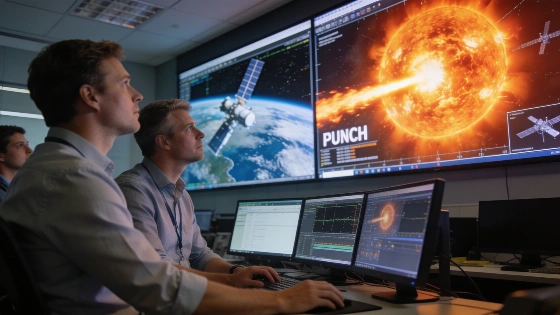
Solar storms, driven by CMEs-large eruptions of plasma and magnetic field from the Sun-pose risks to satellites, power grids, and astronauts. Historically, scientists have struggled to track these ejections beyond the first fifth of their journey from the Sun to Earth, leaving substantial uncertainty in arrival predictions. The PUNCH mission, launched in 2025, consists of four spacecraft in low Earth orbit, each equipped to capture 3D images of the inner solar system every four minutes. This setup enables nearly uninterrupted monitoring of CMEs as they propagate toward Earth.
In a test case, researchers analyzed a CME that erupted from the Sun on May 31, 2025. By feeding the continuous PUNCH imagery into a computer model, they tracked the leading edge of the CME and calculated its speed and geometry throughout its transit. The model's prediction, made twelve hours after the CME's departure, estimated the storm would reach Earth eight hours later-a forecast that ultimately proved accurate to within 30 minutes. This represents a tenfold improvement over previous methods, which typically provide a five-hour window for CME arrival.
Modeling and Forecasting Improvements
The PUNCH data allowed scientists to refine their models by providing a direct, time-resolved view of CME evolution. The model not only predicted the arrival time but also indicated when its estimate had stabilized, giving forecasters a clear signal of prediction reliability. This approach contrasts with earlier techniques that relied on limited snapshots and required extrapolation over most of the CME's journey.
Beyond timing, the high-cadence images revealed new structural details within the CME, showing that the ejected plasma is more clumpy and dynamic than previously recognized. These observations suggest that CMEs continue to evolve as they travel, which may affect their interaction with Earth's magnetosphere and the severity of resulting geomagnetic storms.
Mission Operations and Scientific Context
PUNCH is operated by Southwest Research Institute from its Boulder, Colorado facilities, with mission management provided by NASA's Goddard Space Flight Center. The mission's primary goal is to unify observations of the solar corona and heliosphere, bridging the gap between solar eruptions and their effects near Earth. The continuous imaging capability is central to this objective, enabling both operational forecasting and fundamental research into solar plasma behavior.
These advances in CME tracking come as interest in space weather forecasting grows, especially with increasing reliance on satellite infrastructure and human activity in space. The ability to predict solar storm arrivals with greater accuracy could help mitigate risks to technology and crewed missions. For context, the unpredictable influence of solar activity on spacecraft trajectories has also been highlighted in recent analyses of objects such as the Falcon 9 upper stage, whose lunar impact was shaped by both gravity and solar conditions (see this related report).
Limitations and Future Prospects
While the initial PUNCH demonstration marks a significant step, the results remain preliminary. The forecast accuracy was established in a retrospective test, and further validation will require additional CME events and refined modeling. The mission team anticipates that improvements in data processing and model sophistication could extend the lead time for reliable forecasts, but the inherent variability of solar eruptions and their interaction with the interplanetary medium will continue to pose challenges.
In addition to operational forecasting, PUNCH data are providing new insights into the physics of plasma transport across the solar system. By resolving fine-scale structures and tracking their evolution, researchers hope to better understand not only space weather but also fundamental plasma processes relevant to astrophysical environments far beyond the Sun-Earth system.
To interpret the timing and impact of solar storms, it is essential to understand how coronal mass ejections are tracked from the Sun to Earth. Instruments like those on PUNCH detect scattered sunlight from plasma clouds, producing images that reveal the position and structure of CMEs over time. By combining these observations with physical models, scientists can estimate the speed, direction, and evolution of solar eruptions. However, uncertainties remain due to the complex, changing nature of plasma in space and the limitations of current models. Continuous imaging reduces some of these uncertainties, but forecasting remains a probabilistic science, shaped by both observational limits and the unpredictable dynamics of the Sun.