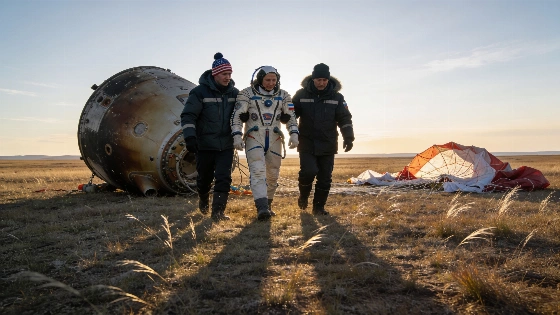
NASA astronaut Chris Williams and Roscosmos cosmonauts Sergey Kud-Sverchkov and Sergei Mikaev are scheduled to depart the International Space Station aboard Soyuz MS-28, with landing expected in Kazakhstan on July 26
Three crew members aboard the International Space Station are preparing to conclude their mission, with a scheduled return to Earth on July 26. NASA astronaut Chris Williams, along with Roscosmos cosmonauts Sergey Kud-Sverchkov and Sergei Mikaev, will depart the orbital laboratory in the Soyuz MS-28 spacecraft, marking the end of their 241-day stay in low Earth orbit.
Departure and Landing Timeline
The Soyuz MS-28 vehicle is set to undock from the International Space Station at 03:02 EDT (07:02 GMT) on Sunday, July 26. Following undocking, the spacecraft will initiate a controlled deorbit burn, targeting a landing on the steppe of Kazakhstan approximately 3.5 hours later, at 06:26 EDT (10:26 GMT). The landing site is located southeast of Dzhezkazgan, a region routinely used for Soyuz recoveries due to its open terrain and established recovery infrastructure.
NASA will provide live coverage of key mission milestones, including the change-of-command ceremony, crew farewells, hatch closure, undocking, and landing. The transition of station command from Kud-Sverchkov to NASA astronaut Jessica Meir will formally mark the shift from Expedition 74 to Expedition 75, with the new expedition officially beginning upon Soyuz MS-28's undocking.
Mission Duration and Crew Achievements
Soyuz MS-28 launched to the ISS on November 27, 2025, coinciding with Thanksgiving Day in the United States. For Williams and Mikaev, this mission represented their first flight to space, while Kud-Sverchkov completed his second long-duration stay aboard the station. Over the course of 241 days, the crew orbited Earth 3,856 times and traveled more than 164 million kilometers (102 million miles), contributing to a range of scientific experiments and station maintenance activities.
After landing, the crew will be transported by helicopter to Karaganda, Kazakhstan, where recovery teams are based. Williams will then return to NASA's Johnson Space Center in Houston, while Kud-Sverchkov and Mikaev will travel to their training base in Star City, Russia. The recovery and repatriation process is a standard procedure for Soyuz missions, designed to ensure medical evaluation and support for returning astronauts and cosmonauts.
Operational Procedures and International Collaboration
The return of Soyuz MS-28 highlights the ongoing collaboration between NASA and Roscosmos in maintaining continuous human presence aboard the ISS. The mission's timeline includes a series of coordinated activities: a change-of-command ceremony broadcast on July 25, hatch closure at 23:30 EDT (03:30 GMT on July 26), and sequential live coverage of undocking and landing operations. These procedures are designed to maximize crew safety and mission transparency, with real-time updates provided to the public and mission control centers.
International partnerships remain central to ISS operations, as demonstrated by the integrated crew composition and shared responsibilities for station management. The transition between expeditions ensures uninterrupted scientific research and station upkeep, while also providing opportunities for cross-training and knowledge transfer among astronauts and cosmonauts. For context on how NASA addresses astronaut health risks during long-duration ISS missions, see this analysis of a new risk assessment algorithm for venous thromboembolism: NASA's approach to VTE risk on ISS missions.
Scientific and Technical Context
The Soyuz MS-28 mission underscores the operational reliability of the Soyuz spacecraft, which has served as a primary crew transport vehicle for the ISS since the station's earliest years. The spacecraft's design enables rapid undocking, controlled deorbit, and targeted landing, with robust systems for crew safety during reentry and recovery. The mission also reflects the logistical complexity of supporting multinational crews in orbit, requiring precise coordination between NASA, Roscosmos, and ground-based recovery teams.
While the Soyuz system has a long record of successful operations, each mission is subject to rigorous pre-landing checks, real-time monitoring, and contingency planning. The upcoming return will be closely observed for any deviations from nominal procedures, as even minor anomalies can inform future mission planning and spacecraft design improvements.
Space station expeditions are structured to balance scientific output, crew health, and operational safety. The transition from one expedition to the next is carefully managed to maintain continuous research and station functionality, with each crew rotation providing new data on the physiological and psychological effects of extended spaceflight.
Spacecraft undocking and reentry are among the most technically demanding phases of a mission. The Soyuz MS-28 crew will follow established protocols for hatch closure, pressure checks, and separation maneuvers, with mission controllers monitoring telemetry throughout descent and landing. The recovery process in Kazakhstan is supported by specialized teams equipped to respond rapidly to the spacecraft's touchdown location, regardless of weather or terrain conditions.
Understanding the Soyuz return process requires familiarity with orbital mechanics and spacecraft operations. After undocking, the Soyuz performs a deorbit burn to reduce its velocity and initiate atmospheric reentry. The spacecraft is designed to withstand the intense heat and deceleration forces of reentry, using ablative shielding and a parachute system to slow its descent. Crew members experience significant g-forces during this phase, and the landing is cushioned by retrorockets just before touchdown. Post-landing, recovery teams conduct medical checks and assist the crew in readapting to Earth's gravity, a process informed by decades of human spaceflight experience.