NASA's medical office has established a new risk assessment algorithm for venous thromboembolism (VTE) in astronauts, following updated case reviews and in-flight blood flow data from International Space Station missions
NASA's Office of the Chief Health and Medical Officer has introduced a new evidence-based algorithm to assess and mitigate the risk of venous thromboembolism in astronauts during spaceflight. The initiative follows a series of VTE cases identified in crew members aboard the International Space Station, prompting a comprehensive review of clinical data and in-flight physiological measurements.
NASA Reviews VTE Risk in Microgravity
In April 2026, a dedicated working group was convened to evaluate updated VTE case reports and analyze additional ultrasound data revealing altered blood flow patterns in astronauts. The group's primary objective was to refine clinical practice recommendations and develop a systematic approach to VTE risk assessment tailored to the unique environment of microgravity.
VTE, which includes deep vein thrombosis and pulmonary embolism, poses a significant health risk in space due to the effects of microgravity on venous blood flow. The working group's review highlighted that stasis, particularly in the left internal jugular vein, remains a dominant risk factor for VTE in orbit. However, the panel also noted ongoing debate regarding the relative contributions of slow qualitative flow, endothelial changes, and retrograde flow to overall risk.
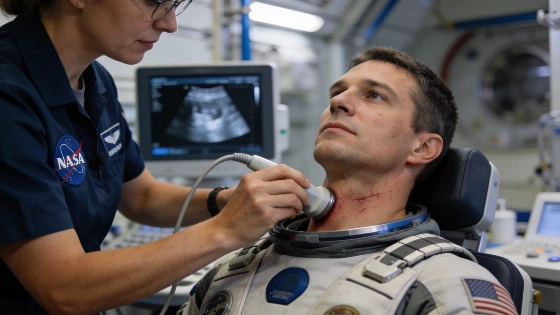
Current in-flight ultrasound technology, while valuable, has limitations in accurately quantifying venous stasis and slow flow. The group recommended further review and potential enhancement of ultrasound protocols to improve risk detection. After evaluating the available evidence, the majority of the panel agreed that both stasis and retrograde flow should prompt consideration of anticoagulation prophylaxis, with additional risk factors assessed according to terrestrial clinical literature.
New Algorithm Guides Preventive Treatment
Based on these findings, NASA has formalized a VTE Risk Score for Astronauts Algorithm. This tool incorporates weighted risk factors and provides guidance on when to initiate preventive anticoagulation, either for stasis alone or in combination with other established thrombosis risks. The algorithm is designed to be adaptable as new data emerge from ongoing research and operational experience.
The development of this algorithm builds on earlier efforts initiated in October 2024, when the first VTE cases were diagnosed in ISS crew members. Since then, NASA has updated its Clinical Practice Guidelines and expanded its review to include both case data and broader physiological studies. The agency's approach reflects a growing recognition of the need for tailored medical protocols in space, where standard terrestrial risk models may not fully capture the effects of microgravity on human physiology.
Ultrasound Findings Refine the Risk Model
Recent working group meetings have also emphasized the importance of integrating new research findings into operational protocols. For example, the identification of spontaneous echo contrast and peripheral echogenicity in astronaut ultrasound images has provided additional insight into the mechanisms underlying VTE risk in space. These observations have informed the weighting of risk factors within the new algorithm.
While the focus of this initiative is on astronaut health and mission safety, the broader context of risk assessment in extreme environments continues to evolve. The challenge of adapting terrestrial medical knowledge to the unique conditions of spaceflight is mirrored in other areas of space science, such as the detection of exoplanets in complex stellar systems. For instance, the use of advanced spectroscopic techniques to identify hidden planetary companions, as demonstrated in the recent Webb Telescope study of the Beta Pictoris system, highlights the ongoing need for specialized tools and adaptive methodologies in frontier research.
According to NASA's published technical report, the VTE Risk Score for Astronauts Algorithm will be periodically reviewed and updated as new evidence becomes available. The agency continues to monitor astronaut health outcomes and refine its protocols to ensure the highest standards of crew safety during long-duration missions.
Why Blood Clot Risk Changes in Space
Understanding VTE risk in space requires careful consideration of both direct measurements and model-based inference. In microgravity, the absence of normal gravitational forces alters venous return and can lead to blood pooling in the upper body, increasing the likelihood of stasis and clot formation.
Ultrasound imaging is used to assess blood flow and detect early signs of thrombosis, but its sensitivity is limited by technical constraints and the unique physiology of astronauts. The new algorithm aims to bridge these gaps by integrating multiple risk factors and providing a structured framework for clinical decision-making in the space environment.