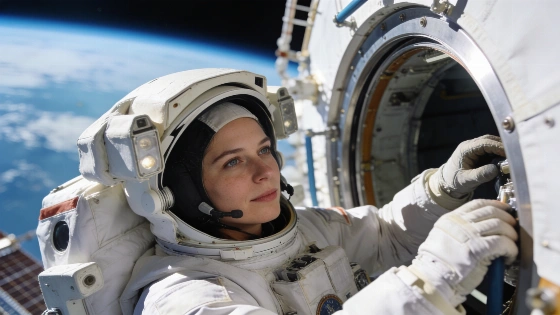
European Space Agency astronaut Sophie Adenot is set to conduct a 6.5-hour spacewalk outside the International Space Station, marking the first time a French woman has participated in an extravehicular activity
European Space Agency astronaut Sophie Adenot is scheduled to make history today as she prepares to step outside the International Space Station (ISS) for her first extravehicular activity (EVA). Adenot will be joined by NASA astronaut Anil Menon for a planned 6.5-hour spacewalk, during which the pair will replace a critical communications antenna on the station's exterior. The operation is set to begin at approximately 8:35 a.m. EDT (1235 GMT), with live coverage provided by NASA starting earlier in the morning.
Mission Objectives and Technical Details
The primary task for Adenot and Menon is to remove and replace a space-to-ground antenna that serves as a vital communications link between the ISS and the Mission Control Center in Houston. This antenna enables high-speed data transmission, supporting both routine operations and scientific experiments aboard the station. The replacement procedure requires careful coordination, as the hardware is mounted on the station's exterior and must be handled in the vacuum of space using specialized tools and safety protocols.
This EVA marks the 282nd spacewalk conducted in support of ISS assembly, maintenance, and upgrades since the station's first crewed operations began in 2000. Menon, who launched to the ISS aboard a Russian Soyuz spacecraft on July 14, will serve as crewmember 1 for the activity, while Adenot, a member of SpaceX's Crew-12 mission that arrived in February, will be crewmember 2. The operation is expected to last approximately six and a half hours, with real-time monitoring by mission controllers on the ground.
Operational Challenges and Safety Measures
Spacewalks are among the most technically demanding activities performed on the ISS, requiring astronauts to work in microgravity while exposed to extreme temperature fluctuations and radiation. During Menon's previous EVA on August 6, a carbon dioxide sensor in his spacesuit reported an unexpected data reading, prompting NASA to conduct additional checks before approving today's operation. The sensor returned to normal after the suit was removed, but the agency delayed the second spacewalk from its original August 13 date to ensure crew safety and equipment reliability.
Both astronauts have undergone extensive training for extravehicular operations, including simulations in neutral buoyancy pools and virtual reality environments. The replacement of the antenna is considered a high-priority maintenance task, as uninterrupted communications are essential for both crew safety and the transmission of scientific data. The EVA will be closely monitored for any anomalies, with contingency procedures in place should unexpected issues arise.
Historical Context and International Participation
Sophie Adenot's participation in today's spacewalk marks a significant milestone for France and the European Space Agency. While several French male astronauts, including Jean-Loup Chrétien, Philippe Perrin, and Thomas Pesquet, have previously conducted EVAs, Adenot is the first French woman to do so. Chrétien performed the first French spacewalk in 1988 outside the Soviet Union's Mir space station, and Pesquet later became the first French commander of an ISS mission in 2021.
The ISS has long served as a platform for international collaboration in space science and engineering. The inclusion of astronauts from diverse backgrounds and nationalities reflects the station's role as a shared scientific laboratory. For additional perspective on how space events have shaped scientific understanding, readers may be interested in a discussion of ancient astronomical observations, such as those explored in this analysis of early solar eclipse records.
Significance for Space Science and Communication
The successful replacement of the ISS antenna will help maintain the station's ability to support high-bandwidth communications, which are essential for transmitting large volumes of scientific data and coordinating complex mission activities. Reliable communication links are also critical for real-time health monitoring, emergency response, and the operation of remote experiments. As the ISS continues to serve as a testbed for future exploration missions, maintaining its infrastructure remains a priority for all partner agencies.
Today's EVA also highlights the ongoing evolution of crew composition aboard the ISS, with increasing participation from women and a broader range of nationalities. These developments reflect both the technical demands of modern spaceflight and the growing emphasis on diversity in international scientific collaboration.
Extravehicular activities, or spacewalks, are complex operations that require astronauts to exit the pressurized environment of the ISS and work in the vacuum of space. Each EVA involves careful planning, specialized training, and the use of advanced life-support systems within the spacesuit. Astronauts must manage limited mobility, exposure to temperature extremes, and the risk of micrometeoroid impacts. The success of an EVA depends on both the reliability of equipment and the ability of the crew to adapt to unexpected challenges, making each spacewalk a critical test of human and technological capability in orbit.