William Sheehan's new book examines the earliest recorded solar eclipses, including Archilochus's eyewitness account, and explores how these rare events influenced ancient astronomy and religious thought
Solar eclipses have long captured human attention, but their true nature remained elusive for most of history. While total solar eclipses occur somewhere on Earth roughly every 18 months, their narrow paths mean that any single location may wait centuries between events. The ability to predict eclipses with precision is a relatively recent achievement, built on centuries of astronomical observation and mathematical modeling.
Ancient Observations and Early Records
The earliest known personal account of a total solar eclipse comes from the Greek poet and soldier Archilochus, who described the sudden darkness he witnessed on 6 April 648 B.C.E. His poem, preserved in fragments, conveys both awe and fear at the Sun's disappearance. This record stands as the oldest surviving eyewitness description of a total solar eclipse, offering a rare glimpse into how ancient observers interpreted such dramatic celestial events.
For ancient civilizations, eclipses were often seen as omens or supernatural interventions. Without a physical explanation for the Moon's shadow crossing the Sun, early societies developed religious and mythological interpretations. The inability to predict when and where eclipses would occur reinforced their mysterious reputation, and only by the second century B.C.E. did astronomers begin to develop reliable predictive methods.
From Mystery to Prediction
Progress in understanding eclipses depended on careful tracking of the Sun and Moon's motions. Ancient astronomers in Babylon, Greece, and China gradually recognized patterns in eclipse cycles, such as the Saros cycle of approximately 18 years. However, accurate prediction required both mathematical models and precise observations, which were not widely available until the development of more advanced instruments and record-keeping.
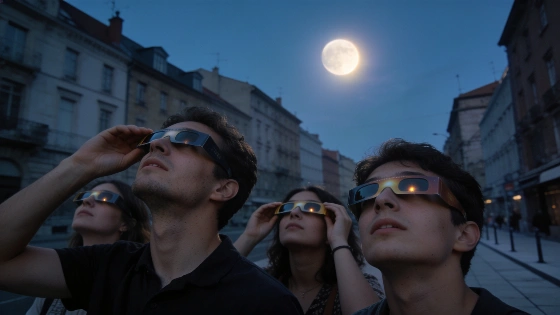
Today, eclipse prediction is routine, and the rarity of totality at any given site is well understood. For example, the total solar eclipse of 30 June 1954 was the last to pass over Minneapolis until 14 September 2099, illustrating how the Moon's umbral shadow often misses populated regions. Modern eclipse chasers travel globally to witness these fleeting moments of totality, motivated by both scientific interest and the profound sensory experience.
Cultural Impact and Enduring Fascination
Solar eclipses have left a lasting mark on human culture, shaping religious practices, inspiring art, and driving advances in astronomy. The emotional responses recorded by early observers, such as Archilochus, echo in contemporary accounts of eclipse viewing. The transition from fear and superstition to scientific understanding reflects broader changes in humanity's relationship with the cosmos.
Recent eclipses continue to draw widespread attention, with each event offering new opportunities for observation and public engagement. The upcoming total solar eclipse in 2026, for instance, is expected to attract significant interest across Europe and the Arctic. For a detailed look at the stages and scientific opportunities of that event, see this overview of what to expect during the 2026 total solar eclipse.
Despite advances in prediction and explanation, the experience of totality remains unique. The sudden transformation of daylight into darkness, the appearance of the solar corona, and the rapid changes in temperature and animal behavior all contribute to the eclipse's enduring appeal.
Limits of Ancient and Modern Understanding
While modern astronomy can forecast eclipses centuries in advance, the physical mechanisms behind the phenomenon were inaccessible to early observers. The shift from mythological to scientific explanations required not only improved measurement but also a willingness to question established beliefs. Even today, the emotional and cultural resonance of eclipses persists, reminding us that scientific knowledge does not erase the sense of wonder these events inspire.
Ongoing research into historical eclipse records helps refine our understanding of ancient calendars, astronomical knowledge, and the evolution of scientific thought. The study of past eclipses also informs current models of Earth's rotation and the long-term dynamics of the Earth-Moon system.
Understanding solar eclipses requires grasping the geometry of the Sun, Moon, and Earth. A total solar eclipse occurs when the Moon passes directly between the Sun and Earth, casting a narrow shadow-the umbra-onto the planet's surface. The path of totality, where the Sun is completely obscured, is typically only about 100-200 kilometers wide. Predicting eclipses involves calculating the precise alignment of these bodies, accounting for their orbits, distances, and the tilt of Earth's axis. Advances in astronomical observation and mathematical modeling have made it possible to forecast eclipses with remarkable accuracy, but the rarity of totality at any given location ensures that each event remains a significant occasion for both scientists and the public.