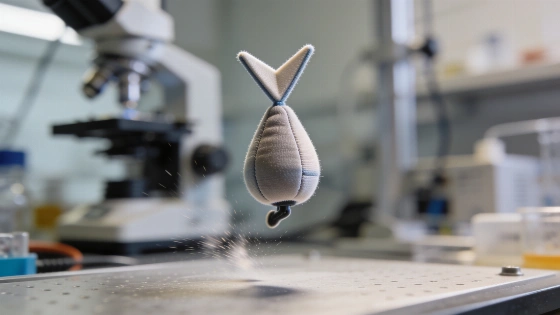
Engineers at North Carolina State University have built soft robots that can repeatedly jump when illuminated by infrared light, using a self-resetting mechanical design that eliminates the need for motors or external resetting devices
Researchers at North Carolina State University have developed a soft robotic system capable of continuous jumping when exposed to infrared light, without relying on motors, batteries, or external resetting mechanisms. The prototype, shaped like a teardrop, combines a photothermally responsive liquid crystal elastomer ring with a rigid V-shaped tail. When illuminated, the elastomer contracts and twists, while the tail constrains this motion, storing elastic energy. Once a critical threshold is reached, the tail snaps against the ground, releasing the stored energy and propelling the robot into the air.
Unlike conventional jumping robots that require external intervention to reset after each leap, this design leverages the material's natural relaxation during flight. As the robot leaves the ground, the elastomer ring untwists and returns to its original configuration, enabling the cycle to repeat autonomously as long as the infrared light remains on. This approach allows for repetitive, light-driven locomotion without complex control systems or software.
Mechanical Design and Control
The robot's movement can be adjusted by altering the geometry of the V-shaped tail. A wider tail angle of 120 degrees produces a crawling motion, while a 90-degree angle enables forward jumping. Reducing the angle to around 50 degrees results in vertical leaps. Directional control can be further refined by shifting the robot's center of mass; adding a small weight to the rounded end increases the stability and power of forward jumps. The intensity of the infrared light also acts as a control parameter, with insufficient illumination failing to trigger the jump and excessive intensity causing unpredictable trajectories.
Testing was conducted across a variety of surfaces, including slopes, grass, sand, rocks, and mulch. The robots were also able to traverse water-land interfaces, demonstrating adaptability to environments where wheeled or rigid robots often struggle. In optimized configurations, the system achieved vertical jumps exceeding 80 times the robot's body height and directional leaps of more than three body lengths. These results were obtained in controlled laboratory settings, and the underlying mechanical dynamics were modeled to capture the twisting, snapping, and jumping behavior.
Comparison and Limitations
The demonstration highlights a distinct approach to soft robotics, focusing on material properties and mechanical design rather than traditional actuation or software-based control. While the system operates autonomously in the sense that it repeats its motion without human intervention during operation, it remains dependent on continuous infrared illumination and does not incorporate sensing, navigation, or adaptive decision-making. The absence of onboard computation or feedback limits its applicability to tasks requiring environmental awareness or complex interaction.
Related research in the field has explored adaptive locomotion strategies, such as the use of biological movement data to inform robot control. For example, a six-legged robot that learns walking strategies from stick insect movement data has demonstrated the potential for adaptive terrain navigation (see this report on adaptive walking robots). In contrast, the North Carolina State University system relies on passive mechanical resetting and light-driven actuation, offering a simpler but less flexible form of repetitive movement.
Potential Applications and Open Questions
The research team suggests that this mechanism could be useful for swarm robotics, environmental monitoring, or navigation in unstructured terrain, where simplicity and robustness are prioritized over complex control. However, the current prototype has not been tested outside laboratory conditions, and its performance in real-world environments with variable lighting, obstacles, or unpredictable surfaces remains unproven. The lack of sensing and feedback also raises questions about safety, reliability, and the ability to recover from failure or adapt to changing conditions.
Further development would be required to integrate sensing, onboard power, or more sophisticated control if the technology is to be deployed in practical applications. The demonstration provides a proof of concept for continuous, light-powered jumping in soft robots, but does not establish general-purpose autonomy or environmental adaptability.
Soft robotics is an area of research focused on building machines from flexible, deformable materials rather than rigid components. These systems often exploit the intrinsic properties of their materials to achieve movement, shape change, or environmental interaction. Unlike traditional robots, which rely on motors, gears, and programmed control, soft robots can use material responses-such as thermal contraction, swelling, or elasticity-to generate motion. This approach can simplify design and reduce the need for complex electronics, but typically limits the robot's ability to sense, plan, or adapt to new situations without additional hardware or software.