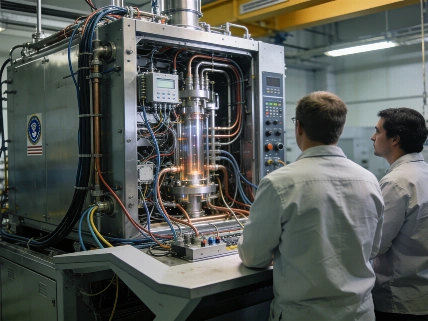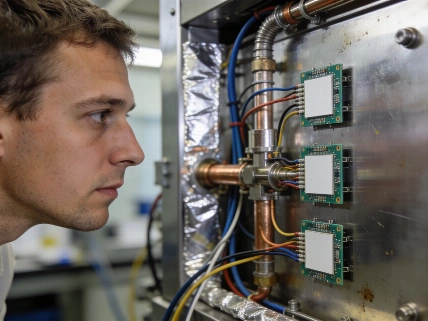
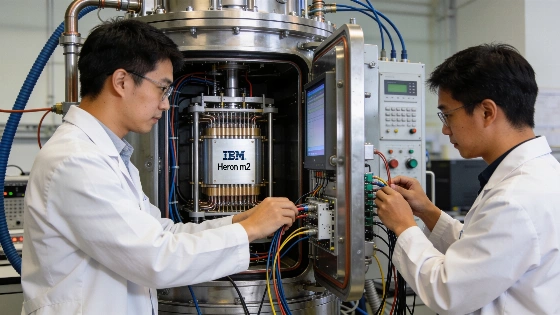
Researchers at A*STAR and NUS have demonstrated a hybrid quantum-classical approach that reduces the number of qubits needed for molecular docking, running verified experiments on IBM's 156-qubit Heron r2 processor
Researchers from Singapore's Agency for Science, Technology and Research (A*STAR) and the National University of Singapore (NUS) have experimentally demonstrated a method to reduce the number of physical qubits required for structure-based drug discovery tasks on current quantum hardware. Their work, published as a preprint on arXiv, introduces a hybrid quantum-classical framework that compresses the mapping of molecular docking problems onto quantum processors, enabling resource-efficient experiments on IBM's 156-qubit Heron r2 device.
Hybrid Encoding for Molecular Docking
The central technical advance is a full-basis encoding (FBE) scheme that allows up to three classical decision variables to be represented on a single physical qubit. In conventional quantum optimization, each variable is mapped to one qubit, quickly exceeding the capacity of today's noisy intermediate-scale quantum (NISQ) devices. By instead assigning variables across all three orthogonal Bloch-sphere expectation values-⟨σx⟩, ⟨σy⟩, and ⟨σz⟩-the FBE approach reduces the required qubit count for an N-variable problem to just ⌈N/3⌉. This compression is particularly relevant for molecular docking, where the search space for compatible pharmacophore interactions is combinatorially large.
The researchers mathematically proved that the global minimum of the continuous FBE objective can always be represented as a pure product state, meaning that complex multi-qubit entanglement is not required to reach the optimal discrete solution. This result justifies the use of shallow variational circuits, which are less susceptible to noise and decoherence on current hardware.
Experimental Validation on IBM Heron
The team validated their framework on two protein-ligand complexes from the Protein Data Bank: the streptavidin-biotin complex (PDB: 1stp) and the trypsin-benzamidine complex (PDB: 9aw2). The 1stp system, with 18 binding interaction variables, was mapped to just 6 physical qubits, while the 9aw2 system, with 14 variables, required only 5 qubits. Both experiments were executed on the IBM Heron r2 quantum processor, with the quantum circuits initialized using a qDRIFT-inspired stochastic imaginary-time evolution warm-start calculated classically via matrix product states.
Despite the presence of real gate and readout errors, the hardware measurements recovered the exact ground-truth clique assignments as determined by classical graph solvers. The FBE approach outperformed standard two-basis (ZX) encodings under identical circuit depth and training constraints, demonstrating improved resource efficiency for this class of combinatorial optimization problems.
Comparison and Limitations
While the demonstration shows that hybrid encoding can reduce the physical qubit requirements for certain molecular docking tasks, the experiments remain limited to small protein-ligand systems that are still tractable for classical solvers. The approach does not eliminate the need for error mitigation or address the broader challenges of scaling quantum hardware to larger, industrially relevant molecules. The results were obtained on a preprint basis and have not yet undergone peer review or independent replication. For context, recent advances in quantum error correction and decoding, such as those described in reports of AI-based decoders outperforming classical matching algorithms on Google's surface-code data, highlight the ongoing need for both algorithmic and hardware improvements before quantum advantage can be claimed for practical chemistry applications.
Engineering and Verification
The experiments relied on constructing a binding interaction graph for each protein-ligand pair, mapping the maximum vertex-weighted clique problem to a quadratic unconstrained binary optimization (QUBO) or Ising Hamiltonian. The FBE mapping was then used to encode the problem onto the available qubits. The use of shallow circuits and warm-start initialization helped mitigate the effects of barren plateaus and slow convergence, but the overall fidelity and scalability remain constrained by the underlying hardware's noise and connectivity. The research was supported by Singapore's National Research Foundation and A*STAR's Quantum Innovation Centre, reflecting ongoing national investment in quantum technology infrastructure.
In quantum computing, a physical qubit is a controllable quantum system-such as a superconducting circuit or trapped ion-that can be manipulated and measured. Logical qubits, by contrast, are encoded across multiple physical qubits using error-correcting codes to protect against noise and decoherence. Most current quantum processors operate with physical qubits only, and the number of usable logical qubits is typically much lower due to the overhead of error correction. Hybrid encoding schemes like full-basis encoding aim to maximize the utility of each physical qubit by representing more information per device, but the ultimate scalability of this approach will depend on improvements in hardware fidelity, error mitigation, and the development of robust logical qubit architectures.