A new Dream with Us challenge asks middle school teams to redesign an airport around liquefied natural gas and traditional aviation fuel while accounting for safety, aircraft changes and passenger needs.
Middle school students will be asked to redesign an airport before they can claim a place in the 2026-2027 Dream with Us Challenge. Their task is not to draw a futuristic terminal in isolation but to show how one additional aviation fuel could alter airport operations, aircraft arrangements and safety planning.
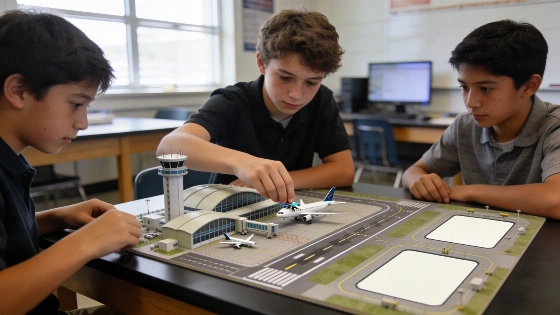
The middle school challenge opens on September 25, 2026 and accepts submissions through January 22, 2027 at 11:59 p.m. ET. Teams of two to four students may adapt an existing airport or create one of their own, but the final design must accommodate both liquefied natural gas (LNG) and traditional aviation fuel.
Every airport layout must identify core infrastructure such as runways, control towers, hangars, fuel locations, terminals and passenger parking. The assignment also requires teams to explain what they changed to support multiple fuel types and how those changes affect airport safety and the aircraft expected to use the facility.
The challenge sits within a larger aviation problem identified by NASA and partners at the FAA, universities and the aviation industry. As more aircraft operate within the United States National Airspace System, researchers and designers are examining ways to improve safety, reduce the cost of flight, develop new aircraft fuels and reduce the time passengers and cargo spend in the air.
NASA's technical work shows why this is more than an imaginative classroom exercise. Cryogenic aviation concepts involving LNG, liquid hydrogen or ammonia would require FAA-aligned certification, automated leak detection and specialized fire-management systems before commercial use, according to an NASA technical paper.
For much of commercial aviation history, aircraft and airports have been shaped around familiar tube-and-wing designs and traditional fuel infrastructure. New materials and technologies could support aircraft that do not follow that basic form, while research into fuel types and increasing electrification could create new demands on the airports that serve them.
The student brief therefore treats the airport as part of the aircraft system rather than as a fixed backdrop. A different fuel may require new fuel locations, revised gateways for unfamiliar aircraft configurations and distinct operating areas for different aircraft types. NASA research discussed by the University of Illinois emphasizes that cryogenic-fuel aircraft could require major airport safety and infrastructure changes, including robust fire-prevention planning, because methane or LNG and hydrogen present handling risks unlike those of conventional jet fuel.
Current airport fuel operations are built around a mature kerosene-based logistics and regulatory system. Aviation turbine fuel is classified under UN 1863 as a transport-category-3 hazardous material, a reminder that introducing LNG would not simply mean adding another tank to an existing apron.
The challenge does not present one settled engineering solution; it asks students to reason through the infrastructure changes that the aeronautics community is beginning to confront. That focus gives the exercise a useful constraint: a persuasive design must connect its physical layout to a stated operational purpose rather than rely on an attractive drawing alone.
LNG is already part of large energy logistics networks. U.S. LNG exports reached near-record levels in 2025 in the Caribbean, even though airport use of LNG remains experimental. The contrast helps students separate fuel availability from aviation readiness: a fuel can have an established supply chain while still requiring new aircraft certification, airport equipment and emergency procedures.
Regulatory experience from other fuel transitions also matters. FAA transition policy for unleaded avgas indicates that airports may need to maintain access to legacy 100LL supplies during the transition period under Grant Assurance 40. A two-fuel airport therefore has to plan not only for new infrastructure but also for continuity, segregation and reliable access to existing fuels.
Recent LNG regulation illustrates the same systems approach. An expansion of FortisBC's Tilbury LNG facility in British Columbia was approved with 18 legally binding conditions covering air quality, emergency planning, greenhouse-gas reduction and monitoring. For student designers, the lesson is that fuel infrastructure is evaluated through multiple safety and environmental controls rather than through storage capacity alone.
Each submission must contain both a technical presentation and a creative product. The technical presentation can be produced in PowerPoint or similar software and must include a title slide with the team name, school or organization and each member's first name and last initial. It must also include a labeled airport layout and an explanation of the modifications made for multiple fuel types.
Teams must address safety, airport benefits and the possible arrival of new aircraft types. A recorded narrative is optional, but presentations without audio must explain themselves through the slides. All sources used in the presentation must be cited, including image sources.
The creative product must advertise the benefits of the modified airport to an audience such as city or state leaders, potential airport investors or airlines. Students may choose a video, brochure, flyer, infographic, commercial, website or another format. The practical communication test is clear: the proposal must make its value understandable to people deciding whether the airport deserves support or use.
Educators and students can also draw on NASA activities covering aircraft design, propellers, gliders, flight priorities and airport planning. The earlier NASA education report shows how the agency has used structured opportunities to connect students with future science and engineering pathways, although this challenge is specifically centered on aviation design.
The middle school category is open to students in grades 6 through 8 attending public, private, parochial or home schools in the United States, as well as children of U.S. military members stationed overseas. Teams containing both middle and high school students must enter the high school challenge. Registration requires someone over 13 to create the account, and each team may submit only one entry.
Entries must be submitted through the NASA Gateway link listed on the Dream with Us Design Challenge webpage. Each participant needs a signed permission form from a parent or legal guardian. Presentations must be submitted as PDFs no larger than 10 MB, while artwork must be supplied as high-resolution JPG or PNG images with at least 2,400 pixels on the longest edge.
Artificial intelligence tools are prohibited. Teams may not upload, process or generate challenge material with browser-based generative AI services, AI-assisted coding tools or AI-generated imagery. Videos must be uploaded to YouTube with a watch URL or QR code supplied in a PDF so judges can access the work.
Industry experts will judge entries on impact, practicality, originality and communication. A virtual awards reception will come first, with its date still to be announced, followed by publication of the winners on social media and the Dream with Us design challenge webpage. An October midpoint check-in is also planned for educators and students, although its dates have not yet been released.
The strongest entries will not be the ones that simply place LNG tanks beside a runway. They will show that an airport is an interacting system in which fuel storage, aircraft design, terminals, gates, emergency response and safety procedures must work together. By requiring students to make those links visible, the challenge offers a more serious engineering exercise than a conventional poster competition while keeping the final judgment grounded in practicality rather than speculation.