Germany has invited a QUDORA-led consortium to submit a full proposal for a five-year trapped-ion machine targeting 1,000 physical qubits, 50 logical qubits and semiconductor-compatible quantum control.
Germany has advanced a QUDORA-led consortium to the next stage of a proposed €122 million quantum-computing project. NFQC-1k targets a fault-tolerant trapped-ion machine with at least 1,000 physical qubits, 50 logical qubits and a logical error rate below 0.01% over a period of up to five years. The announcement concerns a project proposal, not a completed processor or a system whose full financing has already been transferred.
Braunschweig-based QUDORA Technologies is coordinating the seven-member research and industrial group and would act as system integrator. After evaluating the consortium's initial outline under Germany's Quantum Computing Competition, the Federal Ministry of Research, Technology and Space invited it to submit a full proposal. That decision represents meaningful progress in the selection process, but it does not establish that NFQC-1k has already been built or that its performance targets have been experimentally demonstrated.
The wider German competition aims to deliver at least two European-level fault-tolerant or error-corrected quantum computers by 2030 and make them available to industrial users. In that policy context, NFQC-1k is best understood as an integrated engineering program intended to connect quantum hardware, control electronics, fabrication, verification and user access.
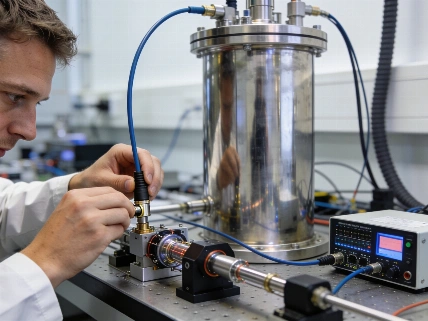
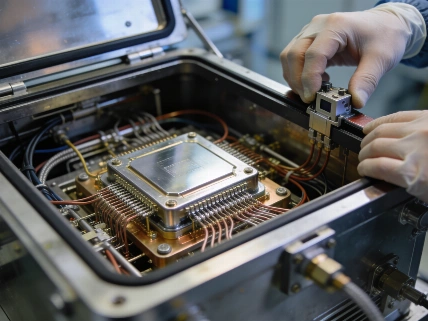
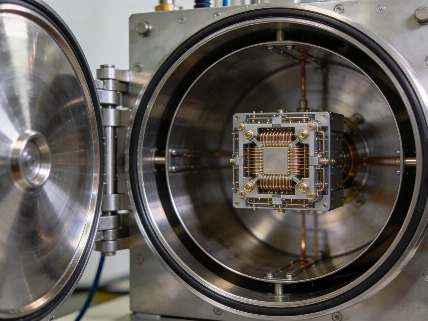
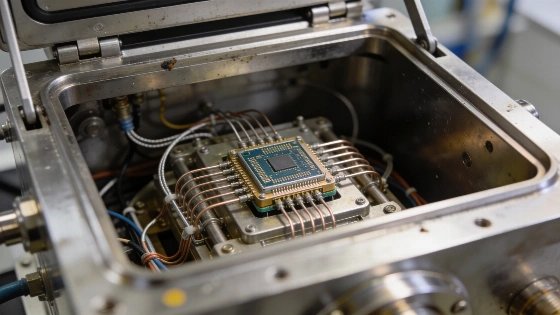
The proposed architecture uses QUDORA's Near Field Quantum Control, or NFQC, approach for trapped-ion control. Instead of depending on complex arrays of individually addressed lasers, the design uses chip-scale microwave radiation fields. Its stated engineering objective is to move more of the control system toward processes compatible with semiconductor manufacturing while supporting quantum-processor packaging and system integration.
This distinction between a target and a demonstrated result is central. The publicly described specifications concern the planned machine; they are not measurements of current gate fidelity, coherence time, readout accuracy, operating temperature, calibration stability or logical-qubit operation. The available information also does not report a demonstrated 50-logical-qubit processor.
Trapped-ion systems encode quantum information in the internal states of electrically confined ions. Lasers or microwave fields can be used to manipulate those states, while electromagnetic confinement keeps the ions isolated from much of the surrounding environment. In practice, scaling requires the control fields, ion transport, state preparation, measurement and classical feedback systems to remain reliable as the number of ions and operations increases.
TU Braunschweig and Leibniz University Hannover contribute trapped-ion physics and quantum optics. The Physikalisch-Technische Bundesanstalt brings high-precision metrology and laser-cooling expertise, while Forschungszentrum Jülich is associated with algorithm benchmarking and verification through a Quantum Fourier Transform. NXP Semiconductors Germany is expected to support microfabrication and the QPU pilot line, and AQT Germany would contribute cryogenic packaging and commercial system integration.
That combination makes the proposal broader than a qubit-count exercise. It links the ion trap to control electronics, semiconductor processing, packaging, cryogenic integration and algorithmic testing. The proposed semiconductor pilot line is therefore an engineering deliverable within the initiative, not evidence that a production-ready quantum processor has already been established.
The project also builds on a regional research base in Lower Saxony. Industry reporting describes NFQC-1k as a continuation of the earlier QVLS-Q1 effort, launched in 2021 with approximately €25 million and a goal of developing a 50-qubit trapped-ion platform. Regional officials have characterized QVLS and QUDORA's progress to the next competition stage as excellent news and linked it to earlier state investment in quantum technologies. The intended national project consequently represents both a scale-up and a test of whether regional expertise can support a much larger integrated system.
The numerical target is unusually explicit: at least 1,000 physical qubits, 50 logical qubits and logical gate error rates below 0.01%. Physical qubits are the individual quantum systems used to store and manipulate information. Logical qubits encode information across multiple physical qubits so that errors can be detected and corrected; the two figures therefore cannot be treated as equivalent measures of computing capacity.
Quantum error correction is meaningful only when the complete cycle of noisy operations, syndrome measurement, decoding and corrective action improves logical performance. The general distinction has been demonstrated in the research literature, including a Nature error-correction study, but a result on one device does not validate the architecture or targets of NFQC-1k. The relevant question for the proposed system will be whether logical error rates improve as correction resources are increased.
The planned verification route includes a full Quantum Fourier Transform benchmark. That would test the integrated system through a defined algorithmic workload rather than relying only on component specifications. The available material does not provide the intended circuit depth, number of repetitions, decoder design, connectivity, physical error rates or classical comparison, so it cannot yet establish algorithmic performance or quantum advantage.
This proposal sits within a wider hardware race in which control architecture matters as much as raw qubit count. A earlier hardware report described a different effort centered on physical testing and verification; NFQC-1k instead places semiconductor-compatible control and QPU production at the center of its proposed system.
The scale problem is familiar across quantum-computing research, including work discussed by institutions such as MIT, CERN and the Max Planck Society. A fault-tolerant machine must coordinate state preparation, entangling operations, measurement, error decoding and system-level calibration. Increasing the physical-qubit count alone does not guarantee a corresponding increase in useful logical computation.
The stated logical error-rate target is therefore a requirement for the proposed machine, not a result already measured on 50 logical qubits. The decisive evidence would come from fabrication results, integrated operation, repeated error-correction cycles and the QFT benchmark, accompanied by transparent reporting of physical error rates, logical failure probabilities and confidence limits.
Germany's selection gives QUDORA and its partners a serious platform for turning a control concept into a semiconductor-linked trapped-ion system. It does not yet prove that NFQC overcomes the full scaling problem, that the proposed logical error rate is achievable or that the eventual machine will deliver useful computation. The important development is the decision to advance a tightly integrated test of those claims; the important journalistic limit is that the test remains ahead of the result.